DVLT Stock Crashes 50% as Datavault AI Can’t Withdraw BTC
Datavault AI (DVLT) stock fell nearly 50% after the company said it cannot withdraw bitcoin from Biconomy and must restate more than a year of financial statements.
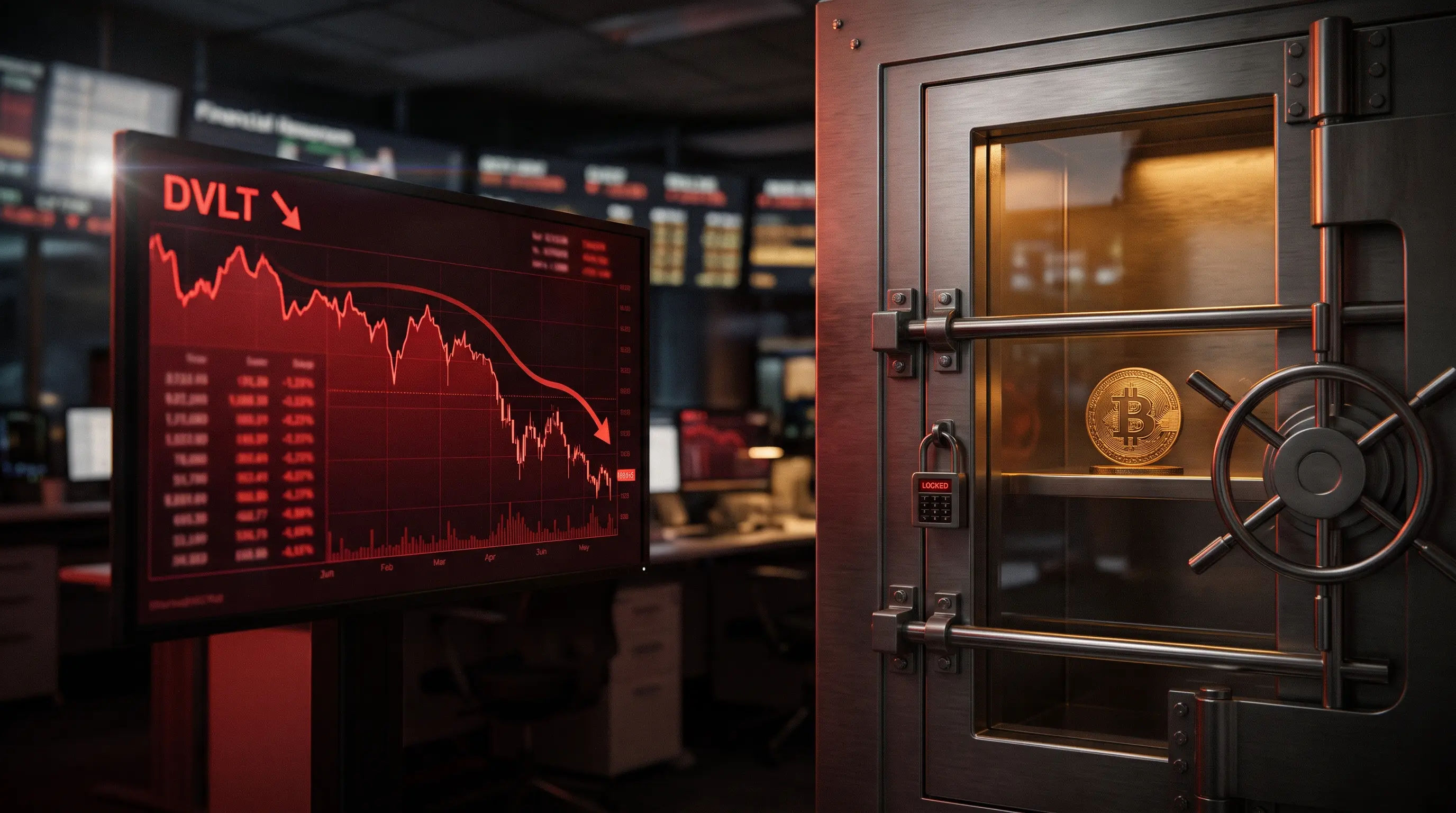
Datavault AI (DVLT) stock fell nearly 50% on Tuesday after the company disclosed that it has been unable to withdraw bitcoin from the Biconomy exchange since June and will restate more than a year of financial statements.
The Nasdaq-listed company closed at $0.067 on October 27, down 49.55%, according to CoinDesk. The disclosure came in a Form 8-K filed with the SEC on October 26.
The issue is not simply that bitcoin’s price moved. Datavault now says bitcoin credited to its Biconomy account through a $150 million Scilex deal should not have been recorded as its own digital asset. That accounting change is expected to reduce reported assets by tens of millions of dollars across several reporting periods.
Why Is DVLT Stock Down Today?
DVLT stock fell nearly 50% because Datavault AI disclosed that it cannot withdraw bitcoin held at Biconomy and must restate financial statements from Q3 2025 through Q2 2026. The company will reclassify the bitcoin as a subscription receivable from Scilex rather than as its own digital asset.
According to CoinDesk, DVLT closed at $0.067 on October 27, down 49.55%, with roughly 244 million shares traded. CoinDesk
The sell-off reflects two concerns at once: the company may not be able to access bitcoin it previously treated as a source of liquidity, and its prior financial statements need to be corrected.
What Datavault AI Disclosed in Its 8-K
A Form 8-K is a current report that public companies file with the SEC to disclose material events that shareholders may need to know about.
In its October 26 filing, Datavault AI said it requested a withdrawal of bitcoin from its digital wallet at Biconomy Pte. Ltd. to an external account in June 2026. As of the filing date, that withdrawal had not been completed. Datavault AI Form 8-K
The company did not disclose why the withdrawal has not been completed.
Datavault also said that financial statements for Q3 2025 through Q2 2026 should no longer be relied upon. It intends to restate those statements, but has not set a date for the restatement filings.
The company also said it will reassess its going-concern conclusion. In simple terms, a going-concern assessment asks whether a company has enough resources to continue operating for the foreseeable future. Datavault had previously counted the bitcoin balances as a potential source of liquidity.
How the Bitcoin Ended Up on Biconomy
The issue traces back to a September 2025 securities purchase agreement between Datavault AI and Scilex Holding Company (SCLX).
Under that agreement, Scilex agreed to buy 15 million DVLT shares and a pre-funded warrant covering about 263.9 million additional shares for $150 million, payable in bitcoin. At the agreed spot rate of $112,915.52 per bitcoin, that equated to approximately 1,328.43 BTC. Datavault AI Form 8-K
Scilex credited 1,309.04 BTC to Datavault’s wallet at Biconomy through off-chain transfers on September 26 and November 25, 2025. The lower amount reflected a reduction of 19.39 BTC related to cash advances Scilex had made to Datavault before the deal closed.
Between September 2025 and January 2026, Datavault sold 491.431 BTC back to Scilex through off-chain transfers in exchange for approximately $40.5 million in cash.
Based on those reported figures, simple arithmetic suggests about 817.6 BTC remained credited to Datavault’s Biconomy account. That is not a confirmed on-chain balance; it is simply 1,309.04 BTC minus 491.431 BTC.
Scilex’s own reporting has said it sold $200 million of shares in its subsidiary Semnur to Biconomy for bitcoin, then used $150 million of that bitcoin to buy Datavault securities. That helps explain Biconomy’s role in the transaction, though the reason for the withdrawal delay remains undisclosed.
What Is an Off-Chain Transfer?
An off-chain transfer is a balance change recorded inside a platform’s internal ledger rather than through a transaction on the underlying blockchain.
For example, if two users hold bitcoin on the same exchange and one sends bitcoin to the other, the exchange may simply update both internal account balances. No bitcoin transaction needs to appear on the Bitcoin blockchain at that moment.
That is different from an on-chain transfer. An on-chain bitcoin withdrawal creates a transaction on the Bitcoin blockchain, where anyone can independently verify the sending address, receiving address, amount, and confirmation status.
In Datavault’s case, the bitcoin was credited to its Biconomy wallet through off-chain transfers. The company later requested an on-chain withdrawal to an external account—but, according to its 8-K, that withdrawal has not been completed.
Why Datavault Is Restating Its Financials
After reviewing the transaction, Datavault concluded that the bitcoin associated with the Scilex deal did not meet the requirements to be recognized as the company’s own digital asset.
Instead, it will be recorded as a subscription receivable from Scilex.
A subscription receivable is essentially an amount owed to a company for shares that an investor agreed to purchase. It is a claim against the counterparty—not an asset the company fully controls.
That distinction matters. Datavault had treated the credited bitcoin as a digital asset on its balance sheet. The correction moves that value out of crypto assets and presents it as a reduction of stockholders’ equity.
The company also said related crypto gains and losses will be reversed.
The expected impact on reported total assets is significant:
| As of | Expected reduction in total assets |
|---|---|
| September 30, 2025 | $8.1 million |
| December 31, 2025 | $92.2 million |
| March 31, 2026 | $57.1 million |
| June 30, 2026 | $49.0 million |
These figures come from Datavault’s Form 8-K. Datavault AI Form 8-K
What We Still Don’t Know
Several important questions remain unanswered.
It is not publicly known why Biconomy has not completed Datavault’s withdrawal request. The 8-K does not explain the reason, and CoinDesk reported that Biconomy had not responded to its request for comment as of Wednesday afternoon in Asia. CoinDesk
It is also unclear when Datavault will file its restated financial statements.
And while the company said it will reassess its going-concern conclusion, investors will need to wait for future filings to see what that assessment concludes.
This is a developing story. Any Biconomy statement, new SEC filing, or Nasdaq announcement could change the picture.
What This Means for Bitcoin Treasury Companies
The episode is a reminder that a company holding crypto through a third-party platform does not necessarily control that crypto in the same way it would control assets in its own self-custody wallet.
An exchange balance can depend on the platform’s internal systems, operational processes, compliance controls, and ability to process withdrawals.
For bitcoin treasury companies, investors may want to look beyond the headline number of “bitcoin held” and ask practical questions:
-
Is the bitcoin held in self-custody or with a third party?
-
Can the company withdraw assets to an external wallet?
-
Are holdings verifiable on-chain?
-
What legal or contractual rights does the company have if a withdrawal is delayed?
-
How would a custody issue affect liquidity and financial reporting?
None of these questions alone proves that a company is safe or unsafe. But they help investors understand the difference between a reported balance and an asset the company can independently access.
Lessons for Crypto Holders and Token Projects
The broader lesson applies to anyone holding crypto through a third-party platform.
A balance shown in an exchange account is not always the same as an asset you control directly on-chain. If the platform cannot process withdrawals, the balance may be difficult to access regardless of what the dashboard shows.
For crypto projects and token treasuries, practical steps include:
-
Keep operational funds in wallets where the project controls the keys, where appropriate for its security setup.
-
Use a test withdrawal before moving large amounts from any platform.
-
Verify treasury balances on-chain rather than relying only on an exchange dashboard.
-
Document where funds are held, who controls access, and what backup procedures exist.
-
Do not treat an exchange balance as fully controlled liquidity.
For Solana token creators, verifying a token’s mint address, metadata, and on-chain details is equally important. Solsmint’s rug-check tool can help users review a token’s on-chain risk profile before interacting with it.
This does not mean the tool could have prevented Datavault’s situation. It simply highlights the same principle: on-chain verification gives users a way to check what they are actually dealing with.
Frequently Asked Questions
Why did Datavault AI stock drop 50%?
DVLT fell nearly 50% after Datavault AI disclosed that it could not withdraw bitcoin from Biconomy and would restate financial statements from Q3 2025 through Q2 2026. The company will reclassify the bitcoin as a subscription receivable rather than its own digital asset.
What happened to Datavault AI’s bitcoin?
Scilex credited 1,309.04 BTC to Datavault’s Biconomy wallet through off-chain transfers in 2025. Datavault later sold 491.431 BTC back to Scilex for about $40.5 million. In June 2026, Datavault requested a withdrawal of the remaining bitcoin, but the withdrawal remained incomplete as of October 26.
What is Biconomy?
In this story, Biconomy refers to Biconomy Pte. Ltd., the crypto platform where Datavault’s bitcoin wallet was maintained. It should not be confused with similarly named crypto projects or services.
How much bitcoin did Scilex send to Datavault AI?
Scilex credited 1,309.04 BTC to Datavault’s Biconomy wallet through off-chain transfers on September 26 and November 25, 2025, according to Datavault’s Form 8-K.
What does a financial restatement mean for DVLT shareholders?
A restatement means previously issued financial statements should no longer be relied upon and will be corrected. For DVLT, the correction is expected to reduce reported total assets across four reporting periods.
What is an off-chain transfer in crypto?
An off-chain transfer changes balances within a platform’s internal ledger rather than through a transaction on the underlying blockchain. It is different from an on-chain transfer, which can be independently verified on a public block explorer.
Is Datavault AI a bitcoin treasury company?
Datavault AI has been described as a bitcoin treasury company because it received bitcoin through a corporate transaction and previously reported crypto holdings. However, its latest filing changes how part of that bitcoin should be accounted for.
What is a subscription receivable?
A subscription receivable is an amount owed to a company for shares that an investor agreed to buy. It represents a claim against the investor, not an asset the company fully controls.
Conclusion
Datavault AI’s 50% stock decline follows a disclosure that its bitcoin held at Biconomy could not be withdrawn and that more than a year of financial statements must be restated.
The company now says the bitcoin tied to the Scilex deal should be recorded as a subscription receivable rather than as its own digital asset. That correction is expected to reduce reported assets by $92.2 million at the end of 2025 and $49 million as of June 2026.
The reason for the delayed withdrawal remains undisclosed.
For crypto holders and project treasuries, the practical takeaway is simple: understand the difference between a balance shown on a platform and an asset you can verify and control on-chain.
This article is for informational purposes only and is not financial advice.
Continue Reading
-
Learn what an SPL token is before evaluating tokens on Solana.
-
Understand how Solana token authorities work before trusting a token’s supply or transfer controls.
-
See how Solana liquidity pools support token trading after launch.
-
Use Solsmint’s rug-check tool to review a Solana token’s on-chain risk profile.
Disclaimer: This article is for information and education only and is not financial, investment, or tax advice. Crypto assets are volatile and you can lose money. Always verify token authorities and contract details yourself before interacting with any asset.

About Solsmint
Solsmint publishes hands-on guides about Solana, SPL tokens, DeFi, and NFTs based on direct use of the tools described. Every article names its author and dates, and corrections are reviewed after a request via our contact page. Read more about our editorial approach.