Solana Liquidity Pools Explained: How to Create, Add, and Manage Liquidity
Learn how Solana liquidity pools work, how token/SOL pools are priced, and how Standard and CLMM pools differ. Understand liquidity, slippage, price impact, fees, and withdrawal mechanics.

Solsmint
Author
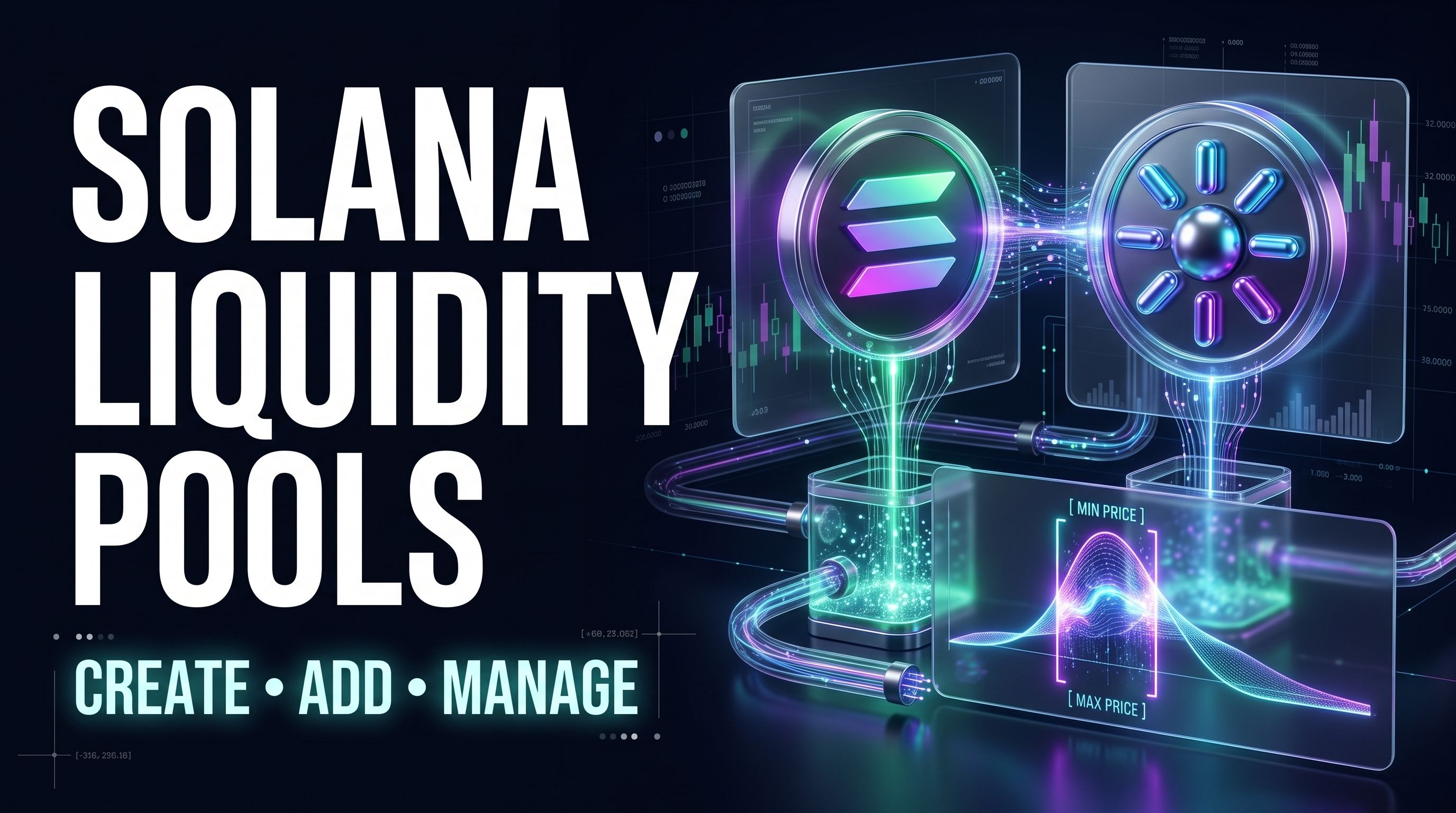
A Solana liquidity pool holds two tokens that traders can swap against through a decentralized exchange. For a new SPL token, a token/SOL pool lets users trade between the project token and SOL without relying on a traditional order book.
Liquidity is part of a token’s trading infrastructure. It can reduce the price impact of swaps, but it does not create demand, guarantee trading volume, protect a token from manipulation, or determine whether a project succeeds. This guide explains how pools work, how Standard and CLMM pools differ, what to review before adding liquidity, and what costs and risks to consider.
Educational notice: This article is for informational purposes only. It is not financial, investment, legal, or trading advice. Liquidity provision involves market risk, including potential impermanent loss, and liquidity can be removed or changed depending on the pool and protocol.
What Is a Solana Liquidity Pool?
A liquidity pool is a smart-contract-based reserve of tokens that supports decentralized trading. Instead of matching a buyer with a seller in an order book, an automated market maker (AMM) lets traders swap against the assets held in the pool.
A simple token/SOL pool might contain:
-
A project’s SPL token.
-
SOL as the quote asset.
A trader can swap SOL for the project token, or the project token for SOL. The pool’s pricing mechanism determines the exchange rate based on the available balances and the pool type.
Illustrative example
Suppose a pool holds 100,000 project tokens and 10 SOL. Those balances imply an initial relative price based on the pool’s mechanics—not a guaranteed market price.
If a trader swaps a large amount of SOL for the project token, the pool’s token balance falls and its SOL balance rises. The quoted price can move as a result. A larger trade generally has a larger price impact, especially in a pool with limited liquidity.
The exact behavior depends on the AMM design. A standard constant-product pool and a concentrated-liquidity pool do not price trades in exactly the same way.
Why Does Liquidity Matter for a Solana Token?
Liquidity affects how easily users can trade a token at a given size without materially moving the quoted price.
A token can exist on-chain without having a useful trading market. Creating an SPL token does not automatically create buyers, sellers, trading volume, exchange listings, or price appreciation.
Liquidity is different from:
-
Token supply: the number of units minted.
-
Market capitalization: a valuation metric, often calculated by multiplying price by circulating supply.
-
Trading volume: the value or quantity of trades over a period.
-
Token price: the quoted value of the asset in a particular market.
A pool can provide a venue for trading, but demand still comes from users. Liquidity alone does not guarantee either.
How Does a Token/SOL Liquidity Pool Work?
A token/SOL liquidity pool generally contains both assets. A liquidity provider deposits them according to the pool’s required ratio and receives a representation of their position.
Initial pricing
When creating a new pool, the creator chooses the amounts of each asset and, in many interfaces, an initial price. The pool’s mechanics determine how those inputs relate to one another.
For example, if a creator wants an initial price of 0.0001 SOL per project token, the pool must hold assets in the ratio implied by that price. If the creator deposits 10 SOL, the corresponding token amount depends on the selected initial price and the pool’s pricing model.
That initial price is not a promise that the token will trade at that level. Market participants may buy, sell, or ignore the asset entirely.
Swaps
When someone buys the project token with SOL, the pool receives SOL and sends project tokens to the buyer. When someone sells the project token, the reverse occurs.
Because the pool balances change, the quoted price can change after each trade. Larger trades tend to have a greater effect on price, especially when liquidity is limited.
Liquidity providers
A liquidity provider (LP) supplies the assets. In a Standard or CPMM pool, the provider commonly receives fungible LP tokens representing their share of the pool. In a CLMM pool, the provider receives a position NFT representing a specific price range.
LPs may receive trading fees generated by pool activity, but fee earnings depend on the pool design, trading activity, fee tier, position range, and other factors. No earnings are guaranteed.
Standard vs. CLMM Liquidity Pools
A Standard pool—often called a CPMM or constant-product pool—spreads liquidity across the full price curve. A CLMM (concentrated liquidity market maker) lets a provider allocate liquidity within a selected price range.
| Feature | Standard / CPMM pool | CLMM pool |
|---|---|---|
| Liquidity distribution | Spread across the full price curve | Concentrated within a selected price range |
| Position representation | Often fungible LP tokens | Typically a position NFT |
| Ongoing management | Generally simpler | Requires active range management |
| Capital efficiency | Lower relative to a well-managed in-range CLMM position | Potentially higher while the price remains in range |
| When price leaves the range | Liquidity remains active across the curve | The position may become inactive or single-sided |
| Fee accounting | Often pool-level, depending on protocol | Often position-level |
| Beginner consideration | Usually simpler to understand | Requires understanding price ranges and rebalancing |
Raydium describes CPMM as a standard xy=k constant-product pool and CLMM as a concentrated-liquidity AMM in which liquidity is provided within price ranges. CLMM positions can earn fees only while the price remains inside the selected range. Raydium pool-creation documentation Raydium CLMM overview
Neither option is universally better. A Standard pool may suit a creator who wants a simpler setup. A CLMM pool may suit an experienced manager who understands price ranges and is prepared to monitor the position.
How to Create a Liquidity Pool on Solana
The exact steps depend on the protocol, pool type, and interface. The general process is:
-
Create the SPL token and record its mint address.
-
Decide which trading pair to use, such as token/SOL.
-
Choose the pool type: Standard/CPMM or CLMM.
-
Decide the initial price and the amount of each asset to deposit.
-
Review the implied pool ratio and the assets required.
-
Check applicable network, protocol, and platform fees.
-
Connect a compatible Solana wallet to the supported interface.
-
Review the pool details, including token mints, pool type, initial price, deposit amounts, and any fees.
-
Approve the transaction in the wallet.
-
Confirm the resulting pool or liquidity position using the interface or an on-chain explorer.
Raydium’s pool-creation guidance separates CPMM and CLMM workflows. For a CPMM pool, the creator selects a pool type, enters both tokens, chooses a fee tier, sets an initial price and deposit, reviews the details, and signs. For CLMM, the creator also selects a lower and upper price range before entering a deposit. Raydium CPMM pool-creation guide Raydium CLMM pool-creation guide
Always verify the token mint addresses before signing. A wrong mint address, incorrect pool type, or misunderstood price setting can be costly.
How Much Liquidity Should a Token Creator Add?
There is no universal amount. The right amount depends on the project’s resources, goals, and risk tolerance.
Consider:
-
The amount of project tokens allocated to liquidity.
-
The amount of SOL or another quote asset available.
-
The intended initial pool price.
-
The trade sizes users may attempt.
-
The price impact those trades may create.
-
The project’s ability to manage liquidity over time.
-
Transaction, protocol, and platform costs.
-
Market uncertainty and the risk of price movement.
A larger deposit can reduce price impact for a given trade size, but it does not guarantee demand, trading volume, price stability, or a successful launch. Do not commit funds the project cannot afford to have exposed to market risk.
Slippage, Price Impact, and Impermanent Loss
These terms are related, but they are not the same.
Slippage
Slippage is the difference between the result a trader expects and the result they receive when a transaction executes. It can occur when the market moves before the transaction is confirmed or when the trade is large relative to available liquidity.
A trader may set a slippage tolerance, but setting it too high can expose them to unfavorable execution.
Price impact
Price impact is the effect a trade has on the pool’s quoted price under its pricing mechanism. A larger trade relative to available liquidity generally creates more price impact.
For example, buying a small amount of a token from a deep pool may barely move the price. Buying a large amount from a thin pool can move the quoted price substantially.
Impermanent loss
Impermanent loss describes a potential relative outcome for a liquidity provider compared with simply holding the deposited assets. It can occur when the relative prices of the two assets change.
It is not a guaranteed loss. The provider may still receive trading fees, and the final result depends on the pool design, price movement, trade activity, fees, and when liquidity is withdrawn.
Raydium’s documentation notes that impermanent loss can grow as the prices of the two assets diverge, and that CLMM exposure can be amplified within a selected range. Raydium pool-creation documentation
Adding vs. Removing Liquidity
Adding liquidity means depositing assets into a pool. Removing liquidity means withdrawing part or all of an available position.
A creator might add liquidity to establish a trading market or increase available depth. Someone might remove liquidity to reduce exposure, reallocate capital, or close a position.
The assets received on withdrawal may differ from the amounts originally deposited. Pool balances and prices can change over time, and the withdrawal amount depends on the pool’s mechanics and the provider’s share or position.
In Raydium’s CPMM flow, a provider removes liquidity by selecting an LP-token amount or percentage and reviewing the estimated token amounts before signing. In CLMM, a provider can increase, decrease, or close a position; closing removes all liquidity and burns the position NFT. Raydium add/remove liquidity documentation
Removing liquidity can affect the market. A large withdrawal may reduce available depth and increase price impact for remaining traders. The exact process, timing, and restrictions depend on the pool and protocol.
What Costs Are Involved in Solana Liquidity?
Liquidity operations can involve several types of costs.
| Cost type | What it covers |
|---|---|
| Solana network fees | Transaction fees and, in some cases, priority fees |
| DEX or protocol fees | Fees charged by the decentralized exchange or protocol |
| Platform fees | Fees charged by a third-party interface or tool |
| Trading fees | Fees paid by traders on swaps; these may be distributed to liquidity providers depending on the pool design |
| Account or rent-related costs | Costs associated with creating or maintaining certain on-chain accounts |
Solsmint advertises a 0% platform fee for adding or removing liquidity. That refers to Solsmint’s platform fee only. Solana network fees and DEX or protocol-related costs may still apply. Solsmint liquidity page
Review the wallet transaction before signing. The final cost depends on the selected network, protocol, pool type, and operation.
Common Liquidity Mistakes to Avoid
Depositing without understanding the implied price
Before adding liquidity, calculate what the selected deposit amounts imply for the token’s initial price. Do not assume the pool price will remain there.
Confusing liquidity with market capitalization
A pool holds tradable assets. Market capitalization is a valuation metric and can be calculated differently depending on the supply figure used.
Committing more capital than the project can manage
Liquidity is exposed to market movement. Only allocate assets the project can reasonably manage over time.
Ignoring price impact and slippage
Test how a realistic trade size would affect the pool. A thin pool may produce significant price movement even for modest trades.
Choosing CLMM without understanding ranges
A CLMM position can become inactive if the market price moves outside the selected range. Understand the range, rebalancing needs, and fee mechanics before choosing this option. Raydium CLMM overview
Assuming liquidity creates buyers
A pool enables swaps. It does not create organic demand, community interest, or trading volume.
Misunderstanding the position type
Standard pools may use fungible LP tokens, while CLMM positions are commonly represented by NFTs. Check which asset represents your position before trying to manage or transfer it. Raydium add/remove liquidity documentation
Failing to review the transaction
Check token mints, pool type, deposit amounts, price settings, fee details, and wallet permissions before signing.
Treating a pool as proof of legitimacy
A liquidity pool does not prove that a project is safe, legitimate, or likely to succeed. Review the token mint, distribution, project information, and risk factors separately.
How Solsmint Helps With Solana Liquidity
Solsmint provides a no-code liquidity workflow for users who want to create or manage liquidity for Solana tokens. Its liquidity page supports pool creation and includes Standard and CLMM options, with Raydium integration referenced in Solsmint’s product materials. Solsmint liquidity page
Solsmint advertises a 0% platform fee for adding or removing liquidity. Solana network fees and DEX or protocol-related costs may still apply. Solsmint liquidity page
Before using any liquidity tool, confirm the supported pool types, token pair, fee settings, and transaction details in the current interface. Solsmint does not supply liquidity capital, guarantee trading activity, or determine a token’s market outcome.
For related workflows, see Solsmint token creation, token minting, token burning, and token risk research.
Frequently Asked Questions
What is a liquidity pool on Solana?
A liquidity pool is a reserve of two tokens that traders can swap against through a decentralized exchange. In a token/SOL pool, users can trade between the project token and SOL.
How do I create a liquidity pool for a Solana token?
Create the SPL token, choose a supported trading pair and pool type, decide the initial price and deposit amounts, connect a compatible wallet, review the transaction, and approve it. The exact workflow depends on the protocol and pool type.
How much liquidity does a new token need?
There is no fixed amount. Consider the project’s available assets, intended initial price, expected trade sizes, price impact, costs, and ability to manage the position over time.
What is the difference between Standard and CLMM pools?
A Standard or CPMM pool spreads liquidity across the full price curve and is generally simpler. A CLMM pool concentrates liquidity in a selected price range and may require active management. Raydium pool-creation documentation
Can I remove liquidity after adding it?
Usually, yes, but the process and conditions depend on the pool, protocol, and position type. In a CLMM pool, a provider may decrease or close a position; in a CPMM pool, the provider may redeem LP tokens.
Does adding liquidity increase a token’s price?
No. Adding liquidity can reduce price impact for a given trade size, but it does not create demand or guarantee a higher token price.
What fees apply to Solana liquidity pools?
Solana network fees, DEX or protocol fees, and platform fees may apply. Solsmint advertises a 0% platform fee for adding or removing liquidity, but network and protocol costs may still apply. Solsmint liquidity page
Can a token have liquidity without trading volume?
Yes. A pool can exist with deposited assets even if nobody trades. Liquidity does not guarantee trading volume or market interest.
Conclusion
A Solana liquidity pool is part of a token’s trading infrastructure. It lets users swap between a project token and SOL, but it does not create demand, guarantee volume, or determine a project’s success.
Before creating or adding liquidity, understand the pool type, initial pricing, deposit ratio, price impact, slippage, fees, and withdrawal mechanics. Standard pools are generally simpler, while CLMM pools require an understanding of price ranges and active management.
About Solsmint
Crypto enthusiast and blockchain analyst with expertise in the Solana ecosystem. Passionate about educating others on the potential of decentralized technologies and DeFi innovations.