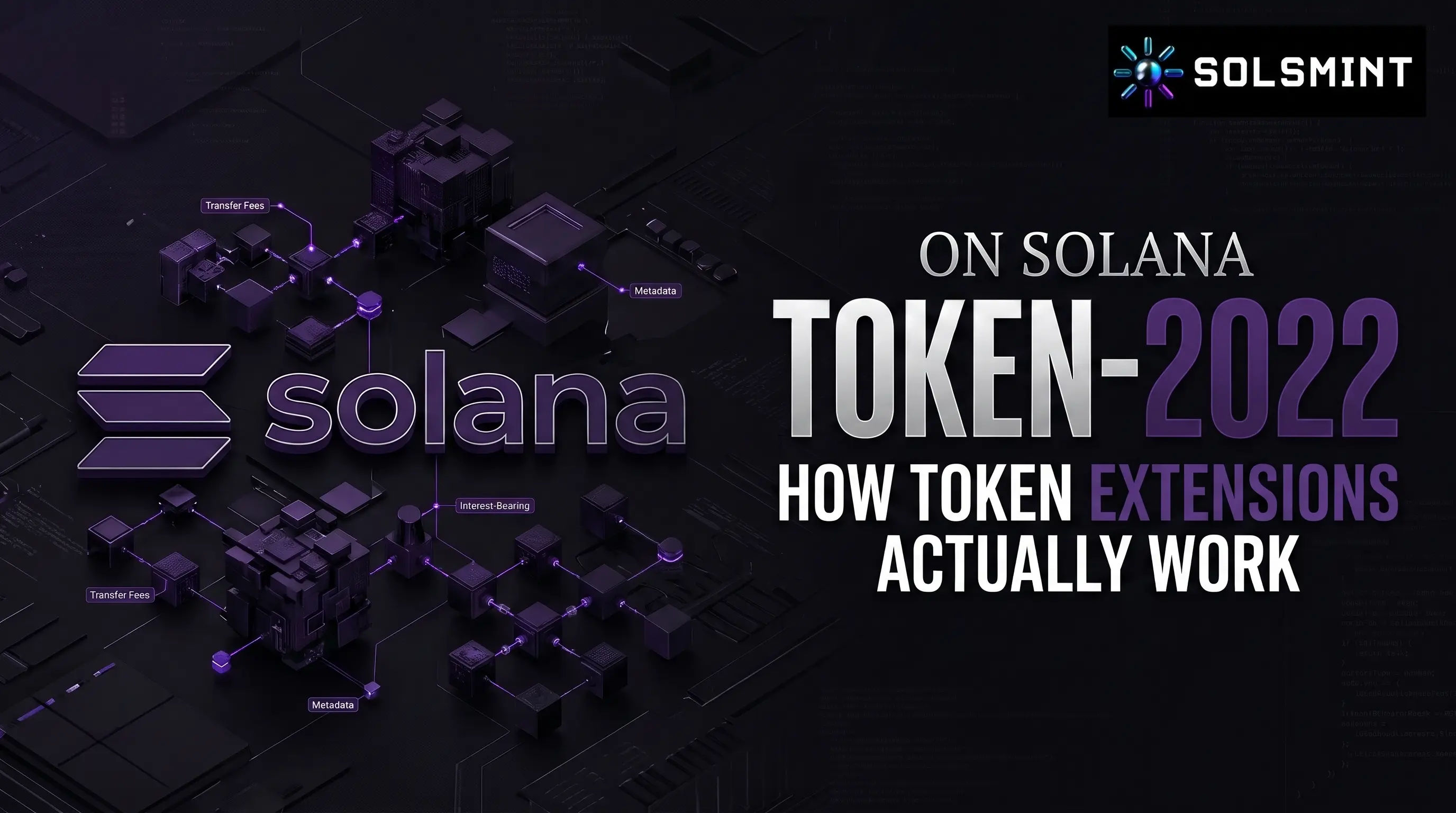
Token-2022 on Solana: How Token Extensions Actually Work
Token-2022 is Solana's extensions-first token program, not an upgrade you can apply to an existing mint. What transfer fees, hooks, permanent delegates and confidential balances change, what they cost, and where they break.
Not financial advice. Solsmint publishes educational content about crypto assets. Prices are volatile, and nothing here is a recommendation to buy, sell, or invest. Verify every contract, authority, and fee yourself before you transact.
Last updated: November 22, 2026
Solana runs two token programs side by side. The original SPL Token program issues almost every token you have traded, including USDC and USDT. Token-2022, officially the Token Extensions Program, is a separate program that keeps the same core instructions and adds optional features: transfer fees, transfer hooks, permanent delegates, frozen-by-default accounts, confidential balances, on-chain metadata and more.
The naming causes most of the confusion. Search results mix SPL Token, SPL Token 2022, Token-2022, Token Extensions and the Token Extensions Program, and they are not all describing the same thing. SPL Token without a year means the original program. Token-2022 is the newer one, and it is not an upgrade you can apply to an existing mint. A token is issued under one program or the other, and that choice is fixed at creation.
That distinction matters more in 2026 than it did in 2023, because issuance has split. Regulated stablecoins and tokenised assets are moving to Token-2022 for its compliance features, while consumer tokens stay on the original program for universal support. This guide covers what each extension actually does, what it costs, which combinations create problems, and how to tell which program a mint uses before you buy or launch one.
This article is for informational purposes only and is not financial, legal, or investment advice. Not financial advice. DYOR.
Key takeaways
- Token-2022 is a separate program, not a newer version of the original SPL Token program. A classic mint cannot switch to it, and a Token-2022 mint cannot switch back.
- Extensions are chosen when the mint is created. Most cannot be added later, because the mint account’s size and layout are fixed at that point.
- The extensions that change behaviour most are transfer fees, transfer hooks, permanent delegates, frozen-by-default accounts, pausable mints and confidential balances.
- Costs go beyond the mint: larger accounts need more rent, hooks add compute to every transfer, confidential transfers need client-side zero-knowledge proofs, and integrations need testing.
- Support is extension-specific. A wallet that displays a Token-2022 token may still fail to trade one with a transfer hook or a transfer fee.
- The fastest check is the mint’s owner program on an explorer:
TokenkegQfeZyiNwAJbNbGKPFXCWuBvf9Ss623VQ5DAis the original program,TokenzQdBNbLqP5VEhdkAS6EPFLC1PHnBqCXEpPxuEbis Token-2022.
What Token-2022 actually is
Token-2022 is a strict superset of the original token program. Minting, transferring, burning, freezing and closing work the same way, and a wallet that understands the base instructions can read a Token-2022 balance without special handling. What changes is the extension system: extra state stored in the mint or token account that the program checks on every relevant instruction.
That extra state is why a Token-2022 mint is larger than a classic one. A classic mint account is 82 bytes. A Token-2022 mint that carries on-chain metadata, a transfer fee configuration and a couple of other extensions is several hundred bytes, and the rent-exempt deposit scales with it. Token accounts grow too, because account-level extensions such as required memo, CPI guard or immutable owner add their own state.
The program is maintained in the solana-program/token-2022 repository, audited repeatedly, and still changing. Version 11.0.0 was deployed to mainnet on 17 June 2026, and its main job was to restore confidential transfers after a year-long pause. That version history is worth knowing: Token-2022 is production software, but it is not frozen, and a feature that exists today may have been disabled and re-enabled along the way.
The extensions that change behaviour
More than two dozen extensions exist, and most are operational details. These are the ones that alter what a holder can do with the token.
| Extension | What it does | What can go wrong |
|---|---|---|
| Transfer fee | Withholds a percentage of every transfer for a fee authority | The fee can be raised to the configured cap later; venues that ignore it misprice trades |
| Transfer hook | Calls a chosen program on every transfer | The hook can block sells, adds compute, and every integration must pass its extra accounts |
| Permanent delegate | Can transfer or burn from any holder’s account | Absolute issuer control; the extension cannot be removed after creation |
| Default account state | New token accounts start frozen until thawed | Buyers cannot receive or trade until the issuer approves them |
| Pausable | An authority can pause all transfers, mints and burns | Exits can be halted across the whole mint |
| Confidential transfers | Encrypts transfer amounts and balances | Heavy proofs, uneven wallet support, and compliance work |
| Non-transferable | Tokens cannot move between users | Not tradable; useful for credentials and receipts |
| Interest-bearing | Displays accrued interest in the UI amount | Display only; the raw balance does not grow |
| Metadata pointer | Stores or points to name, symbol, logo and fields on-chain | Wallet and explorer support varies; an off-chain URI is often still needed |
| Mint close authority | Closes the mint when supply reaches zero | Reclaims rent; no effect while any supply exists |
The table is a summary, not a safety rating. A permanent delegate on a regulated stablecoin and a permanent delegate on an anonymous memecoin are the same code with very different consequences.
Transfer fees: what they take, and who can change them
The transfer fee extension charges a percentage of each transfer, expressed in basis points, with an absolute cap per transfer. One hundred basis points is 1%. The program accepts a configuration up to 10,000 basis points, which is 100% and effectively turns the token into a non-transferable asset.
Two authorities matter. The fee configuration authority can change the rate and the cap. The withheld-fee authority can claim the fees that have accumulated. The fee is not sent to a wallet at the moment of transfer; it is withheld in the recipient’s token account and later harvested by the withdraw authority. That design keeps transfers working even when the fee recipient is offline, and it means a holder’s displayed balance can include tokens they cannot spend.
Fee changes are not instant. Token-2022 keeps an older and a newer configuration and moves the change through an epoch boundary, so integrations can see a new rate before it applies. That protects in-flight transactions, but it does not protect a buyer who never checked the cap. A token with a 1% fee today and a 99% cap can become unsellable tomorrow without any code change, which is why the cap matters more than the current rate.
Transfer fees also break assumptions in DeFi. An AMM that quotes a price without subtracting the fee will misprice the trade, and a router that does not simulate the fee can produce a transaction that delivers less than the user expected. Raydium, for example, documents separate handling for Token-2022 transfer-fee swaps. Support exists, but it is not the default path that a classic SPL token gets.
Transfer hooks: allowlists, royalties and the composability tax
A transfer hook names a program that Token-2022 calls on every transfer. The hook sees the source, destination, mint, authority and amount, and it can reject the transfer by failing. Issuers use it for allowlists, jurisdiction checks, royalty enforcement, on-chain points and lock-up rules.
The trade-off is that the hook is now part of every transfer path. If the hook program fails, the transfer fails. If the hook requires extra accounts, every wallet, router or program that moves the token has to supply them. If the hook program is upgradeable, the issuer can change the rules after launch, including in ways holders did not expect. And because the hook is a program, it needs its own audit; reviewing the mint tells you almost nothing about what the hook will do.
This is the extension most likely to surprise a trader. A token can look normal on an explorer, have healthy liquidity, and still refuse a sell because the hook rejects the destination or runs out of compute. Before buying a token with a hook, read the hook program and check whether it can be upgraded.
Permanent delegate, frozen-by-default and pausable: the compliance stack
Three extensions exist mainly for regulated issuance, and they are the ones retail traders should understand before buying anything described as a “compliant” token.
Permanent delegate. The mint can name a delegate that can transfer or burn tokens from any holder’s account. Holders cannot revoke it. It is how an issuer complies with a court order, recovers funds after a key compromise, or enforces a sanctions list. It is also a honeypot primitive: the issuer can drain every wallet at any time. The extension cannot be removed from the mint after creation.
Default account state. New token accounts are created frozen and must be thawed by the freeze authority. That turns the token into an allowlist: only approved wallets can hold or transfer it. It is appropriate for permissioned securities and useless for a public memecoin, because every new buyer needs a manual approval before they can do anything.
Pausable. Added in 2025, this extension lets an authority pause all transfers, mints and burns for the entire mint. It exists because regulated issuers need an emergency stop, and it does that job well. It also means the issuer can freeze the market whenever it wants, including during a run.
None of these is a bug. They are deliberate powers, and the question is who holds them and whether the token’s documentation says so. A token with a permanent delegate is not decentralised, no matter what the marketing says.
Confidential transfers after the 2025 pause
Confidential transfers encrypt the amount and the balance in a transfer. Addresses stay public, so this is privacy for values, not anonymity for participants. An issuer can add an auditor key that can decrypt amounts for compliance, and can require approval before a wallet can hold a confidential balance.
The feature has had a difficult run. Token-2022 confidential transfers were disabled in June 2025 at epoch 805 after a responsibly disclosed bug, and the zero-knowledge proof program they depend on was disabled at the same time. Agave 2.1.21 shipped the client fix in March 2026. The proof program was re-enabled at epoch 982 in early June 2026, and Token-2022 v11.0.0, deployed on 17 June 2026, restored the extension on mainnet. The Solana Foundation presented it as available for newly created tokens, which is the important limitation: a token issued without the extension cannot switch it on later.
Adoption is the open question. PayPal’s PYUSD, issued by Paxos, launched on Solana in May 2024 as the first major stablecoin to use Token Extensions, and Paxos Digital Singapore’s USDG followed in 2025. Both initialised confidential transfers on their mints, but as of mid-2026 neither had activated confidential balances for end users. No major issuer had. Initialising an extension is a statement of intent; activating it is a product and compliance decision that has not been made at scale.
The engineering cost is real as well. Confidential transfers rely on client-side proof generation, which is heavier than signing a normal transaction and needs wallet support. If the wallet does not implement the proof flow, the feature does not exist for that user, no matter what the mint supports.
The quieter extensions: metadata, groups, soulbound and interest
Metadata pointer and token metadata. Token-2022 can store a token’s name, symbol, logo URI and additional fields in the mint itself, or point to a separate metadata account. This removes the dependency on a third-party metadata program and lets wallets read the data without an extra lookup. Support is improving but uneven, and Metaplex Token Metadata remains the default for many fungible tokens and most NFTs. If wallet display is critical, test the token in the wallets your buyers actually use.
Group and member pointers. These define an on-chain group and its members, which is useful for tokenised baskets, membership sets and collections that need to be read by other programs. They are infrastructure rather than a consumer feature, and most holders will never see them directly.
Non-transferable. The token cannot be transferred between users. It can still be minted and burned by the relevant authorities, which makes it suitable for credentials, attendance receipts, vesting proofs and compliance attestations. It is not suitable for anything that needs a market.
Interest-bearing and scaled UI amount. Interest-bearing tokens display an accrued amount that grows over time without changing the raw balance. Scaled UI amount does something similar for rebasing assets, showing a UI balance that reflects an index while the underlying token count stays fixed. Both are display mechanisms; neither creates yield on its own.
The remaining extensions are operational: mint close authority to reclaim rent when supply is zero, required memo to force a memo on every transfer, CPI guard to block sensitive token-account actions inside cross-program calls, and immutable owner to stop a token account’s owner from being reassigned. They matter to integrators more than to holders, and they are usually chosen for a specific integration problem rather than as a feature list.
What Token-2022 costs
Using the program itself is free. You pay Solana network fees and rent, the same as any other token, and the extensions change the size of those costs rather than adding a licence fee.
Rent. A classic mint costs about 0.00146 SOL to keep rent-exempt. A Token-2022 mint with metadata and several extensions is larger and can cost two to three times that; token accounts with account-level extensions cost more too. Rent is refundable when an account is closed, but only if the extension set permits closing and the supply rules allow it.
Per-transfer cost. A transfer fee takes a cut of every movement. A transfer hook adds a cross-program invocation to every transfer, which consumes compute and can fail. Confidential transfers add proof verification, and proof generation happens on the client, so the user’s device and wallet matter.
Integration cost. This is the one teams underestimate. A token with a hook needs every venue to resolve the hook’s extra accounts. A token with a fee needs pricing that accounts for the fee. A token with confidential balances needs wallets that can generate proofs. Each of those is a separate integration, and a DEX supporting Token-2022 in general does not automatically support your extension combination.
Audit and legal cost. A hook program is custom code and needs review. A permanent delegate, pausable mint or confidential balance has regulatory implications that a standard token does not. The on-chain cost is small; the surrounding work is not.
How to tell which program a mint uses, and how to create one
Every mint account is owned by exactly one token program, and explorers show that ownership. If the owner is TokenkegQfeZyiNwAJbNbGKPFXCWuBvf9Ss623VQ5DA, the token is classic SPL. If it is TokenzQdBNbLqP5VEhdkAS6EPFLC1PHnBqCXEpPxuEb, it is Token-2022. That single check settles most arguments about what a token can do.
A Token-2022 creator is simply a tool that issues the mint under the Token-2022 program and initialises the extensions you select. The Solana CLI can do it, the Token-2022 JavaScript and Rust clients can do it, and a growing number of no-code tools expose some of the options. Many no-code creators still default to classic SPL because that is what every wallet and DEX reads without special handling, so the program is worth confirming before you pay.
Four questions are worth asking any creator or developer:
- Which token program will the mint be owned by, and can I see the program ID before I sign?
- Which extensions will be initialised, and can any of them be changed or used against holders later?
- Who holds the mint, freeze, fee, hook, delegate and pause authorities after launch, and can they be revoked?
- Has the tool tested the mint in the wallets and venues I plan to use, not just on an explorer page?
If you only need a name, symbol, supply, decimals and a logo, a standard SPL token is simpler, cheaper, and compatible with everything. Extensions are a product decision, not a badge of quality.
When Token-2022 is the right choice, and when it is not
Token-2022 fits when the token needs behaviour that the original program cannot express:
- Regulated assets. Allowlists, frozen-by-default accounts, a permanent delegate for legal orders and a pause switch are all native.
- Fee-on-transfer models. A protocol fee, treasury cut or royalty can be enforced by the token rather than by a wrapper.
- Permissioned or jurisdiction-limited tokens. A transfer hook can check a wallet against an allowlist on every transfer.
- Soulbound credentials and receipts. Non-transferable tokens are the cleanest way to represent something that should not be sold.
- Confidential payments with an auditor. Amounts can be hidden while an auditor key preserves oversight.
- On-chain metadata and groups. Tokens that other programs need to read without an external metadata dependency.
It is usually the wrong choice for a consumer token that needs the widest possible distribution. A memecoin with a transfer hook will hit routers that cannot resolve the hook. A token with a transfer fee will be misquoted by venues that ignore it. A token with a permanent delegate will be flagged by scanners, and holders will treat it as a honeypot whether or not the issuer intends to use the power. If the extension is not essential to the product, the compatibility cost is not worth paying.
Who is actually using it
The split is clearer than the marketing suggests. USDC and USDT remain on the original program. Most memecoins and community tokens launch on the original program too, because they want every wallet, bot and DEX to work without special handling. Token-2022 issuance is concentrated in regulated stablecoins, tokenised funds and equities, and assets that need an allowlist or a transfer restriction.
PYUSD and USDG are the clearest examples: both are Token-2022 mints with permanent delegates, transfer hooks and confidential transfer configurations, and both remain subject to issuer control by design. Tokenised equities use transfer hooks and allowlists to enforce who may hold them. That is a real product need, not a trend.
The lesson for anyone launching a token is that Token-2022 is not the “new standard” that replaces the old one. It is the compliance and feature branch, and it is winning where compliance and features matter. The original program is winning where distribution matters. Both are SPL tokens, and neither is going away.
What we still don’t know
Whether confidential transfers reach ordinary users is unresolved. The extension is live again, but the two largest issuers that initialised it have not activated confidential balances, and wallet support is the bottleneck. A privacy feature that requires a proof on the user’s device needs wallet teams to build the flow before it becomes real.
Extension support across DeFi is uneven and poorly documented. “Supports Token-2022” can mean the venue can read a plain Token-2022 mint, or it can mean it handles fees, hooks and confidential balances correctly. Those are different claims, and most comparisons do not separate them.
Audit standards for transfer hooks are still forming. A hook is arbitrary code that runs on every transfer, often upgradeable, and there is no common disclosure format for what it checks or who can change it. Buyers are left reading source code or trusting a scanner.
It is also unclear whether Token-2022 becomes the default for new issuance or remains a compliance niche. The program’s roadmap points towards more features, but the original program’s advantage is universal support, and that advantage compounds with every integration.
And the regulatory treatment of permanent delegates and confidential balances is not settled. A regulator may treat a seizure-capable token as a security-like instrument, or may require exactly those powers for a compliant one. The same feature can be a red flag in one jurisdiction and a prerequisite in another.
FAQ: Token-2022 on Solana
What is Token-2022 on Solana?
Token-2022, also called the Token Extensions Program, is a separate Solana token program that supports optional extensions such as transfer fees, transfer hooks, permanent delegates, confidential balances, on-chain metadata and pausable mints. It keeps the original program’s core instructions and stores the extra features as extension state on the mint or token account.
Is Token-2022 the same as SPL Token?
No. Both issue SPL tokens, but they are different programs. The original SPL Token program is TokenkegQfeZyiNwAJbNbGKPFXCWuBvf9Ss623VQ5DA; Token-2022 is TokenzQdBNbLqP5VEhdkAS6EPFLC1PHnBqCXEpPxuEb. A mint belongs to one program, and that ownership cannot be changed.
Can I add extensions to an existing token?
Usually not. Most extensions have to be initialised when the mint is created because the account is sized for them at that point. Token-2022 does have a reallocate instruction that can grow some accounts, but not every extension supports being added later. The safe assumption is that the extension set is permanent.
What is a Token-2022 creator?
A Token-2022 creator is a tool or script that creates the mint under the Token-2022 program and initialises the extensions the issuer selects. The Solana CLI, the official JavaScript and Rust clients, and some no-code platforms can do it. Confirm the program ID before you sign, because many no-code tools still issue classic SPL tokens.
Are Token-2022 tokens safe?
The program is audited and widely used, but the extensions decide the risk. A permanent delegate can drain any holder, a transfer hook can block sells, a pausable mint can halt exits, and a transfer fee can be raised to its cap. Read the extension list and the authorities before buying, and treat any undisclosed power as a reason not to.
Do wallets and DEXs support Token-2022?
Most major wallets can display a Token-2022 balance, and many DEXs can trade plain Token-2022 mints. Support is extension-specific: a venue that handles a basic Token-2022 token may fail on a transfer hook, ignore a transfer fee or be unable to read confidential balances. Test the exact mint on the exact venue before committing liquidity.
What happened to confidential transfers?
They were disabled in June 2025 after a security bug and restored in June 2026. The zero-knowledge proof program was re-enabled at epoch 982, and Token-2022 v11.0.0 was deployed on 17 June 2026. Tokens created without the extension before the pause cannot enable it later.
Should I use Token-2022 or classic SPL for a new token?
Use Token-2022 when you need an extension that the original program cannot provide, such as an allowlist, a permanent delegate, a transfer fee or confidential balances, and you can support the integration work. Use classic SPL when you want maximum wallet and DEX compatibility with the least friction, which covers most consumer tokens.
Continue reading
- Start with what an SPL token is, including how the original program and Token-2022 divide the work.
- See how Solana token metadata works, from Metaplex accounts to the Token-2022 metadata pointer.
- Read how mint, freeze and update authorities work, and what revocation actually removes.
- Ready to launch? Create a standard SPL token without code using Solsmint.
Disclaimer: This article is for information and education only and is not financial, investment, or tax advice. Crypto assets are volatile and you can lose money. Always verify token authorities and contract details yourself before interacting with any asset.
Ready to create your own token?
Launch an SPL token on Solana in minutes. No code, 0.05 SOL total, metadata and authorities handled for you.

Amir Ali
Founder of Solsmint | Solana Ecosystem Builder | Crypto & Web3 Enthusiast
Amir Ali is the founder of Solsmint, a Solana-based platform focused on making token launches and on-chain tools more accessible. He writes about Solana, crypto, memecoins, blockchain technology, and the evolving Web3 ecosystem.
Through Solsmint, Amir aims to simplify token creation and liquidity management by building practical, affordable tools for creators, developers, and crypto communities. His work focuses on making blockchain technology easier to use and helping builders turn their ideas into reality.
Follow Amir and explore his work at Solsmint.com.