Solana Foundation Takes Control of CoinGecko: What Changes
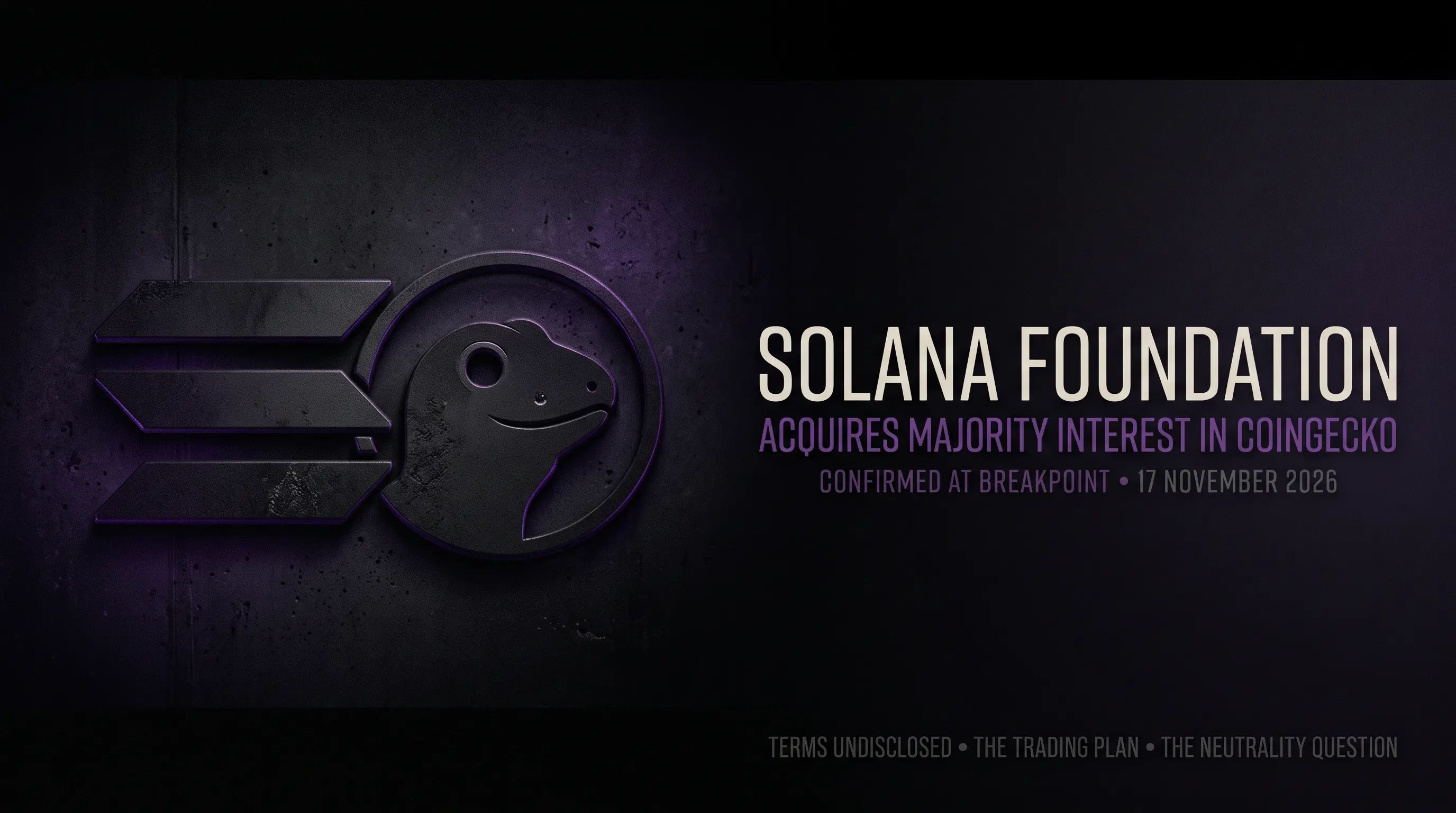
The Solana Foundation holds a majority interest in CoinGecko, confirmed at Breakpoint on 17 November 2026. The terms nobody disclosed, the trading plan, and the neutrality question.
Not financial advice. Solsmint publishes educational content about crypto assets. Prices are volatile, and nothing here is a recommendation to buy, sell, or invest. Verify every contract, authority, and fee yourself before you transact.
Last updated: November 20, 2026
The Solana Foundation now holds a majority interest in CoinGecko, the price-tracking site most of the crypto industry uses as a reference point. The deal was disclosed on November 17, 2026, the final day of Breakpoint at Olympia London, and confirmed by the foundation's chief product officer, Vibhu Norby, on X.
CoinGecko described it as a "next phase of growth, backed by Solana Foundation." Neither side disclosed the price, the exact size of the stake, or any governance rights attached to it.
That gap is the story. A foundation tied to one blockchain now controls a data provider that tracks more than 50 million tokens across 2,000-odd exchanges, and nobody outside the deal knows what influence that ownership carries.
This article is for informational purposes only and is not financial, legal, or investment advice. Not financial advice. DYOR.
Key takeaways
- The Solana Foundation CoinGecko stake was disclosed on November 17, 2026, at Breakpoint in London: a majority interest, with terms left unstated.
- Price, exact stake size, and control rights were not disclosed by either party.
- CoinGecko reports 18 million registered users, more than 50 million monthly sessions, and APIs serving over 10 billion requests a month.
- The foundation plans CoinGecko trading on Solana rails through the site, GeckoTerminal, and the mobile app, though CoinGecko's own release still describes trading as being explored.
- CoinGecko says its methodologies stay public and its data commitment is unchanged. Listing governance has not been addressed publicly.
- The closest precedent is Binance's 2020 purchase of CoinMarketCap, which raised the same neutrality question and never fully answered it.
What was actually announced
The announcement was short on terms and long on framing. The Solana Foundation said CoinGecko has been the leading crypto data provider for more than a decade, serving tens of millions of users a year and powering around 180,000 applications and businesses through its APIs. Norby's post confirmed a majority interest and thanked CoinGecko's founders for twelve years of work.
CoinGecko's chief executive, Bobby Ong, framed the deal around participation rather than prices. The goal, he said, is to help people "not just discover crypto, but participate in it." The company had been bootstrapped for roughly twelve years from Malaysia, which makes a majority sale a notable exit for founders who had never taken institutional money.
What the release did not include: a valuation, a percentage, board seats, veto rights, or any statement about how listings are decided. Those omissions are normal in private transactions and still matter, because the thing being bought is a neutrality claim as much as a dataset.
Why a price tracker is worth buying
CoinGecko is not a media property. It is infrastructure. The numbers published in the announcement explain why: 18 million registered users, more than 50 million monthly sessions, coverage of over 50 million tokens across 2,000-plus exchanges, and an API handling more than 10 billion requests a month.
That API is the part most people never see. Wallets, portfolio trackers, DeFi dashboards, tax tools, and exchange interfaces call it to price assets. When a token is missing from CoinGecko, it is effectively invisible to a large share of the applications that display crypto data. When a token is listed with the wrong supply figure, the error propagates.
For the Solana Foundation, owning that layer means owning the reference point for how Solana assets are priced and ranked across the wider market. For CoinGecko, it means a strategic backer with an interest in the platform growing beyond a price table.
The trading plan, and how firm it is
The foundation's stated intent is Solana-powered trading inside CoinGecko's website, GeckoTerminal, and mobile app. That would turn a reference site into a venue, which changes the business substantially: trading generates fees, and fees depend on order flow rather than page views.
The two companies describe that plan differently. The foundation's announcement presents it as a direction. CoinGecko's own release describes trading as "exploring," which is the standard word for something that has not been built, priced, or approved. Both can be true at once, and the difference tells you how early this is.
If it ships, the practical effect is that a user checking a token's price could buy it without leaving the page. That is a familiar pattern in crypto, and it has a familiar consequence: the line between data provider and exchange collapses.
The neutrality question
The obvious comparison is Binance's 2020 acquisition of CoinMarketCap. Crypto's largest exchange bought crypto's most-cited data site, and the industry spent a year asking whether rankings would tilt toward Binance-listed assets. The answer was never settled publicly, and the acquisition became a reference point for why concentration in data infrastructure is uncomfortable.
This deal has the same shape with a different buyer. A chain foundation is not an exchange, but it is not neutral either. The Solana Foundation majority stake means the company that ranks Solana tokens is now controlled by the organisation whose job is to promote them. Its mandate is to grow Solana, and it now holds a majority position in a site that ranks Solana tokens against everything else.
CoinGecko's response is that its methodologies stay public and its commitment to accurate data "remains unchanged." That is a real commitment, and public methodology is a genuine defence: a ranking rule anyone can read is harder to bend quietly than one that lives in a spreadsheet. But methodology covers how a score is calculated, not which assets are included, how suspicious volume is treated, or whose team answers when a listing decision is challenged.
Neither announcement addressed listing governance. That silence is the part to watch.
What it means if you are launching a token
For a new Solana token, CoinGecko is usually the first external listing that matters. It is where holders check supply, where aggregators pull prices, and where a project's credibility gets a small, arbitrary-looking boost simply by existing in a database.
Nothing about that process changed on November 17. There is no new fast track, and the foundation has not said it will create one. Treat any suggestion that a Solana token can now shortcut a CoinGecko listing as speculation.
What could change is the volume of submissions. If the owner of the data layer is also the organisation promoting a specific ecosystem, more Solana projects will assume the door is open, and CoinGecko will need a clear, published process to answer them consistently. Publishing that process would do more for the neutrality argument than any statement about methodology.
For builders, the durable lesson is the same one that applied before the deal: do not let one aggregator define your market. Verify supply figures yourself, keep your metadata accurate, and remember that a listing is a distribution detail, not a validation.
The wider Breakpoint context
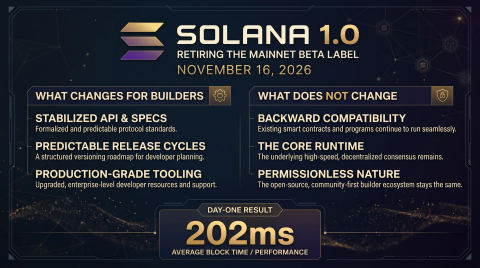
The CoinGecko deal landed on the last day of a week in which Solana's institutional story ran ahead of its price. The Foundation retired the "mainnet beta" label and introduced Solana 1.0 on November 16. Zelle routed a $1.25 million confidential transfer live on stage. Intercontinental Exchange, which owns the NYSE, said its planned tokenised trading venue can already accept Solana-minted tokens and is weighing whether to run a validator. DTCC has committed to bringing tokenised Russell 1000 stocks, index ETFs, and Treasuries to Solana in the second half of 2027.
Against that, SOL traded near $72, roughly 29% below its October 29 open, with spot ETFs in their sixth straight week of outflows. A media and data acquisition does not fix a chart, and the market treated it accordingly.
What we still don’t know
The price is unknown, which means the size of the bet is unknown. CoinGecko's revenue has never been published, so there is no way to judge whether this was a strategic premium or a distressed sale of a bootstrapped company facing well-funded competitors.
The stake size is unknown beyond "majority." Fifty-one per cent and ninety per cent produce very different incentives, and control rights can sit anywhere in between. We also do not know whether Ong and his team have earn-outs, retention terms, or a contractual guarantee of editorial independence.
Listing governance is unaddressed. There is no published policy on how Solana assets will be reviewed, whether foundation employees will sit in listing decisions, or how a dispute would be escalated.
And the trading plan is a direction, not a product. Whether CoinGecko becomes a venue, and whether regulators treat it as one, will take longer to answer than a conference announcement allows.
FAQ: the Solana Foundation and CoinGecko
Did the Solana Foundation buy CoinGecko?
It acquired a majority interest, according to the foundation's chief product officer. Neither side disclosed the price, the exact percentage, or any control rights.
How much did the deal cost?
That has not been disclosed. The CoinGecko acquisition price is unknown, and because the company is privately held with no published revenue, the size of the transaction cannot be estimated from public filings.
Will CoinGecko stay neutral?
CoinGecko says its methodologies remain public and its commitment to accurate data is unchanged. How listings are governed after the deal has not been addressed.
Does this affect how CoinGecko prices Solana tokens?
No pricing or methodology change has been announced. The stated plan is to add trading functionality, which is a product change rather than a data change.
What is GeckoTerminal?
GeckoTerminal is CoinGecko's on-chain trading data product. It is one of the three surfaces named in the foundation's plan for Solana-based trading, alongside the main site and mobile app.
Is CoinGecko becoming an exchange?
Possibly, but not yet. The foundation describes Solana-powered trading as a plan, while CoinGecko's own release says it is exploring trading. No product, fee structure, or launch date has been announced.
How does this compare to Binance buying CoinMarketCap?
Both put a major industry player in control of a widely used data source. Binance's 2020 purchase raised the same neutrality questions, and the answers were never made public either.
Does my token get listed faster now?
There is no announced change to CoinGecko's listing process. Any claim that Solana tokens now receive preferential treatment is speculation, not published policy.
Continue reading
- See how institutional payments are arriving on Solana through Visa, Formation, and stablecoin card spending.
- Read why Solana DeFi keeps growing while the price stalls, the on-chain side of the same story.
- Understand why tokenised stocks are growing on Solana and what the DTCC commitment changes.
- Ready to build? Create a Solana token without code using Solsmint.
Disclaimer: This article is for information and education only and is not financial, investment, or tax advice. Crypto assets are volatile and you can lose money. Always verify token authorities and contract details yourself before interacting with any asset.
Ready to create your own token?
Launch an SPL token on Solana in minutes. No code, 0.05 SOL total, metadata and authorities handled for you.

Amir Ali
Founder of Solsmint | Solana Ecosystem Builder | Crypto & Web3 Enthusiast
Amir Ali is the founder of Solsmint, a Solana-based platform focused on making token launches and on-chain tools more accessible. He writes about Solana, crypto, memecoins, blockchain technology, and the evolving Web3 ecosystem.
Through Solsmint, Amir aims to simplify token creation and liquidity management by building practical, affordable tools for creators, developers, and crypto communities. His work focuses on making blockchain technology easier to use and helping builders turn their ideas into reality.
Follow Amir and explore his work at Solsmint.com.
Last updated: