OCC Finalizes GENIUS Act Rule: Stablecoin Rules for 2027
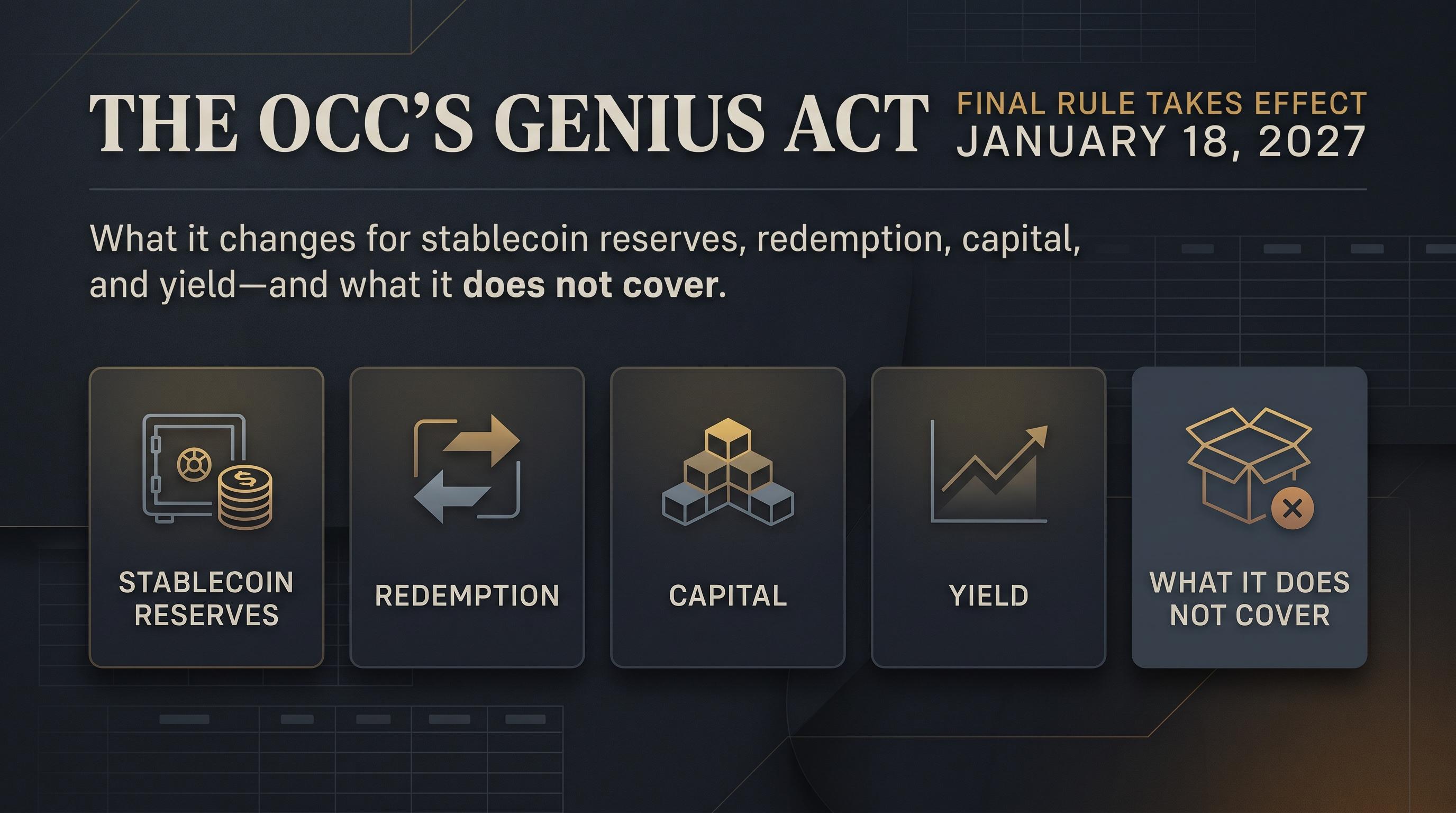
The OCC's GENIUS Act final rule takes effect on January 18, 2027. Here is what it changes for stablecoin reserves, redemption, capital, and yield, and what it does not cover.
Not financial advice. Solsmint publishes educational content about crypto assets. Prices are volatile, and nothing here is a recommendation to buy, sell, or invest. Verify every contract, authority, and fee yourself before you transact.
Last updated: November 14, 2026
The OCC GENIUS Act final rule was published on October 21, 2026. It implements the Guiding and Establishing National Innovation for U.S. Stablecoins Act for payment stablecoin issuers supervised by the OCC, and it takes effect on January 18, 2027.
The short version: issuers must redeem within two business days, hold reserves that are liquid and diversified, keep at least $5 million in capital plus a 12-month operating expense backstop, and they may not pay holders interest or yield on the stablecoin itself.
That matters beyond banking. Stablecoins are the settlement layer for most on-chain payments, and Solana is one of the networks where that volume sits. The rule decides which issuers can operate at scale, what backs their tokens, and how quickly holders can get out.
This article is for informational purposes only and is not financial, legal, or investment advice. Not financial advice. DYOR.
Key takeaways
- The OCC final rule was issued on October 21, 2026 and takes effect January 18, 2027.
- Redemption stays at two business days. The proposed automatic seven-day extension was dropped.
- Reserves must include at least 5% in cash-like assets, and no more than 40% may sit with one counterparty.
- Issuers need $5 million in capital plus an operational backstop equal to 12 months of expenses.
- The yield ban stays, but the blanket presumption against third-party rewards was removed.
- An ordinary SPL token is not a payment stablecoin. The rule does not license or approve random tokens that call themselves stable.
What the OCC GENIUS Act final rule requires
The GENIUS Act became law on July 18, 2025. It told several federal regulators to write rules for payment stablecoins, and it set the compliance date at 18 months after enactment. The OCC moved first. Its final rule covers the parts of the statute assigned to it, apart from Bank Secrecy Act, anti-money-laundering, and sanctions requirements, which will come in a separate rulemaking with the Treasury.
A payment stablecoin, in this framework, is a digital asset issued for payment or settlement that promises a fixed monetary value and is backed by reserves. That definition matters later, because plenty of tokens borrow the word "stable" without making that promise.
Redemption in two business days
Issuers must honour a valid redemption order within two business days. The clock starts when the issuer receives the order and the customer has completed onboarding and any other legal conditions, assuming the onboarding process is not designed to stall in a stress event. Redemption counts as complete when the issuer has processed and initiated the outgoing transfer.
The proposal would have extended that window automatically to seven calendar days whenever redemption requests passed 10% of a brand's outstanding issuance in 24 hours. The final rule removed the automatic extension. Instead, an issuer that crosses the 10% threshold must notify the OCC within 24 hours and may request more time, which the OCC can grant or refuse.
Reserves that can actually be sold
Reserve assets must be sufficient, diversified, and monetizable at short notice. Two numeric floors survive:
- At least 5% of reserves in demand deposits, insured shares, or Federal Reserve balances.
- No more than 40% of reserves with a single counterparty, with an exception for qualifying custodians.
The practical test is not whether the assets are "safe" on paper. It is whether they can be turned into cash quickly without moving the market.
Capital and the operational backstop
Permitted issuers must hold at least $5 million in capital, plus an operational backstop equal to 12 months of total expenses. Up to half of that backstop may take the form of qualifying debt. The backstop is meant to cover the cost of winding down or fixing operations, not to absorb a run on reserves.
The yield ban, with one change
The final rule keeps the statutory ban on paying holders any form of interest or yield solely for holding, using, or keeping a payment stablecoin. The OCC declined to define "interest" or "yield" and said it will judge arrangements by economic substance rather than labels.
What changed is the presumption. The proposal treated third-party rewards, exchange incentives, and white-label programmes as a likely attempt to evade the ban. The final rule drops that presumption and reviews those arrangements case by case, while keeping the authority to act against evasion.
Who the rule covers
| Entity | Status under the final rule | Practical effect |
|---|---|---|
| National banks and federal savings associations | Covered, including subsidiaries and federal branches | Can issue through a regulated entity, subject to supervision |
| Nonbank federal qualified issuers | Covered once approved as permitted payment stablecoin issuers | Must meet capital, reserve, and reporting standards |
| Certain state-qualified issuers | Covered where they fall under OCC authority | Federal standards apply on top of state rules |
| Registered foreign issuers | Covered under the foreign issuer framework | Reserves for U.S. customers must sit in U.S. financial institutions |
| Ordinary SPL tokens | Not payment stablecoins | Unaffected by this rule, and not endorsed by it |
Why the yield decision matters more than it looks
The yield ban is the part of the GENIUS Act that most directly shapes product design. A stablecoin that pays interest competes with bank deposits and money market funds.
Removing the presumption does not legalise rewards. It moves the decision from a rule to a supervisory judgment. An exchange paying a "boost" to holders of a partner stablecoin is not automatically violating the ban, but it is also not automatically safe. The OCC can look at the economic substance, and it kept explicit authority to pursue evasion.
What this means for stablecoins on Solana
Solana is a settlement network, not an issuer, so the rule does not regulate it. The chain's relevance is volume. Solana's own conference materials cite more than $4.7 trillion in stablecoin volume processed on the network in 2026 and more than 50% of blockchain transactions, alongside $4 billion or more in tokenized real-world asset value.
Two effects are worth watching.
Issuance may consolidate. Reserve, reporting, and capital obligations favour issuers with compliance teams and balance sheets. Smaller issuers either partner with a regulated entity, operate under a state regime, or exit. Fewer, larger issuers on Solana would mean deeper liquidity in a handful of tokens rather than a long tail of dollar coins.
Chain choice becomes a compliance question. Settlement speed, finality, fee predictability, and the ability to freeze or block addresses are all part of an issuer's risk review. Solana's throughput helps; the issuer's own controls matter just as much.
Yield-bearing tokens such as tokenized Treasury products are a separate category. They are investment products, not payment stablecoins, and they answer to securities rules rather than this one. That distinction gets blurred in marketing far more often than it should.
What it means for Solana token creators
Most SPL tokens are not payment stablecoins and never will be. A community token, a utility token, or a memecoin makes no promise to redeem at a fixed value, so the GENIUS Act framework does not apply to it.
The risk sits in imitation. If a project markets its token as "always worth $1", "backed 1:1 by USDC", or "redeemable on demand", it is describing a payment stablecoin. Making that promise without a licence, reserves, and redemption operations is a regulatory and reputational problem, and it is also a promise the team probably cannot keep.
A few practical rules for creators:
- Do not use "stable", "backed", or "pegged" unless you can document the reserve and the redemption process.
- Do not imply that a token is insured, guaranteed, or protected by Solsmint or any other platform.
- Publish supply, mint authority status, and treasury wallet addresses so buyers can verify what exists.
- Treat treasury disclosures as an ongoing obligation, not a launch-day paragraph.
- If the plan is a dollar-denominated product, get legal advice before writing the token contract, not after.
Solsmint's guide to SPL tokens covers the difference between SOL, SPL tokens, mint accounts, and token accounts, which is the baseline for anyone writing token claims. The rug-check tool helps users inspect authorities and supply before they trust a token.
What we still don't know
The OCC has not said when it will begin accepting applications and waiver requests. Until that window opens, the timing for a new nonbank issuer is unclear.
The BSA, AML, and sanctions rules are still pending, and they will shape onboarding and monitoring costs. How the OCC treats exchange reward programmes in practice will only become visible through supervisory action or published guidance.
The rule's effect on stablecoin supply is an open question. The OCC expects clarity to encourage issuance, and clarity can also raise costs enough to push marginal issuers out.
FAQ: OCC GENIUS Act final rule
When does the OCC stablecoin rule take effect?
January 18, 2027. That is 18 months after the GENIUS Act was signed on July 18, 2025, and it matches the statutory effective date.
Does the rule apply to USDC or USDT?
It applies to issuers under OCC jurisdiction. A large issuer supervised by the OCC falls inside it. An issuer regulated by another federal or state authority answers to that regulator's rules, which are being written under the same statute.
Can stablecoins still pay yield?
The issuer cannot pay interest or yield for holding the token. Third-party rewards are assessed case by case on economic substance, and the OCC can pursue arrangements it sees as evasion.
How fast must an issuer redeem?
Within two business days of a valid order, with no automatic extension. Outflows above 10% of outstanding issuance in 24 hours trigger a notice to the OCC within 24 hours and allow a request for more time.
What reserves are required?
Reserves must cover outstanding tokens, stay diversified, and be monetizable. At least 5% must sit in cash-like assets, and no more than 40% may be held with a single counterparty.
Does this regulate Solana or SPL tokens?
No. It regulates payment stablecoin issuers and certain custody activities. Solana is the settlement network, and ordinary SPL tokens are outside this framework.
Can I create a stablecoin with a no-code tool?
You can create an SPL token with a fixed supply and metadata. That is not the same as issuing a regulated payment stablecoin, which requires reserves, redemption operations, and licensing.
Bottom line
The OCC rule turns stablecoin promises into operational requirements: redeem fast, hold assets you can sell, keep a capital cushion, and do not pay yield on the token. The removal of the automatic redemption extension is the sharpest change, because it means a stressed issuer cannot rely on a rule to buy time.
For Solana, the near-term effect is consolidation pressure on issuance and more scrutiny of what "stable" means in a token pitch. For creators, the lesson is simpler. If your token does not promise redemption at a fixed value, do not market it as if it does.
Continue reading
- Start with what an SPL token is to separate SOL, SPL tokens, and stablecoin-like assets.
- See how stablecoin payments are scaling on Solana through cards and institutional rails.
- Read how tokenized assets are regulated differently from payment stablecoins.
- Ready to build? Create a Solana token without code using Solsmint.
Disclaimer: This article is for information and education only and is not financial, investment, or tax advice. Crypto assets are volatile and you can lose money. Always verify token authorities and contract details yourself before interacting with any asset.
Ready to create your own token?
Launch an SPL token on Solana in minutes. No code, 0.05 SOL total, metadata and authorities handled for you.

Amir Ali
Founder of Solsmint | Solana Ecosystem Builder | Crypto & Web3 Enthusiast
Amir Ali is the founder of Solsmint, a Solana-based platform focused on making token launches and on-chain tools more accessible. He writes about Solana, crypto, memecoins, blockchain technology, and the evolving Web3 ecosystem.
Through Solsmint, Amir aims to simplify token creation and liquidity management by building practical, affordable tools for creators, developers, and crypto communities. His work focuses on making blockchain technology easier to use and helping builders turn their ideas into reality.
Follow Amir and explore his work at Solsmint.com.