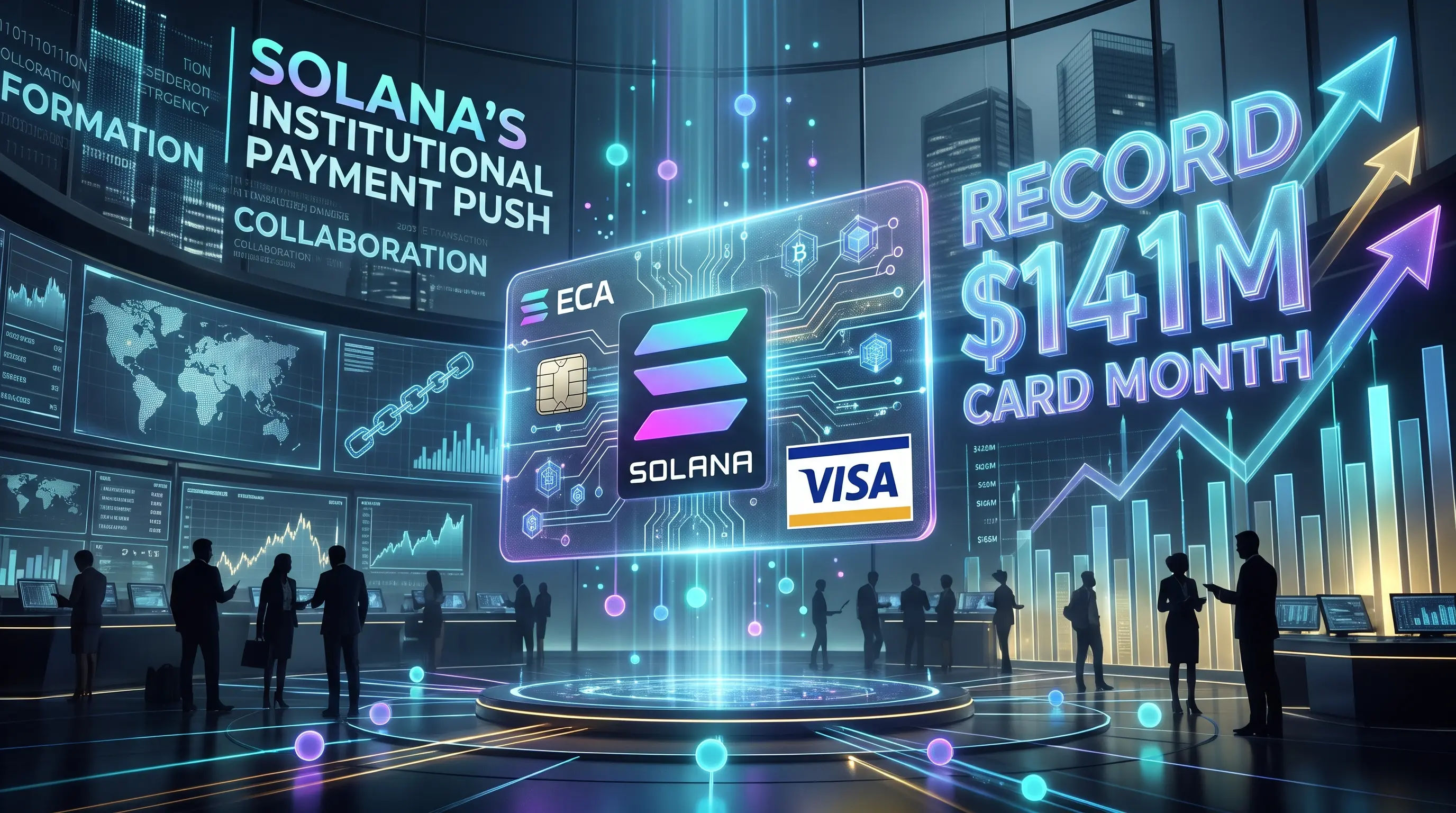
Solana’s Institutional Payment Push: Formation, Visa, and a Record $141M Card Month
Formation filed an SEC notice for a 24/7 tokenized stock venue on Solana, Visa settles USDC on the network, and card spending hit $141 million in October. Here is how the three layers fit together.
Not financial advice. Solsmint publishes educational content about crypto assets. Prices are volatile, and nothing here is a recommendation to buy, sell, or invest. Verify every contract, authority, and fee yourself before you transact.
Last updated: November 11, 2026
Solana’s institutional story is no longer just about token launches and trading apps. Three developments this month show different parts of the same payment stack coming together.
Formation Securities filed an SEC notice on November 9 describing a venue for tokenized U.S. equities on Solana. Visa has been settling USDC on the network with U.S. banks since late 2025. And stablecoin card spending on Solana reached $141.1 million in October, a record month according to Paymentscan data reported by TokenPost and Crypto Briefing.
These are separate products, but they point in the same direction: issuance and trading, bank settlement, and consumer spending are beginning to run on the same public infrastructure.
This article is for informational purposes only and is not financial, legal, or investment advice. Not financial advice. DYOR.
Key takeaways
-
Formation Securities filed an SEC notice on November 9 to operate a tokenized stock venue on Solana, targeting an early-2027 launch.
-
The venue would use permissioned AMM pools under the SEC’s Innovation Exemption, with atomic delivery-versus-payment settlement.
-
Visa has settled USDC on Solana with U.S. banks since December 2025 and reported a multi-billion-dollar annualized settlement run rate.
-
Stablecoin card spending on Solana reached $141.1 million in October, up 24% month over month and roughly seven times year over year.
-
Each layer still has limits: permissioned access, concentrated card volume, and legal and operational dependencies.
What Formation filed with the SEC
Formation Securities submitted a public notice to the SEC describing a venue for trading tokenized U.S. equities around the clock. The filing was made under the SEC’s Innovation Exemption, issued on September 17, 2026, which gives qualifying venues five years of relief to test permissioned on-chain trading.
It is not an approval. It is a notice, and Formation points to early 2027 as its target launch window.
The first listings are expected to include tokenized shares of Exodus Movement, Forward Industries, and Galaxy Digital. Formation was formed from the merger of Orca and Loopscale, and the venue is built on Orca’s automated market maker, which the company says has processed more than $550 billion in cumulative trading volume through October 31, 2026.
Operationally, the filing describes identity checks, sanctions screening, and wallet approval before a participant can trade. Formation would retain authority to restrict wallets and pause operations. Trades would be reported with price, size, and timestamp within ten minutes, alongside daily liquidity and volume disclosures.
How the trading actually settles
The core design is atomic settlement: the tokenized share and the payment move in the same Solana transaction, or neither moves. A failed transaction transfers nothing, though network fees can still apply.
Payment must come from an eligible stablecoin, another tokenized stock, or a tokenized money market fund. That keeps the venue within the boundaries of the exemption.
Trading would continue outside normal exchange hours but stop when the underlying listed security is halted. That detail matters. A 24/7 venue that ignored halts could price shares against stale information, which is why the exemption includes that restriction.
Why atomic settlement matters
Traditional securities settlement depends on intermediaries passing instructions to one another. There is often a gap between when one side delivers an asset and when the other side pays.
On a public blockchain, both legs can execute in one transaction. That removes the window where one party has delivered but the other has not.
It can also simplify reconciliation. Every trade is a transaction with a timestamp, and balance changes are visible to the parties involved. The harder work does not disappear, though. Identity checks, eligibility rules, custody arrangements, and the legal relationship between a token and the underlying share still matter.
Solana’s low-cost transaction model is part of why the idea is practical. If settlement costs fractions of a cent, smaller orders become more viable. That matters for tokenized stocks, where high fixed costs can make small trades uneconomical.
Visa’s USDC rails are the other half of the stack
Formation is about securities. Visa’s program is about the settlement plumbing underneath.
In December 2025, Visa opened U.S. stablecoin settlement to issuer and acquirer partners, with Cross River Bank and Lead Bank settling in Circle’s USDC over Solana. The change extended settlement from five business days to seven, including weekends and holidays.
Visa disclosed $3.5 billion in annualized stablecoin settlement volume as of November 30, 2025. By April 2026, CoinDesk reported a $7 billion annualized run rate, up about 50% quarter over quarter, across nine supported blockchains.
Those are network-level figures, not Solana-only figures. Solana has been part of the settlement program since the earlier pilot phase, but Visa has not published a Solana-specific breakdown.
What a bank actually gets
For a bank, the appeal is not ideology. It is treasury efficiency.
Settling in USDC removes the weekend gap, reduces the number of intermediaries touching a payment, and gives treasury teams a programmable record of each obligation. The consumer card experience does not change, which is why the program can grow without merchants noticing.
That distinction matters. Most “crypto payments” announcements change what the customer sees. Visa’s change is largely invisible to the cardholder and visible to the bank’s back office, where much of the expensive operational friction sits.
The consumer layer: a $141 million month
Stablecoin card spending tracked on Solana reached $141.1 million in October, according to Paymentscan data reported by TokenPost and Crypto Briefing. That was 24% above September’s $113.9 million and roughly seven times the $19.7 million recorded in October 2025. It was the fourth consecutive monthly record.
The growth has been steady rather than explosive. Spending started the year at about $44.5 million in January, crossed $100 million for the first time in August, and has set a new high in every month except June. Cumulative stablecoin card volume on the network has passed $1 billion.
| Layer | What it does | Latest marker |
|---|---|---|
| Issuance and trading | Tokenized equities with on-chain settlement | Formation SEC notice, November 9 |
| Bank settlement | Institutions settle obligations in USDC | Visa program, seven-day window |
| Consumer spending | Cards funded by stablecoin balances | $141.1 million in October |
The numbers behind October’s record
The total is more concentrated than the headline suggests.
KAST, a stablecoin neobank, processed $100.4 million of October’s volume. Programs built on Rain’s card infrastructure added about $31.7 million. Wallet-native cards from Phantom, MetaMask, and Solflare together accounted for roughly $2 million.
Across all chains, stablecoin card spending reached $938.2 million in October. Base led with $259.1 million, Optimism followed at $144.6 million, and Solana sat third at $141.1 million, about $3.5 million behind second place. Those three networks handled roughly 58% of tracked volume.
Solana also counted more than 14 million stablecoin-holding addresses by early October. That is the addressable base for card products, and it helps explain why issuers keep launching on the network even when per-transaction economics look thin.
The publicly reported card figures cover nine of thirteen tracked Solana programs and exclude some issuer data. The true total is probably higher, but it is also less precise than the headline suggests.
What this means for token creators and small teams
Institutional infrastructure changes the demand side of the market in slow, practical ways.
A venue that lists tokenized equities needs market makers, compliance tooling, wallet support, and reporting. A bank settling in USDC needs reconciliation software and treasury dashboards. None of that is a consumer app, but all of it creates work for teams that understand both crypto and traditional finance.
Agent-driven payments are the next layer, and they run on the same rails. Our breakdown of AI agents and stablecoins explains why machine-to-machine settlement needs cheap, final transfers rather than card fees.
For token creators, the practical shift is credibility. When banks and regulated venues use the same settlement asset your project uses, explaining your token becomes easier. That does not make a token valuable, and it does not create liquidity. It removes one objection.
If you are building a token with a payments angle, a no-code creator handles the issuance, and the SPL token explainer covers what the mint and token accounts actually do. For a payments product, the design question is not which chain to use. It is how you reconcile on-chain transfers with the accounting system that already exists.
Risks and limits worth naming
Permissioned is not open
The Formation venue screens participants, restricts wallets, and can pause trading. That is the price of operating inside U.S. securities law.
Anyone expecting a permissionless market for tokenized stocks should read the filing closely. The design is closer to a regulated exchange with an on-chain ledger than to a public DEX.
Concentration cuts both ways
One card program accounts for most of Solana’s October volume. That is efficient while it lasts and fragile if it changes fees, loses a banking partner, or shifts volume elsewhere.
A record built on a single issuer is a weaker signal than a record spread across many.
The legal claim is the product
A tokenized share is only as good as the custody and brokerage arrangement behind it. If the link between the token and the underlying security breaks, the token becomes a receipt for nothing.
Formation’s filing leans on established custody partners, but the structure still depends on those entities performing as described.
Settlement speed is not settlement certainty
Solana confirms quickly, but institutional settlement also depends on each firm’s confirmation thresholds, compliance checks, and operational policies.
Faster ledgers reduce waiting. They do not remove the work of verifying that the right entity received the right amount.
What we still don’t know
Formation has not published a launch date beyond “early 2027,” a fee schedule, or the full list of securities it will support. The SEC notice is a disclosure, not a license, and the agency could raise questions before trading begins. Volume caps inside the exemption also mean the venue may start small by design.
On the payments side, the publicly reported card figures cover nine of thirteen tracked Solana programs and exclude some issuer data. The true total is probably higher, but it is also less precise than the headline.
Visa’s run-rate figure is network-wide and does not break out Solana’s share. Both numbers are directional, not audited.
FAQ: Solana institutional payments
Did the SEC approve Formation’s venue?
No. Formation filed a public notice under the Innovation Exemption. Approval is not part of that process, and trading is not live.
What is the SEC Innovation Exemption?
Relief issued on September 17, 2026 that lets qualifying venues run permissioned on-chain markets for tokenized securities for five years, under conditions on listings, pairs, and reporting.
Does Visa settle on Solana?
Yes. Cross River Bank and Lead Bank began settling with Visa in USDC over Solana after the U.S. program launched in December 2025.
Is Solana’s card spending all consumer purchases?
It measures card volume funded by stablecoin balances on the network, tracked across most but not all programs. Some issuer data is excluded.
Does tokenized stock trading need a token launch?
No. Tokenized equities are issued under securities arrangements, not as ordinary SPL tokens, and they carry legal claims that a standard token does not.
Can anyone trade on the Formation venue?
Not necessarily. Participants must pass identity checks and wallet approval, and the venue can restrict access.
What should builders watch next?
Whether the venue confirms a launch date, whether new card issuers reduce concentration, and whether Visa breaks out Solana-specific settlement volume.
Where does a normal token fit?
As a utility or community asset with clear disclosures. Use a no-code token creator if that is your path, and keep the claims honest.
Bottom line on Solana’s institutional push
The three announcements describe one direction: public infrastructure absorbing functions that used to require private ledgers. Formation wants to settle securities on-chain, Visa wants banks to settle obligations there, and card programs already let people spend stablecoins at merchants.
The limits are real. Permissioned venues, concentrated card volume, and a filing that is not an approval all argue for patience. But the direction is no longer speculative, and that changes what builders can assume about the next two years.
If you are building in this space, start with the boring part. Understand how a mint account works, how settlement reconciles, and what your token actually claims. A no-code token creator is a fast way to test the issuance side while you work out the rest.
Continue Reading
-
Learn what an SPL token is before you launch or transfer tokens on Solana.
-
See how Solana liquidity pools support token trading if you are building a token-based payments project.
-
See why tokenized stocks are growing on Solana for the market this infrastructure serves.
-
Ready to build? Create a Solana token without code using Solsmint.
Disclaimer: This article is for information and education only and is not financial, investment, or tax advice. Crypto assets are volatile and you can lose money. Always verify token authorities and contract details yourself before interacting with any asset.
Ready to create your own token?
Launch an SPL token on Solana in minutes. No code, 0.05 SOL total, metadata and authorities handled for you.

Amir Ali
Founder of Solsmint | Solana Ecosystem Builder | Crypto & Web3 Enthusiast
Amir Ali is the founder of Solsmint, a Solana-based platform focused on making token launches and on-chain tools more accessible. He writes about Solana, crypto, memecoins, blockchain technology, and the evolving Web3 ecosystem.
Through Solsmint, Amir aims to simplify token creation and liquidity management by building practical, affordable tools for creators, developers, and crypto communities. His work focuses on making blockchain technology easier to use and helping builders turn their ideas into reality.
Follow Amir and explore his work at Solsmint.com.
Last updated: