Binance Hack: Exchange Arranges $6.34B to Cover Losses After Record Crypto Theft
Binance says it arranged more than $6.34 billion to cover losses after attackers drained an estimated $6.3 billion from its hot wallets. About $3 billion in stolen assets have been frozen.
Not financial advice. Solsmint publishes educational content about crypto assets. Prices are volatile, and nothing here is a recommendation to buy, sell, or invest. Verify every contract, authority, and fee yourself before you transact.
Binance says it has arranged more than $6.34 billion in company resources to cover losses after attackers drained an estimated $6.3 billion from its hot wallets across multiple blockchains.
Approximately $3 billion in stolen assets have been frozen by industry partners, while withdrawals remain paused pending security checks. Deposits remain open.
This article explains what happened, what Binance has said about user balances and withdrawals, who investigators suspect, and what the incident reveals about exchange custody, hot wallets, and self-custody.
It is a developing story, so figures and operational status may change.
This article is for informational purposes only and is not financial, legal, or security advice.
What Happened to Binance?
Attackers drained an estimated $6.3 billion from Binance hot wallets across multiple blockchains late Thursday, in what Binance and CoinDesk describe as the largest cryptocurrency theft on record.
Most of the funds moved within roughly 20 minutes. Binance has since arranged more than $6.34 billion in company resources to cover confirmed shortfalls.
According to CoinDesk, the affected assets included bitcoin, ether, Tether’s USDT, Circle’s USDC, and smaller tokens. Binance said its investigation initially identified a compromised DevOps engineer’s laptop, then later found additional points of breach.
The company said it has not seen evidence that wallet private keys were stolen.
A hot wallet is an internet-connected wallet used by an exchange to process withdrawals and provide liquidity. A cold wallet is kept offline and is generally used for longer-term storage.
Exchanges typically use both: hot wallets enable fast withdrawals, while cold storage reduces exposure to online attacks.
Source: CoinDesk
https://www.coindesk.com/business/2026/10/30/binance-arranges-usd6-34-billion-to-cover-losses-from-record-crypto-hack
How Much Has Binance Set Aside?
Binance says it has set aside more than $6.34 billion in company resources to restore affected customer balances.
Of that amount, Binance says $5 billion was already held in the exact token assets affected by the incident. The company says it is acquiring the remaining amount through public markets and over-the-counter transactions so its reserves match the affected assets.
Binance says this reserve is intended to cover confirmed shortfalls without altering or taking customer funds.
That $6.34 billion figure is separate from the approximately $3 billion in stolen assets that Binance says industry partners have frozen.
Frozen assets are funds that exchanges, stablecoin issuers, or other counterparties have restricted from further movement while recovery efforts continue.
Are Binance Withdrawals Paused?
Yes. Binance has paused withdrawals while it completes security checks. Deposits remained open, according to CoinDesk’s reporting on the company’s update.
Binance previously said withdrawals could resume in roughly 45 to 48 hours, but that is not a guaranteed reopening time.
Users should rely on Binance’s official website, app, and verified social channels for the latest status rather than unofficial posts or recovery links.
What Are SAFU and Proof of Reserves?
SAFU stands for Secure Asset Fund for Users. It is Binance’s emergency reserve facility, intended to be used during extreme incidents.
CoinDesk reported that the facility has typically held around $1 billion in bitcoin.
Proof of Reserves is a public verification method that lets an exchange demonstrate that it holds assets backing customer balances.
Binance said it will publicly verify user funds through Proof of Reserves as part of its response.
These mechanisms may help restore confidence, but they do not eliminate exchange risk. An exchange can still face operational failures, security incidents, liquidity constraints, or recovery delays even when it maintains reserves or insurance-style funds.
Who Is Suspected of the Binance Hack?
Blockchain-analysis firms Chainalysis and TRM Labs have linked the attack with high confidence to TraderTraitor, a North Korea-linked hacking group previously associated with large-scale crypto thefts.
Their assessments are investigative attributions, not legal findings or convictions.
The firms’ loss estimates differ slightly from Binance’s:
-
Binance: approximately $6.3 billion
-
Chainalysis: approximately $6.4 billion
-
TRM Labs: approximately $6.36 billion
These differences are normal in fast-moving blockchain investigations because analysts may measure timing, asset valuation, and affected addresses differently.
How the Attack Reportedly Unfolded
The reported sequence, based on Binance’s statements and reporting from CoinDesk and Chainalysis, was:
-
Compromised access: Binance initially said attackers used a compromised DevOps engineer’s laptop to access internal systems. It later said investigators found additional breach points.
-
Unauthorized withdrawal requests: The attackers allegedly submitted withdrawal requests through Binance’s internal systems.
-
Hot-wallet outflows: Funds moved from Binance’s hot wallets across multiple blockchains.
-
Rapid laundering: Chainalysis reported thousands of transactions in a short period, suggesting automated scripts rather than manual transfers.
-
Freezes and recovery efforts: Industry partners froze approximately $3 billion in affected assets, while Binance paused withdrawals and worked with partners and law enforcement.
Chainalysis described a laundering pattern in which funds repeatedly circulated among many addresses, sometimes returning to wallets that appeared earlier in the transaction chain.
It also reported addresses receiving exactly 1 TRX before receiving and immediately transferring larger amounts—a pattern it characterized as a programmatic attempt to obscure the trail.
What This Means for Exchange Custody
Custody means who controls access to crypto assets.
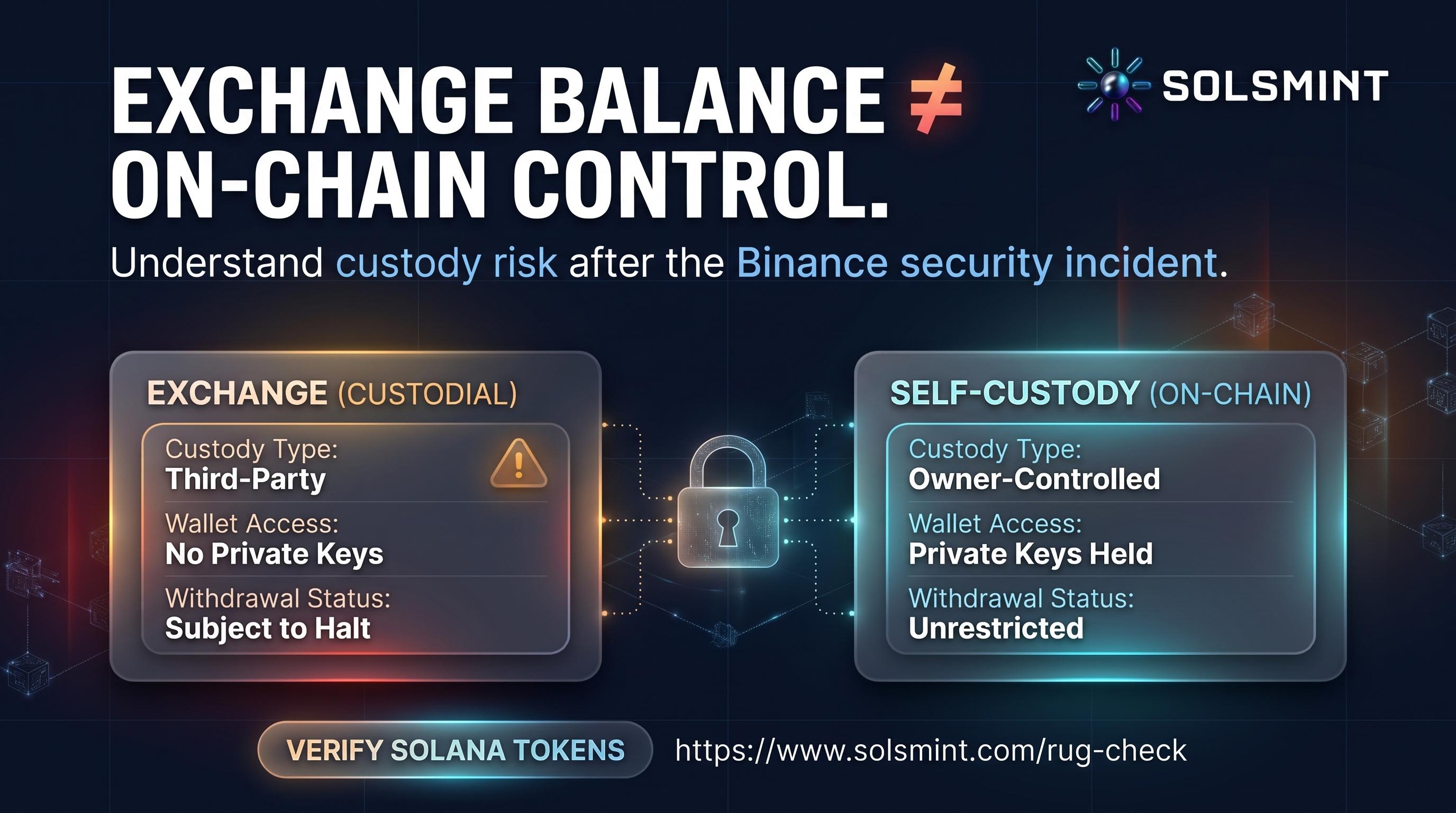
With an exchange, the platform records your balance and controls the wallets used to hold and move customer funds. With self-custody, you control the private keys and can initiate transactions directly from your own wallet.
| Area | Exchange custody | Self-custody |
|---|---|---|
| Who controls keys | The exchange controls operational wallets | You control your wallet’s private keys or seed phrase |
| Access | You request withdrawals through the platform | You can transact directly on-chain |
| Convenience | Usually simpler for trading and fiat access | Requires careful key and backup management |
| Counterparty risk | You depend on the exchange’s security and solvency | You bear responsibility for losing keys or approving malicious transactions |
| Recovery | Depends on the exchange’s incident response | Often impossible if keys or backups are lost |
Neither approach is automatically safer.
Exchange custody introduces platform and counterparty risk. Self-custody introduces user-error, phishing, and key-management risk.
The right arrangement depends on the amount involved, how often you trade, your technical confidence, and your security practices.
Lessons for Crypto Holders and Token Projects
This incident is a reminder that where funds are held matters as much as what assets you own.
Know your custody model.
An exchange balance is a claim on the platform. It is not always the same as assets you directly control on-chain.
Use test withdrawals.
Before moving a large amount, send a small test transaction and confirm it arrives at the intended address.
Avoid putting all funds in one place.
Depending on your needs, splitting holdings between an exchange, self-custody, and institutional custody can reduce single-point-of-failure exposure.
Protect recovery information carefully.
Never share seed phrases or private keys, and be cautious with unsolicited “support” messages or recovery links.
Verify before interacting.
Confirm token contracts, mint addresses, and wallet addresses before swaps, approvals, or transfers.
For Solana users, Solsmint’s rug-check tool can help verify a Solana token’s on-chain risk profile:
https://www.solsmint.com/rug-check
Document treasury controls.
Token projects and DAOs should record which wallets hold treasury assets, who can approve transactions, and how access is recovered if a signer becomes unavailable.
Use multisig where appropriate.
For significant treasury funds, requiring multiple approvals can reduce the risk that one compromised account can move everything.
Frequently Asked Questions
What happened to Binance?
Attackers drained an estimated $6.3 billion from Binance hot wallets across multiple blockchains in a rapid incident late Thursday. Binance paused withdrawals, kept deposits open, and said it arranged more than $6.34 billion in company resources to cover confirmed shortfalls.
How much did the Binance hack cost?
Binance estimates the unauthorized transfers at approximately $6.3 billion. Chainalysis estimated approximately $6.4 billion, while TRM Labs estimated approximately $6.36 billion.
How much has Binance set aside to cover losses?
Binance says it has set aside more than $6.34 billion. It says $5 billion was already held in the exact affected token assets, with the remainder being acquired through public markets and over-the-counter transactions.
Are Binance withdrawals paused?
Yes. Withdrawals were paused for security checks, while deposits remained open. Binance previously indicated withdrawals could resume in roughly 45 to 48 hours, but users should confirm the current status through official Binance channels.
What is Binance SAFU?
SAFU, or Secure Asset Fund for Users, is Binance’s emergency reserve facility. Binance says it will use SAFU as part of its response to the incident.
Who is suspected of the Binance hack?
Chainalysis and TRM Labs linked the attack with high confidence to TraderTraitor, a North Korea-linked hacking group. Attribution is an investigative assessment, not a legal conclusion.
Are user funds safe on Binance?
Binance says it is using company resources, SAFU, and Proof of Reserves to address affected balances and verify user funds. However, no exchange is risk-free, and the full recovery process remains ongoing.
What should crypto users do after an exchange hack?
Check the exchange’s official channels, avoid unofficial recovery links, do not share private keys or seed phrases, and understand whether your assets are held in exchange custody or self-custody.
For large transfers, use a small test transaction first and verify recipient addresses carefully.
Conclusion
The Binance hack is exceptional in scale, but the core lesson is familiar: custody arrangements determine who bears risk when systems fail.
Binance says it has reserved more than $6.34 billion, frozen roughly $3 billion in stolen assets through partners, and paused withdrawals while security checks continue.
Recovery and verification remain in progress.
For users, the practical next step is to verify official Binance updates, avoid unverified recovery links, and understand the difference between an exchange balance and on-chain ownership.
For token projects and DAOs, the incident reinforces the need for documented treasury controls, careful signer management, and on-chain verification before interacting with unfamiliar assets.
Continue Reading
-
Learn what an SPL token is before evaluating tokens on Solana.
-
Understand how Solana token authorities work before trusting a token’s supply or transfer controls.
-
Use Solsmint’s rug-check tool to verify a Solana token’s on-chain risk profile.
Disclaimer: This article is for information and education only and is not financial, investment, or tax advice. Crypto assets are volatile and you can lose money. Always verify token authorities and contract details yourself before interacting with any asset.
Ready to create your own token?
Launch an SPL token on Solana in minutes. No code, 0.05 SOL total, metadata and authorities handled for you.

Amir Ali
Founder of Solsmint | Solana Ecosystem Builder | Crypto & Web3 Enthusiast
Amir Ali is the founder of Solsmint, a Solana-based platform focused on making token launches and on-chain tools more accessible. He writes about Solana, crypto, memecoins, blockchain technology, and the evolving Web3 ecosystem.
Through Solsmint, Amir aims to simplify token creation and liquidity management by building practical, affordable tools for creators, developers, and crypto communities. His work focuses on making blockchain technology easier to use and helping builders turn their ideas into reality.
Follow Amir and explore his work at Solsmint.com.
Last updated: