Solana NFT Marketplaces in 2026: Metaplex Core Explained
Magic Eden retreated, OpenSea and Rarible returned, and Metaplex Core quietly became the default. What the 2026 Solana NFT market looks like, and what a collection costs to launch.
Not financial advice. Solsmint publishes educational content about crypto assets. Prices are volatile, and nothing here is a recommendation to buy, sell, or invest. Verify every contract, authority, and fee yourself before you transact.
Last updated: November 22, 2026
Solana’s NFT market spent 2026 consolidating. Magic Eden closed its Bitcoin and EVM marketplaces in March and kept only Solana. OpenSea returned to Solana NFTs on 31 August, four years after its first attempt fizzled. Rarible came back on 6 August with enforced royalties as its pitch. Tensor stayed where it has been for years, at the centre of trading volume.
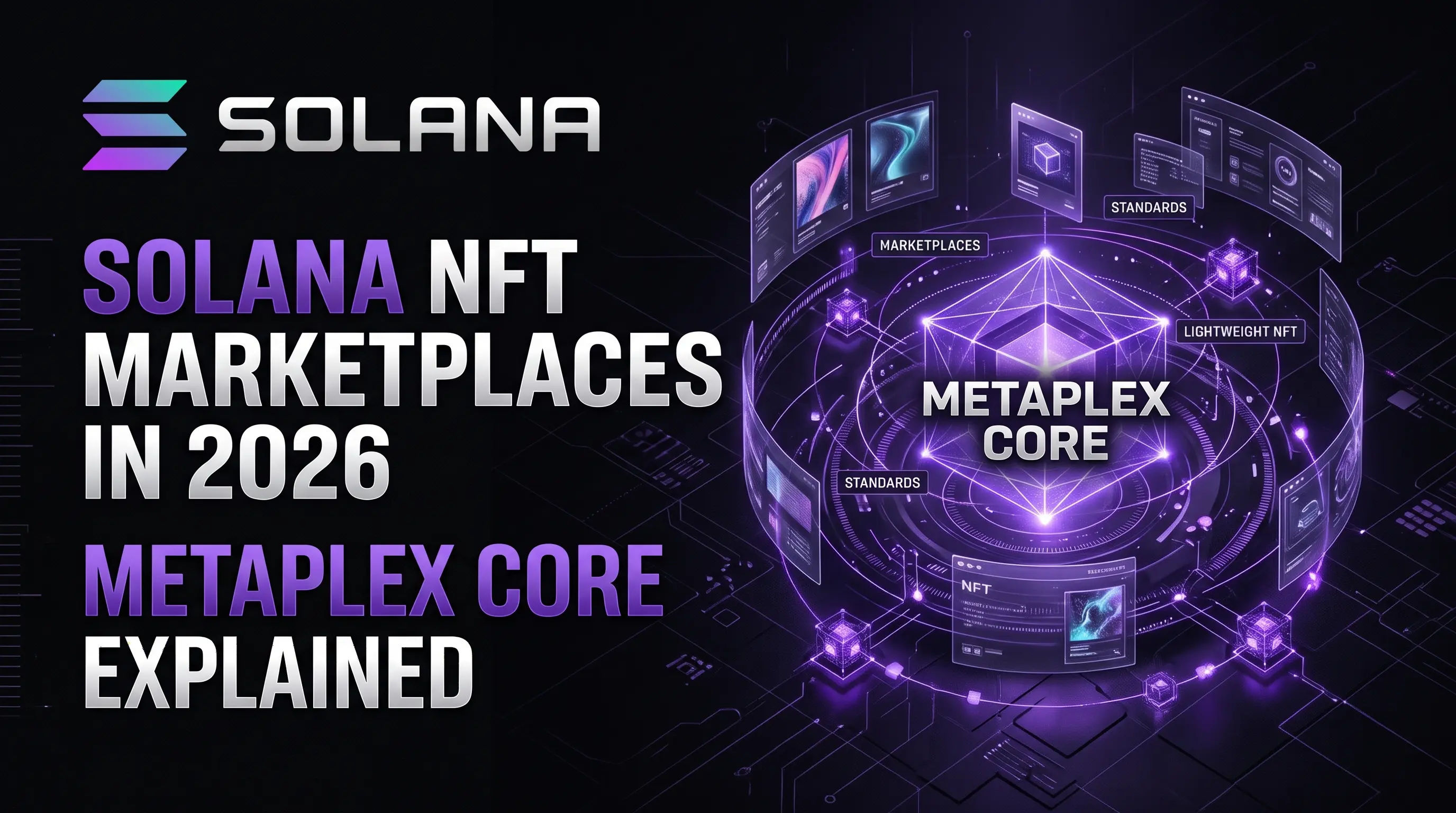
The quieter change sits underneath all of that. Metaplex Core, the single-account NFT standard, has become the default for new collections and for the marketplaces building around them. It changes what an NFT costs to mint, how royalties work, and which account you actually own.
That combination is why the marketplace map and the technical standard belong in the same article. The venues changed because the economics changed.
This article is for informational purposes only and is not financial, legal, or investment advice. Not financial advice. DYOR.
Key takeaways
- Metaplex Core stores an NFT in one account instead of three, at roughly 0.003 SOL per mint against 0.022 SOL for the older Token Metadata standard.
- Core enforces creator royalties by default through a plugin with allowlist and denylist controls, rather than leaving payment to the buyer.
- Solana’s biggest marketplaces, Tensor and Magic Eden, moved to optional royalties during the 2022–2023 fee war and have not reversed that.
- Rarible launched on Solana on 6 August 2026 with escrow-enforced royalties, and OpenSea added Solana NFT trading on 31 August 2026.
- Magic Eden wound down its Bitcoin and EVM marketplaces in March 2026, leaving Solana as its core business.
- For 1,000 new NFTs, the standard choice is worth roughly 19 SOL in rent, which is why new collections start on Core.
What changed in 2026
Two years ago the Solana NFT marketplace question had one answer: Tensor for traders, Magic Eden for discovery, and everyone else fighting for a slice. That is no longer the shape of it.
Magic Eden’s restructuring was the clearest signal. Closing the Bitcoin and EVM marketplaces in March 2026 and discontinuing its multi-chain wallet was a retreat dressed as focus. It kept Solana support because that is where its historical trading activity came from, not because the wider market was growing.
OpenSea went the other way. After rebuilding around OS2, it added Solana NFTs on 31 August 2026, listing Claynosaurz, Mad Lads, Collector Crypt, and Phygitals at launch. Its first Solana attempt, a 2022 beta, never gained traction against Solana-native venues. Whether the second attempt does better depends on whether multi-chain collectors actually want Solana assets in the same interface as everything else.
Rarible’s return was faster and more pointed. A RARI DAO vote authorised the expansion on 31 July, and the marketplace went live six days later on 6 August with Claynosaurz as the featured collection. The team had been building before the vote, so approval unlocked a launch rather than starting one.
Underneath the venue churn, the numbers were not kind. OpenSea’s monthly NFT volume had fallen below $500 million by March 2026, and total NFT market capitalisation had more than halved from mid-January levels. A marketplace launch in that environment is a bet on the next cycle, not a response to the current one.
Metaplex Core: one account instead of three
To understand why Core matters, it helps to remember how the old standard worked. A Token Metadata NFT was a token first: a mint account, a metadata account, and an associated token account, with program calls spread across all three. That is a lot of rent and a lot of instructions for one JPEG.
Core collapses it into a single Asset account that holds the owner, the name, the metadata URI, the update authority, and any plugins. One account, one rent payment, fewer instructions, and fewer ways for a mint to fail halfway through.
The published figures are stark. Metaplex puts Core minting at roughly 0.003 SOL per asset against 0.022 SOL for Token Metadata, a reduction above 80%. A collection account adds about 0.0015 SOL in rent plus a negligible transaction fee. Scale that to a 10,000-piece drop and the difference is the gap between a viable launch and a budget conversation.
Plugins are the other half of the design. A plugin attaches behaviour to an asset or to a collection: royalties, a freeze delegate, a transfer delegate, a burn delegate, on-chain attributes. Collection-level plugins propagate to every member asset unless an individual asset overrides them, which means changing royalties for a 10,000-piece collection is one transaction rather than ten thousand.
That is the technical reason the Solana NFT standard moved. Core is not a cosmetic rewrite; it removes accounts, and accounts are what you pay for.
The royalty fight, and why it restarted
Royalties are the part of NFT economics that never settled. The Solana NFT royalties argument is older than Core, and it has been restarted by every marketplace that tried to enforce where the last one gave up. In 2022 and 2023, Tensor and Magic Eden competed for volume by making creator royalties optional. Traders responded exactly as you would expect. Creators watched secondary revenue fall, and the norm became whatever the buyer chose to pay.
Programmable NFTs, or pNFTs, were Token Metadata’s answer: a wrapper that could restrict transfers to venues enforcing royalties. They worked, in the narrow sense that they could block a sale, and they were awkward enough that adoption stayed partial.
Core approaches the same problem differently. The Royalties plugin enforces creator royalties by default, with allowlist and denylist controls over which programs may transfer the asset. Enforcement is a property of the asset rather than a negotiation with each marketplace.
Rarible’s launch leans on that idea, holding royalties in escrow on secondary sales rather than trusting the buyer. The trade-off is explicit: collectors on Rarible cannot skip creator fees the way they can elsewhere, so a collection that lists there is choosing guaranteed creator revenue over the deepest pool of flippers.
Marketplace policy still decides most NFT royalty enforcement, which is why Rarible’s escrow reads as a positioning statement as much as a product feature. Whether that trade wins is unresolved. Royalty enforcement is a strong pitch to creators who watched revenue erode, and a weak one to traders who moved to Solana for cheap, fast speculation. Both groups are on the same chain, and the venues are now sorted by which one they serve.
What a collection costs in 2026
These are the numbers worth checking before you pick a standard, using Metaplex’s published rent estimates. They exclude marketplace fees and any service you pay to handle the mint.
| Item | Metaplex Core | Token Metadata |
|---|---|---|
| Accounts per NFT | 1 | 3 or more |
| Rent per NFT | ~0.003 SOL | ~0.022 SOL |
| 1,000 NFTs | ~3 SOL | ~22 SOL |
| Collection account | ~0.0015 SOL | Varies by setup |
| Royalty enforcement | Built in, on by default | Via pNFT wrapper |
Compressed NFTs sit below both on cost per item, and they remain the right answer for very large distributions such as event tickets, gaming inventories, or loyalty badges. They trade per-item independence and some composability for scale, so the decision is about the collection rather than the budget alone.
One caveat on the table: rent is refundable when an account is closed, so the figures describe capital parked rather than capital spent. That distinction matters if you plan to burn unsold supply, and it is the reason a failed mint is cheaper than it looks.
Core or Token Metadata?
For a new collection in 2026, the default answer is Core. It is cheaper, it is the standard the returning marketplaces built against, and it handles royalties without a wrapper. The same venues also list wrapped .sol domains, which are NFTs with a naming record attached.
Token Metadata is still the right choice in three situations. Existing collections already live there, and migrating a large one costs more than it saves unless royalties or collection management are causing real pain. Some tooling still assumes Token Metadata accounts, particularly older analytics and portfolio trackers. And compressed NFTs, which are built on a different Metaplex program, remain the only sensible option at very large scale.
Migration from Token Metadata to Core exists, and it is not a re-mint. It moves the asset while preserving identity, which matters for anything with a history. Treat it as a project with testing, not a button.
What this means if you are launching
Three decisions do most of the work. Pick the standard first, because it determines your rent and your royalty options. Pick the venue second, because enforced royalties and optional royalties attract different buyers. Decide whether the collection needs a fungible token at all, because most do not, and a token that exists only to pump an NFT floor usually ends up harming both.
The creators doing well in this market treat the collection as a product with a distribution plan: an audience before the mint, a reason to hold after it, and a route to revenue that does not depend on secondary trading volume. Claynosaurz is the obvious local example, having moved from a 10,000-piece mint that sold out in three minutes in 2022 to animated micro-episodes on Amazon Prime Video in July 2026. The NFT was the entry point, not the business.
If your project does need a token for access, staking, or rewards, create it deliberately and keep the supply and authority decisions documented. Solsmint’s token creator handles the mint, metadata, and authority setup in one flow, which is a reasonable place to start before you think about how the token and the collection relate.
What we still don’t know
Nobody knows whether enforced royalties can build durable volume. Rarible’s position is principled and its liquidity is unproven. If creators list there and buyers stay on Tensor, the model produces revenue on trades that never happen.
OpenSea’s commitment is also untested. It has added and withdrawn Solana support once already, and a marketplace that treats the chain as one of twenty-five is not the same as one that depends on it. A second retreat would be more damaging than the first.
Core’s plugin system is young relative to Token Metadata’s decade of edge cases. Expect gaps in tooling, indexers, and marketplace support to surface as more collections push the standard in unusual directions.
And the demand question sits over all of it. NFT trading is well below its 2021–2022 peak, and the 2026 recovery has been in infrastructure and standards rather than in prices. A better mint standard does not create collectors. It only makes it cheaper to try.
FAQ: Solana NFTs, Core, and royalties
What is Metaplex Core?
Metaplex Core is Solana’s single-account NFT standard. It stores ownership, metadata reference, update authority, and plugins in one account instead of the three or more required by Token Metadata, which cuts minting rent by more than 80%.
How much does it cost to mint an NFT on Solana in 2026?
With Metaplex Core, roughly 0.003 SOL in rent per NFT, plus a negligible transaction fee. Token Metadata costs about 0.022 SOL per NFT. A collection account adds roughly 0.0015 SOL, and rent is refundable if the account is later closed.
Are NFT royalties enforced on Solana?
It depends on the asset. Metaplex Core enforces royalties by default through its Royalties plugin, and Rarible enforces them through escrow. Tensor and Magic Eden still allow optional royalties, so a collector can choose to skip creator fees there.
Which marketplaces support Solana NFTs now?
Tensor and Magic Eden are the Solana-native venues. Rarible launched on Solana on 6 August 2026, and OpenSea added Solana NFT trading on 31 August 2026. Magic Eden closed its Bitcoin and EVM marketplaces in March 2026 to concentrate on Solana.
Should I use Core or Token Metadata for a new collection?
Use Core for new collections. It is cheaper, it is the standard new marketplaces build against, and it handles royalties without a wrapper. Keep Token Metadata for existing collections where migration cost outweighs the savings, or where older tooling still requires it.
Do I need a fungible token for my NFT project?
Usually not. A token makes sense for access, staking, or rewards with a clear purpose. Creating one only to support a floor price tends to damage both the token and the collection, because there is no demand beyond speculation.
Are Solana NFTs dead?
No, but the market is smaller and more concentrated than in 2021–2022. Trading volume and market capitalisation fell sharply through early 2026, while infrastructure improved: cheaper minting, enforced royalties, and two returning marketplaces.
What is the difference between Core and compressed NFTs?
Core gives each NFT its own account with plugins and independent behaviour. Compressed NFTs store state in a Merkle tree, which makes them far cheaper per item at large scale but less flexible individually. Core suits collections; compression suits mass distribution.
Continue reading
- Follow the practical route with how to generate NFTs on Solsmint without writing a program.
- Understand what an SPL token is, and why an NFT is a token with one unit of supply.
- See how an NFT brand became a public company asset in the Sharps Technology and Pudgy Penguins deal.
- Ready to build? Create a Solana token without code using Solsmint.
Disclaimer: This article is for information and education only and is not financial, investment, or tax advice. Crypto assets are volatile and you can lose money. Always verify token authorities and contract details yourself before interacting with any asset.
Ready to create your own token?
Launch an SPL token on Solana in minutes. No code, 0.05 SOL total, metadata and authorities handled for you.

Amir Ali
Founder of Solsmint | Solana Ecosystem Builder | Crypto & Web3 Enthusiast
Amir Ali is the founder of Solsmint, a Solana-based platform focused on making token launches and on-chain tools more accessible. He writes about Solana, crypto, memecoins, blockchain technology, and the evolving Web3 ecosystem.
Through Solsmint, Amir aims to simplify token creation and liquidity management by building practical, affordable tools for creators, developers, and crypto communities. His work focuses on making blockchain technology easier to use and helping builders turn their ideas into reality.
Follow Amir and explore his work at Solsmint.com.
Last updated: