Compressed NFTs on Solana: Bubblegum and DAS Explained
A compressed NFT can cost a few millionths of a SOL because only a hash sits on chain. The trade-off is indexing, proofs and wallet support, and those shape what compression is good for.
Not financial advice. Solsmint publishes educational content about crypto assets. Prices are volatile, and nothing here is a recommendation to buy, sell, or invest. Verify every contract, authority, and fee yourself before you transact.
Last updated: November 24, 2026
A normal Solana NFT lives in its own on-chain account and pays rent for that account forever. A compressed NFT stores a hash in a shared Merkle tree instead, and the full data is written to transaction logs where an indexer can retrieve it. The result is an asset that can cost a few millionths of a SOL instead of a few thousandths.
That cost difference is why compressed NFTs, or cNFTs, are used for loyalty programmes, event tickets, game items and drops with hundreds of thousands of participants. It is also why they behave differently from a standard NFT: there is no account to fetch, transfers need proofs, and your application depends on an indexer that supports the Digital Asset Standard.
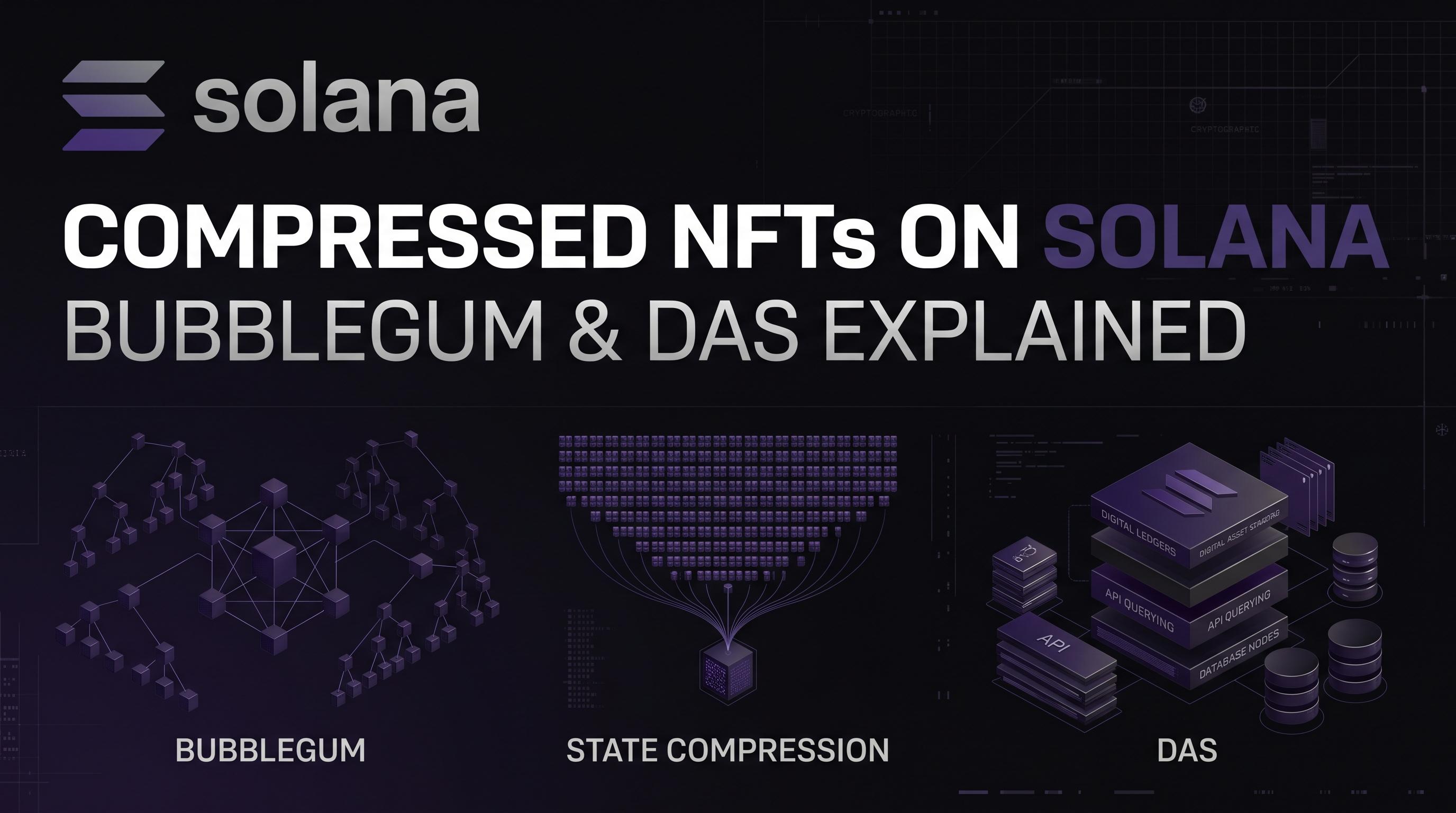
This guide explains how Bubblegum, state compression and the DAS API fit together, what a tree costs, and where compression is the wrong tool.
This article is for informational purposes only and is not financial, legal, or investment advice. Not financial advice. DYOR.
Key takeaways
- A compressed NFT stores a leaf hash in a Merkle tree, not a full account. The asset data is written to transaction logs and served back by an indexer.
- At one million assets, the official Metaplex cost table puts the total near 5.31 SOL, or roughly 0.0000053 SOL per asset.
- Bubblegum v2 is the current program for new projects. It adds Core collections, freeze and thaw, non-transferable assets and royalty enforcement.
- Tree depth, buffer size and canopy depth are fixed at creation. Sizing the tree is the decision you cannot undo.
- Reads and writes go through the DAS API, not a normal account fetch. Not every RPC provider supports it.
- Compression is excellent for large, low-value collections and poor for a small blue-chip collection that must trade everywhere.
Why compression exists
Solana charges rent for account storage. A standard NFT minted with Token Metadata needs a mint account, a metadata account and a token account, and the rent for that structure is roughly 0.022 SOL by Metaplex’s own comparison. Metaplex Core reduces the footprint to about 0.003 SOL per mint because it stores the asset in a single account.
Compression takes a different route. Instead of giving each NFT its own account, it puts thousands of leaves into one tree account. Each leaf is a hash of the asset data. The tree stores the root of the Merkle tree, and the full leaf data is written to the transaction log when the asset is minted.
The economics follow directly. One tree account serves many assets, so the rent per asset falls as the tree fills. At one million assets the official table puts the total near 5.31 SOL, which is about 0.0000053 SOL per asset. That is more than 99% cheaper than Core on a per-asset basis.
The trade-off is that the asset is no longer self-contained. To display it, you need an indexer that has parsed the transaction log and can reconstruct the leaf. To transfer it, you need a proof that the leaf belongs to the current tree root. Those are solvable engineering problems, but they change the architecture of the application.
How a compressed NFT is stored
A Merkle tree is a hash structure. Each asset is a leaf, pairs of leaves are hashed together, and the process repeats until one root remains. The root is stored on chain. A proof is the list of sibling hashes needed to recompute the root from a given leaf.
When you mint a cNFT, the program appends a leaf and updates the root. The leaf’s data goes into the transaction log, and the indexer records it. When you transfer a cNFT, the program verifies the old leaf against the current root using a proof, replaces it with a new leaf for the new owner, and updates the root.
Three tree parameters matter:
- Max depth sets capacity. Capacity is two to the power of the depth, so depth 14 holds 16,384 leaves and depth 20 holds 1,048,576.
- Max buffer size sets concurrency. It is the number of writes the tree can absorb before proofs have to be fast-forwarded through the change log. Writes beyond the buffer fail and must retry.
- Canopy depth caches the top levels of the tree on chain. A deeper canopy costs more rent but shrinks the proof that has to be sent with every transfer.
All three are immutable after the tree is created. You can create another tree later, but you cannot resize the one you have.
Bubblegum v1 and v2
Bubblegum is the Metaplex program that implements compressed NFTs on Solana. Version 1 is now labelled legacy. Version 2 is the recommended program for new projects, and it adds features that make cNFTs behave more like standard assets.
The v2 feature set includes Core collections, freeze and thaw, non-transferable assets and royalty enforcement. That matters for projects that want a collection structure, a way to lock an asset, or a way to enforce royalties without building a custom program. V1 trees and v2 leaves do not mix, so the choice is made at tree creation.
One limitation is worth stating clearly: v2 assets remain compressed. Only v1 supports decompression, where a leaf is redeemed for a voucher and turned into a standard Token Metadata NFT that then pays rent. If some assets must become regular NFTs later, mint those on Core from the start rather than planning a migration from v2.
Metaplex’s documentation recommends v2 for new work, but the support picture is uneven. Some wallets can display v2 assets without transferring them, and some marketplaces do not yet support v2. Check the current support list before you commit a drop to it.
Sizing a tree
Tree sizing is the most consequential decision in a compressed NFT project. The parameters are fixed, and a tree that is too small forces a second tree; a canopy that is too shallow makes transfers fail with a transaction-too-large error.
| Configuration | Capacity | Approximate tree cost | Best for |
|---|---|---|---|
| Depth 14, canopy 8, buffer 64 | 16,384 | About 0.34 SOL | Small and mid-size drops, pilots, event collections |
| Depth 20, canopy 13, buffer 1,024 | 1,048,576 | About 8.5 SOL | Large loyalty programmes, game inventories, mass claims |
The cost table is a starting point, not a quote. Rent depends on the exact parameters and the cluster, and protocol fees may apply on some instructions. Create the tree on devnet first and read the rent it actually charges before you budget a mainnet drop.
The canopy deserves special attention. A depth 20 tree with no canopy sends 640 bytes of proof per transfer. With a canopy of 14, that falls to 192 bytes, which leaves room for a marketplace or escrow instruction in the same transaction. If third-party programs need to compose with your assets, pay for the deeper canopy up front. You cannot add it later.
Capacity should be sized for the collection you expect in two years, not the drop next week. A tree that is 90% full is a migration project waiting to happen.
Minting and the DAS API
Minting a cNFT appends a leaf. The tree stores its rightmost proof on chain, so a mint does not need a proof from the caller. That is why minting is the cheap, parallel part of the lifecycle: you can batch many mints, subject to the buffer size and the transaction size limit.
Reading is where the DAS API comes in. The Digital Asset Standard is a JSON-RPC extension that indexers implement. It gives applications a uniform way to query compressed and uncompressed assets without knowing the underlying program.
Three methods cover most product work:
- getAssetsByOwner returns a wallet’s assets, compressed or not, up to 1,000 per page on common providers.
- getAsset returns one asset by ID, including a compression block with the tree address, leaf ID and data hash.
- getAssetProof returns the root, proof path, node index and tree ID needed for a transfer or burn.
Indexer lag is a real operational issue. A finalized transfer can take a moment to appear in an owner query. Log the last indexed slot with each response and show a pending state rather than telling a user their asset has disappeared.
Provider choice matters too. Not every RPC supports DAS, and public endpoints generally do not index compressed assets. Configure a second DAS-capable provider and health-check it, because an indexer outage takes your inventory screen down even when the chain is fine.
Transfers, proofs and the size limit
A transfer replaces one leaf with another. The program has to verify the old leaf against the current root, so the transaction includes the proof nodes as extra accounts. The proof has to be fetched shortly before the transaction is built, because any write to the tree changes the root.
Solana caps a transaction at 1,232 bytes. Only about 17 proof accounts fit in one transaction, and trees deeper than 24 need a canopy for that reason. A shallow canopy can make a transfer impossible to fit alongside the marketplace or escrow instruction that needs to run in the same transaction.
Stale proofs are a common failure. A proof fetched minutes ago may no longer match the root. The buffer fast-forwards recent proofs through the change log, but it does not make an old proof valid forever. The safe pattern is to fetch, build and send in one tight loop, and to retry with a fresh proof when the program rejects the old one.
Transfers also depend on the asset’s collection and ownership rules. A v2 asset in a Core collection may require the collection to be passed and the collection authority to sign. A non-transferable asset cannot be moved at all, which is the point of the feature.
What compression actually costs
| Item | Approximate cost | Notes |
|---|---|---|
| Tree rent, depth 14 | About 0.34 SOL | One-time, for 16,384 slots |
| Tree rent, depth 20 | About 8.5 SOL | One-time, for 1,048,576 slots |
| Per-asset cost at 1M | About 0.0000053 SOL | Based on the official table’s 5.31 SOL total |
| Network fee per mint | Standard Solana fee plus priority fee | Batching reduces the per-asset overhead |
| Protocol fee | Varies by instruction | Read the live Metaplex fee page before budgeting |
The per-asset figure is the one people quote, but the tree rent is the real up-front commitment. A 16,384-slot tree at 0.34 SOL is cheap for a pilot; a 1,048,576-slot tree at 8.5 SOL is a budget decision. If the drop sells fewer assets than expected, the unused capacity is still paid for.
There is also an operating cost that does not appear in the table: the indexer. A DAS provider, a fallback provider and the engineering work to handle lag and retries are part of the total cost of ownership.
Where compression fits, and where it does not
Compression is a good fit when the collection is large, the per-asset value is low and the experience can tolerate an indexer.
- Loyalty programmes. A million members can each hold a compressed membership pass for a fraction of the cost of standard NFTs.
- Event tickets. Tickets are numerous, time-bound and often non-transferable, which matches the v2 feature set.
- Game items. Inventories can run into millions of low-value items that are minted and burned frequently.
- Mass claims and airdrops. A claim link can distribute a compressed asset to thousands of wallets without a rent bill per wallet.
It is a poor fit for a small blue-chip collection that must trade on every marketplace. The lack of universal wallet and marketplace support is a real constraint, and a collector who cannot transfer an asset from their favourite wallet will not care that the mint was cheap.
It is also a poor fit when the asset must be read directly by another on-chain program without an indexer. A compressed asset has no account to pass into an instruction, so composability depends on the program supporting the compression model or on an oracle-style proof.
Operational gotchas
Immutable tree settings. Depth, buffer and canopy cannot be changed. Plan for the collection you expect, not the one you have.
Indexer dependence. Your app is only as available as the indexer behind it. Keep a second provider configured and test failover.
Stale proofs. Fetch the proof immediately before building the transaction, and retry with a fresh one when a write fails.
Buffer limits. A burst of mints beyond the buffer size fails and must be retried. A retry queue with back-off is not optional for a large drop.
Wallet and marketplace support. Check the current list for the exact program version you use. Support changes, and a wallet that displays an asset may not transfer it.
Off-chain metadata. The leaf usually points to a URI for the image and attributes. If that URI goes down, the asset still exists but its content does not render.
What we still don’t know
Whether v2 support becomes universal is unresolved. Metaplex recommends v2 for new projects, but wallets and marketplaces adopt at different speeds, and a standard is only as useful as the software that reads it.
The long-term cost of indexing is also uncertain. Per-asset mint cost is tiny, but someone has to run the indexer that makes the asset visible. If DAS providers consolidate or raise prices, the operating economics of a compressed collection change.
And the boundary between compressed and standard assets is still moving. Core offers a middle ground with a single-account asset and broader support. For many projects the real choice is not compressed versus Token Metadata; it is compressed versus Core, and the answer depends on how much interoperability the collection needs.
What is settled is the trade-off: compression trades per-asset rent for indexer dependence and proof-based writes. That is a good trade for the right collection and a bad one for the wrong one.
FAQ: Compressed NFTs on Solana
What is a compressed NFT?
A compressed NFT is an asset whose data is stored as a leaf in a Merkle tree rather than in its own on-chain account. The tree stores a root hash, the leaf data is written to transaction logs, and a DAS indexer serves the asset back to applications.
How much does a compressed NFT cost to mint?
At one million assets, the official Metaplex cost table puts the total near 5.31 SOL, or about 0.0000053 SOL per asset. The tree rent is paid up front, and network and protocol fees apply per transaction.
What is Bubblegum v2?
Bubblegum v2 is the current Metaplex program for compressed NFTs. It adds Core collections, freeze and thaw, non-transferable assets and royalty enforcement. V1 is legacy, and v2 assets cannot be decompressed into standard NFTs.
What is the DAS API?
The Digital Asset Standard API is a JSON-RPC extension that indexers implement. It lets applications fetch compressed and uncompressed assets, including proofs for transfers, through methods such as getAssetsByOwner, getAsset and getAssetProof.
Can a compressed NFT be converted to a normal NFT?
Only on Bubblegum v1, which supports decompression into a Token Metadata NFT that then pays rent. V2 assets remain compressed. If some assets must become standard NFTs later, mint those on Core from the start.
Why does my compressed NFT transfer fail?
The most common cause is a proof that no longer matches the tree root, or a transaction that exceeds the 1,232-byte limit because the proof is too large. Fetch a fresh proof and use a tree with a deeper canopy for third-party composability.
Should I use compressed NFTs or Metaplex Core?
Use compression for large, low-value collections where the per-asset saving matters and an indexer is acceptable. Use Core for smaller collections that need broad wallet and marketplace support, or assets that must be read directly by other on-chain programs.
Continue reading
- Read how Solana NFT marketplaces work in 2026, including where Core and compressed assets fit.
- See how to mint an NFT without code if you want a standard collection rather than a compressed drop.
- Then read how Solana token metadata works to understand the off-chain URI behind the image.
- Pairing a collection with a token? Create a Solana token without code and set the supply before the drop goes live.
Disclaimer: This article is for information and education only and is not financial, investment, or tax advice. Crypto assets are volatile and you can lose money. Always verify token authorities and contract details yourself before interacting with any asset.
Ready to create your own token?
Launch an SPL token on Solana in minutes. No code, 0.05 SOL total, metadata and authorities handled for you.

Amir Ali
Founder of Solsmint | Solana Ecosystem Builder | Crypto & Web3 Enthusiast
Amir Ali is the founder of Solsmint, a Solana-based platform focused on making token launches and on-chain tools more accessible. He writes about Solana, crypto, memecoins, blockchain technology, and the evolving Web3 ecosystem.
Through Solsmint, Amir aims to simplify token creation and liquidity management by building practical, affordable tools for creators, developers, and crypto communities. His work focuses on making blockchain technology easier to use and helping builders turn their ideas into reality.
Follow Amir and explore his work at Solsmint.com.