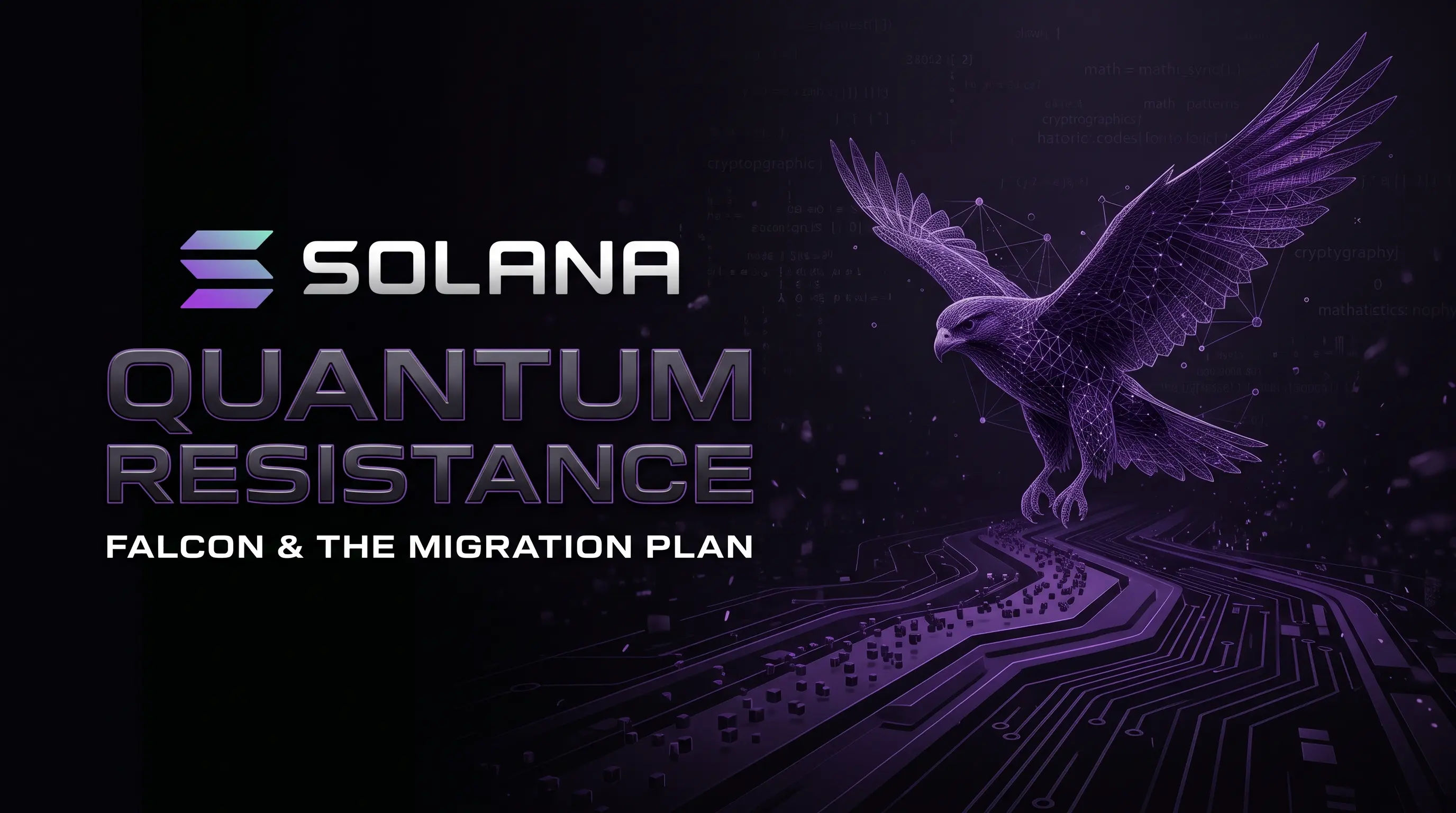
Solana Quantum Resistance: Falcon and the Migration Plan
Solana is not quantum resistant, and Anza does not pretend otherwise. Inside the Falcon prototypes, the 4,096-byte transaction change, and the zero-knowledge migration proof that has to ship first.
Not financial advice. Solsmint publishes educational content about crypto assets. Prices are volatile, and nothing here is a recommendation to buy, sell, or invest. Verify every contract, authority, and fee yourself before you transact.
Last updated: November 22, 2026
Solana is not quantum resistant. Every native transaction on mainnet is authorised by an Ed25519 signature, and Ed25519 rests on elliptic-curve maths that a sufficiently large quantum computer would break. No quantum resistant blockchain exists at the protocol level yet, so this is not a Solana-specific flaw. What is specific is how far the preparation has gone.
Anza and Firedancer, the two teams writing Solana’s validator clients, independently concluded that Falcon is the post-quantum signature scheme worth building around, and both have published working implementations. Engineers at Anza have also prototyped a migration path that lets an existing wallet move to a quantum-safe key without changing its address. That last part is the piece most chains have not solved.
None of it is live. On 20 and 21 November 2026, coverage of the work circulated widely and produced a predictable crop of headlines about Solana becoming quantum-proof. It has not. The accurate version is narrower: the plan exists, the prototypes compile, and the activation date does not.
This article is for informational purposes only and is not financial, legal, or investment advice. Not financial advice. DYOR.
Key takeaways
- Solana still verifies every native signature with Ed25519. No post-quantum verification exists at the protocol level today.
- Anza and Firedancer reached the same conclusion independently and both built Falcon (FN-DSA) implementations.
- Falcon is compact by post-quantum standards and still large by Solana’s: 897-byte public keys and 666-byte signatures, against 32 and 64 bytes for Ed25519.
- SIMD-0296 raises the transaction size limit to 4,096 bytes and is merged. The Falcon precompile, SIMD-0461, was paused in June 2026, and a broader Keccak syscall is being discussed instead.
- Migration is the harder problem. Anza’s prototype produces a roughly 400 kB zero-knowledge proof in about 55 milliseconds to bind an old account to a new key.
- Anza estimates a 3–5% chance of a cryptographically relevant quantum computer within five years, and almost none within two to three.
Where elliptic curves still sit in Solana
It helps to separate four places where the protocol depends on elliptic-curve cryptography, because they fail differently and they migrate separately.
The account model. An account is indexed by its Ed25519 public key, and whoever holds the matching private key can authorise a transfer. A quantum adversary that can recover that private key can drain the account. This is the risk most people mean when they ask whether Solana is quantum resistant, and it is the one that touches ordinary holders.
Block propagation. Turbine and rotor use signatures to authenticate shreds, the fragments validators pass around to rebuild blocks. Forged shreds would not steal funds directly, but an attacker able to produce them could flood the network and degrade availability.
Consensus. Alpenglow, the consensus upgrade that went live in October 2026, relies on BLS signatures over pairing-friendly curves. Forging votes at that layer is how a double spend becomes possible, because an attacker could fabricate confirmations on two conflicting forks.
Programs. Solana programs can call signature-verification syscalls and other cryptographic primitives. Any on-chain multisig, custodial scheme, or custom authorisation built on elliptic-curve operations inherits the same weakness as the base protocol, no matter what the protocol does later.
Those four layers explain why the answer is not a single upgrade. Replacing Ed25519 in the account model is a wallet and tooling problem. Replacing BLS in consensus is a research problem, because BLS aggregates signatures cheaply and post-quantum schemes generally do not.
What Anza and Firedancer actually built
Both teams evaluated the NIST post-quantum standards and landed on the same candidate: Falcon, standardised as FN-DSA and still in draft. It is a lattice-based scheme with the smallest signatures of the three finalists, which matters on a chain that stores and transmits far more signatures per second than most.
The numbers are worth internalising, because they set the engineering agenda. An Ed25519 public key is 32 bytes and a signature is 64. Falcon-512 uses an 897-byte public key and a 666-byte signature. Verification runs at roughly a quarter of Ed25519’s throughput. Nothing about that is disqualifying, but every one of those bytes lands in a block that already has a size limit.
Two limitations follow. Post-quantum signatures are not natively aggregable the way BLS is, so Alpenglow cannot simply swap one scheme for the other and keep its certificate format. Ethereum’s post-quantum researchers have sketched an approach that pairs hash-based validator signatures with a post-quantum SNARK to compress them, and a separate line of work aggregates Falcon signatures using a lattice-based SNARK called LaBRADOR. Both are research, not shipped code, and neither has an agreed route into Solana consensus.
The independent convergence still matters. Two teams, separate codebases, separate incentives, same scheme. That is a stronger signal than either team’s write-up on its own.
What is actually live, merged, and paused
This is where the headlines and the repository diverge, so it is worth being precise.
Merged: SIMD-0296 and SIMD-0385 raise Solana’s transaction size to 4,096 bytes, up from the current limit. Larger transactions are a prerequisite rather than a protection: without them, a Falcon signature plus a normal instruction payload does not fit. Merging the change does not make anything quantum resistant, and it does not affect how you build or send transactions today.
Paused: SIMD-0461 proposed a Falcon verification precompile, which would let programs check post-quantum signatures on-chain without paying prohibitive compute costs. It was closed or paused in June 2026. Discussion moved toward a Keccak-f1600 syscall (SIMD-0563) that would support several post-quantum schemes without committing the protocol to Falcon specifically. That is a sensible hedge given how young the standards are, and it also means the on-chain verification path is less settled than it looked a year ago.
Needed but unscheduled: address versioning. Falcon keys are much larger, so new accounts would be indexed by a hash of the public key rather than the key itself, with the hash mapped into the existing off-curve address space. No wallet, explorer, or indexer needs to care until this ships, and nothing about it is scheduled.
Available today, at the application layer: Blueshift’s Winternitz Vault has been running for more than two years and was cited by Google Quantum AI as an example of proactive post-quantum work. It is a real option for assets you deliberately move into it. It is not a fix for the account model, and it cannot pay transaction fees, because a program cannot be a fee payer on Solana.
Why migration is harder than the cryptography
Assume Falcon ships tomorrow. Every existing account is still protected by an Ed25519 key, and the owner has to rotate it. Most will not, at least not promptly. Some accounts are dormant. Some belong to people who lost a seed phrase years ago. A migration plan that depends on voluntary action leaves a long tail of vulnerable balances, which is exactly the tail an attacker would target.
Anza’s prototype addresses that with a zero-knowledge proof. Because Ed25519 derives a private key deterministically from a 32-byte seed via SHA-512, a holder can prove knowledge of the underlying seed without revealing it, then bind a new post-quantum public key to the same address. The proof is about 400 kB and takes roughly 55 milliseconds to generate. The address does not change, so balances, token accounts, and program-owned state stay where they are.
The construction builds on work from Mysten Labs, and the property that makes it useful is that it still works after Q-day. A holder who kept their seed phrase could migrate even after Ed25519 became forgeable, provided legacy signing had been disabled by then. Bitcoin developers are debating a much harder version of the same question, because some early coins sit in outputs whose key material predates modern derivation standards.
One detail is easy to miss and important. A vault protects assets you move into it. It does not protect the account that pays your fees. As long as fee payment requires an Ed25519 signature, every fee payer remains exposed even if everything valuable sits behind a stronger lock.
How real is the threat, honestly
The threat moved closer in 2026 without arriving. The Solana quantum computing debate is usually framed as a race between hardware and cryptography, which is the wrong frame; the race is between hardware and migration. Google Quantum AI published circuits for Shor’s algorithm that reduce the resources needed to solve a 256-bit elliptic-curve discrete logarithm to under 1,200 logical qubits and 90 million Toffoli gates, or under 1,450 qubits and 70 million gates in a second compilation. On standard superconducting assumptions that is fewer than 500,000 physical qubits, roughly a twentyfold improvement on earlier estimates. Oratomic published complementary error-correction results suggesting that, on neutral atoms, 26,000 physical qubits could run the attack in days.
Set that against reality. The largest number factored with Shor’s algorithm on actual hardware is 21. The distance between 21 and a 256-bit curve is not a matter of engineering effort; it is a different class of machine. Anza’s own forecast assigns a 3–5% probability to a cryptographically relevant quantum computer within five years, up from what it previously treated as negligible, and near-zero probability within two to three.
So the honest reading is this: the cryptography is not urgent, the migration is. Chains that start the boring work now, while nobody is forcing them, will have options later. Chains that wait will be choosing between deprecating unmigrated accounts and leaving a permanent attack surface open.
What this means if you hold SOL or launch a token
Nothing you must do today. There is no migration window, no snapshot, no new address format to adopt, and no wallet that needs updating on account of this. Treat Solana quantum resistance as a roadmap item rather than a feature you can buy: tokens you created last month are unaffected, and creating a new SPL or Token-2022 token remains the same process.
Two things are worth ignoring and one is worth watching. Ignore any token marketed as quantum-proof because it launched on Solana; the network’s signature scheme is a protocol property, not a feature of an individual mint. Ignore claims that an upgrade has made Solana quantum resistant, because no protocol-level post-quantum verification exists yet. Watch the address-versioning work, because that is the signal that a real migration is being scheduled rather than studied.
For anyone holding sizeable balances, the practical question is custody, not consensus. Holding SOL on an exchange means trusting that exchange to rotate keys on your behalf. Holding it in a wallet means trusting that the wallet’s vendor ships migration support when it exists. Neither is a today problem, and both are worth knowing about before they become one.
What we still don’t know
No activation date exists, and no proposal currently commits to one. The public position from Anza is that no change is required today and the plan can be activated when needed. That is a defensible position, and it is also the kind of position that is easy to hold until it is expensive.
It is unresolved whether Falcon survives as the choice. Pausing the Falcon precompile in favour of a multi-scheme Keccak syscall suggests the protocol may stay flexible for longer than the original plan implied. Flexibility is cheaper to build and slower to finish.
Signature aggregation for consensus is unsolved in any production sense. Alpenglow’s certificate model depends on cheap aggregation, and the post-quantum replacements are research prototypes with unresolved security analysis. Nobody has published a design that Solana’s validators could adopt next quarter.
And migration uptake is unknowable in advance. A migration path that works technically can still fail socially if wallets do not surface it, if exchanges drag their feet, or if users ignore prompts for years. That last variable decides how much of the network is actually protected on the day it matters.
FAQ: Solana and quantum computing
Is Solana quantum resistant?
No. Solana verifies every native transaction signature with Ed25519, which is not quantum resistant. Anza and Firedancer have built Falcon prototypes and published a migration design, but none of it is active on mainnet.
What signature scheme does Solana use today?
Ed25519 for transaction signatures, and BLS signatures over pairing-friendly curves for Alpenglow consensus votes. Both rely on elliptic-curve cryptography, which Shor’s algorithm would break on a sufficiently large quantum computer.
What is Falcon, and why did Solana choose it?
Falcon, standardised as FN-DSA, is a lattice-based post-quantum signature scheme with the smallest signatures of the NIST finalists. Anza and Firedancer evaluated the options independently and both concluded that compactness makes it the best fit for a high-throughput chain.
Are post-quantum transactions live on Solana?
No. Falcon verification does not exist at the protocol level. The 4,096-byte transaction limit in SIMD-0296 is merged, but that is a prerequisite, not protection. The Falcon precompile proposal was paused in June 2026.
Will a quantum computer steal my SOL?
Not in the next few years, on current evidence. Anza puts the probability of a cryptographically relevant quantum computer within five years at 3–5%. The realistic concern is preparation, not an imminent theft.
How would existing wallets migrate?
Anza’s prototype lets a holder prove knowledge of their Ed25519 seed with a zero-knowledge proof, then bind a new post-quantum key to the same address. The proof is about 400 kB and takes roughly 55 milliseconds to generate.
Can a vault make my tokens quantum-safe?
Partly. A vault such as Blueshift’s Winternitz Vault can require post-quantum signatures before funds move, which protects assets inside it. It cannot protect the account that pays fees, because Solana programs cannot be fee payers.
Does this affect creating a token on Solana?
No. Minting an SPL or Token-2022 token, setting metadata, revoking authorities, and distributing supply work exactly as before. Quantum readiness is a protocol-level change that token creators inherit rather than implement.
Continue reading
- Understand what the Solana 1.0 label change actually separates, and why a protocol version is not a feature switch.
- See how Alpenglow’s 150-millisecond finality works, including the BLS signatures a post-quantum design would have to replace.
- Read how Solana strengthens its network against fraud, the other side of the security story.
- Ready to build? Create a Solana token without code using Solsmint.
Disclaimer: This article is for information and education only and is not financial, investment, or tax advice. Crypto assets are volatile and you can lose money. Always verify token authorities and contract details yourself before interacting with any asset.
Ready to create your own token?
Launch an SPL token on Solana in minutes. No code, 0.05 SOL total, metadata and authorities handled for you.

Amir Ali
Founder of Solsmint | Solana Ecosystem Builder | Crypto & Web3 Enthusiast
Amir Ali is the founder of Solsmint, a Solana-based platform focused on making token launches and on-chain tools more accessible. He writes about Solana, crypto, memecoins, blockchain technology, and the evolving Web3 ecosystem.
Through Solsmint, Amir aims to simplify token creation and liquidity management by building practical, affordable tools for creators, developers, and crypto communities. His work focuses on making blockchain technology easier to use and helping builders turn their ideas into reality.
Follow Amir and explore his work at Solsmint.com.