Solana Name Service: What a .sol Domain Actually Does
SNS names are more than a shortcut for a wallet address. They carry profile records, support subdomains and can be wrapped as NFTs. Here is what the pricing and ownership rules actually mean.
Not financial advice. Solsmint publishes educational content about crypto assets. Prices are volatile, and nothing here is a recommendation to buy, sell, or invest. Verify every contract, authority, and fee yourself before you transact.
Last updated: November 24, 2026
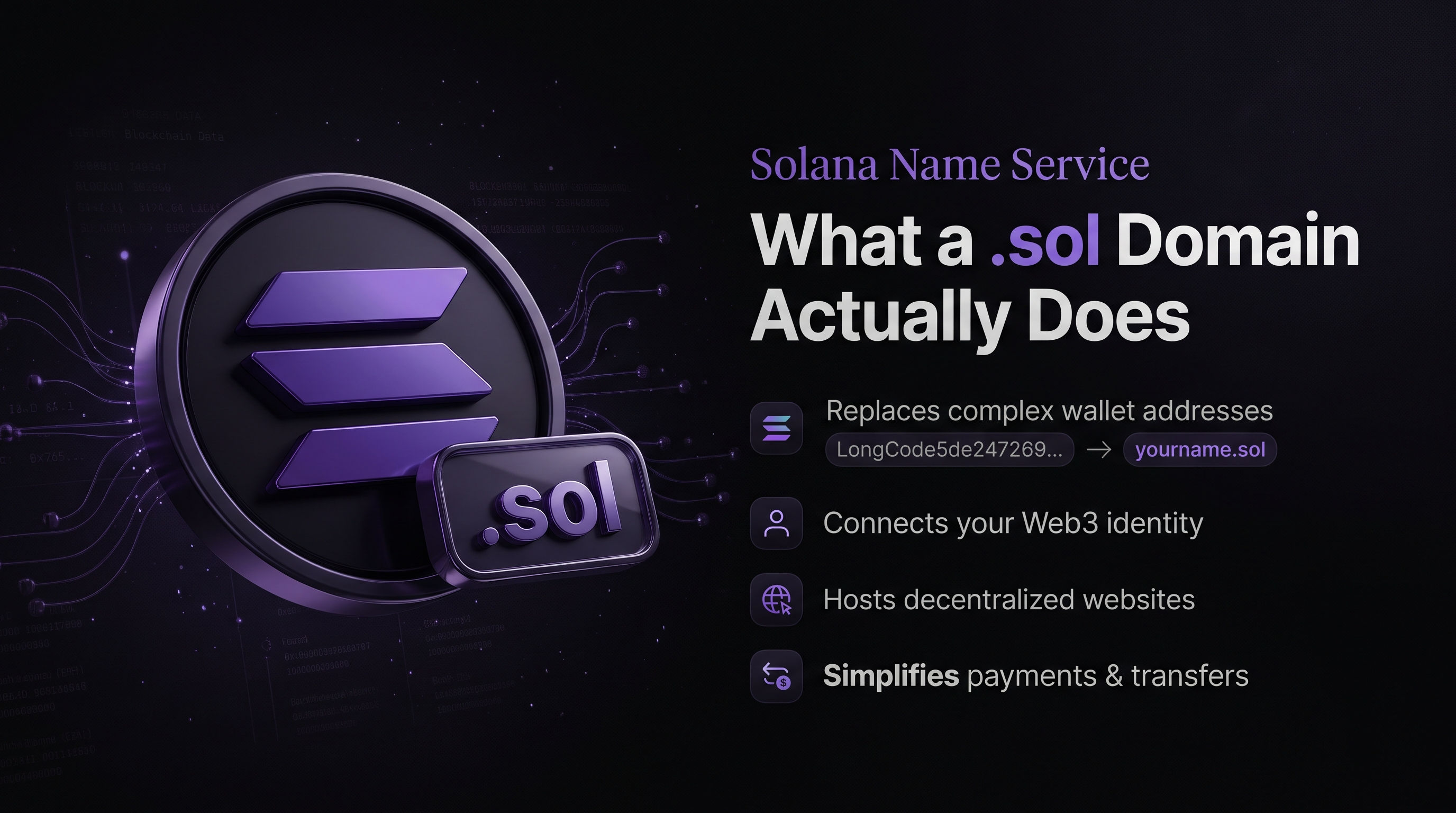
A Solana wallet address is a string of characters that nobody can remember and everybody has to copy. The Solana Name Service exists to replace that string with a name ending in .sol, and to attach a small profile to it: an avatar, a website, social handles and other records that wallets can read.
SNS is built by Bonfida and has been part of the Solana ecosystem since 2021. It is not a domain registrar in the traditional sense, and it is not ENS on a different chain. It is an on-chain naming program with its own pricing schedule, its own ownership rules and its own quirks around wrapping and transfers.
This guide covers what a .sol domain actually does, what it costs in 2026, how registration works, and the ownership details that matter before you buy one on a marketplace.
This article is for informational purposes only and is not financial, legal, or investment advice. Not financial advice. DYOR.
Key takeaways
- SNS maps a
.solname to a Solana address and stores profile records that integrated wallets and apps can read. - Registration is priced by name length: $750 for one character, $700 for two, $640 for three, $160 for four and $20 for five or more.
- Paying with FIDA gets a 5% discount, and credit card checkout is available through Coinflow.
- One wallet can hold any number of domains, and subdomains cost only the Solana network fee.
- A domain can be wrapped into an NFT for trading, but a wrapped domain cannot be edited or transferred as a domain until it is unwrapped.
- The SNS documentation lists a one-time registration price and does not describe an annual renewal fee, which is a meaningful difference from ENS.
What the Solana Name Service is
SNS is a naming program on Solana. It stores a mapping from a human-readable name to on-chain data, most commonly a wallet address. When a wallet supports SNS, you can type alice.sol instead of pasting 7xKX...9fQ, and the wallet resolves the name to the address that owns it.
The name is an account on Solana, not a DNS record held by a registrar. Ownership is controlled by the wallet that holds the name, and the records are stored on chain. That makes the name portable across any application that reads the SNS program, and it makes the ownership rules transparent in a way that a traditional registrar’s database is not.
Bonfida built the original system and continues to maintain the primary interface at sns.id. The program has gone through versions, and the current documentation distinguishes SNS v2 from the earlier v1 pages. For a buyer, the practical point is that the name, the records and the ownership all live on Solana, and the interface is a convenience rather than the source of truth.
What a .sol name can hold
A name is more than an alias. SNS supports profile fields that integrated applications can display. The documentation lists an avatar URL, a website, social media handles and other details that help people identify the owner. The profile is public: anyone can read the content of a domain.
Owners can also set a primary domain. That tells integrated platforms to show the name instead of the raw address, which is useful when you have several names and want one to represent you. The primary flag is a preference, not a transfer of ownership.
Subdomains extend the structure. A parent domain can create an unlimited number of subdomains, which can be used for separate wallets, team members, projects or organisation. Creating a subdomain costs only the Solana network fee; there is no separate registration price.
The records are editable at any time while the domain is unwrapped. That is the practical difference between a name you control and a name you have listed for sale as an NFT.
What a .sol domain costs
SNS prices names by length, not by demand. Shorter names are scarcer, so they cost more. The current published registration prices are:
| Name length | Price | Example shape |
|---|---|---|
| 1 character | $750 | a.sol |
| 2 characters | $700 | ab.sol |
| 3 characters | $640 | abc.sol |
| 4 characters | $160 | abcd.sol |
| 5 or more characters | $20 | alice.sol |
The charge is the USD equivalent in the token you choose. Paying with FIDA gets a 5% discount on the purchase. Credit card checkout is available through Coinflow, which means you do not need to hold crypto before you register.
These are registration prices, not marketplace prices. A name that is already owned can be listed for any amount, and the secondary market is where short or desirable names trade well above the registration schedule. A four-character name that costs $160 to register can be listed for far more if someone else wants it.
The renewal question
This is the detail that separates SNS from ENS most clearly. ENS charges an annual fee to keep a name registered, and letting the fee lapse returns the name to the pool. SNS’s registration page lists a price for registering a domain and does not describe an annual renewal charge.
That does not mean the policy can never change. It means the documentation as published in November 2026 presents registration as a one-time purchase, and buyers should confirm the current terms at checkout rather than assume a perpetual right from a third-party blog post. If a renewal policy is introduced later, it would be a governance and product decision, not something a buyer can infer from today’s price list.
The practical implication is that .sol is cheaper than ENS over a long holding period at the five-character tier, and potentially much cheaper at the short tiers. The trade-off is that .sol resolution is supported by fewer applications than ENS, and its secondary market is smaller.
How registration works
The flow is short, but the details are worth knowing.
- Connect a Solana wallet. Use a wallet that supports the SNS interface and has enough SOL or the token you want to pay with.
- Search for the name. The interface tells you whether it is unregistered, owned or listed for sale. An unregistered name has never been owned; an owned name can only be bought from its current owner.
- Choose a payment method. You can pay in crypto or by card through Coinflow. FIDA payments receive the 5% discount.
- Decide whether to set it as primary. This is a preference that tells integrated apps to display the name instead of your address.
- Approve the transaction. The domain is linked to the wallet that signs, so you can use it immediately after confirmation.
One wallet can hold an unlimited number of domains. That makes SNS usable as a portfolio of identities, brand names or subdomain parents rather than a single vanity handle.
Subdomains, wrapping and transfers
Subdomains are the cheapest part of the system. Once you own a parent, you can create as many subdomains as you need, and the only cost is the network fee for the transaction. Teams use them for separate roles, projects use them for separate products, and individuals use them to organise payments.
Wrapping is where the ownership model gets more complex. SNS lets you tokenise a domain as an NFT so it can be listed on a marketplace. The domain is moved into an escrow account and an NFT is issued to you. Unwrapping burns the NFT and returns the domain.
The costs are small but specific. The first wrap costs about 0.01719 SOL, which covers metadata creation, the Metaplex fee and gas. Subsequent wraps cost about 0.00204 SOL for the token account, and that amount is returned when the domain is unwrapped.
While a domain is wrapped, you cannot edit its content and you cannot transfer it as a domain. You also cannot transfer it while it is listed. If funds are sent to a wrapped domain, the last person to unwrap it can recover them, which is a reason to unwrap before selling a domain that has received payments. Not every name can be wrapped: Metaplex does not support NFT names longer than 32 UTF-8 characters, and domains mixing several languages or using uncertified Unicode cannot be wrapped.
A direct domain transfer is irreversible. The documentation is explicit about it, and there is no escrow or reversal in the transfer function. If you are moving a name to another wallet, confirm the address before you sign.
Where a .sol name actually works
Resolution depends on the application. Wallets such as Phantom and Solflare support SNS names, and many Solana explorers and payment interfaces resolve them. Solscan displays the primary domain for an address when one is set, which makes it easier to recognise a counterparty.
Sol.site extends the name into web2. It lets an owner point a .sol domain at a website and configure email, which turns the name into something closer to a traditional domain. That is a separate product from the on-chain registry, and it has its own setup and support boundaries.
Not every venue supports SNS. A centralised exchange deposit address field may reject a .sol name, and some wallets only resolve names for sending, not for display. The safe test is to send a small amount first and confirm the receiving wallet shows the expected address.
The name is also not a guarantee of identity. Anyone can register a name that looks like a brand, and a name that resolves correctly says nothing about who owns the destination wallet. Treat it as a convenience layer, not a verification badge.
Security: lookalikes, marketplaces and wrong-chain sends
Lookalike names. A name that differs by one character can be registered by anyone. Before sending a large amount, check the resolved address against a known address, not just the name on screen.
Marketplace buys. When you buy a wrapped domain, you are buying an NFT that can be unwrapped. Confirm the listing is for the name you want, and unwrap it before you try to edit records or transfer it as a domain. A cancelled listing or a transfer during a sale can invalidate the purchase.
Wrong-chain sends. A .sol name resolves on Solana. Sending an asset from another chain to a .sol name is not a cross-chain transfer, and some interfaces will reject it. If a wallet offers to resolve a name on a different network, stop and check the network.
Irreversible transfers. The transfer function has no undo. A typo in the destination address or a transfer to a wallet you do not control is final.
Wrapped-domain payments. If someone sends tokens to a wrapped domain, the funds are recoverable by the last unwrapper. That is a feature of the escrow design, but it means a wrapped domain is not a safe payment address.
What we still don’t know
Whether SNS introduces a renewal fee is unresolved. The current documentation describes a one-time registration price, but naming systems often move toward recurring revenue as they mature. A future change would affect the long-term cost comparison with ENS.
Cross-chain resolution is still experimental. SNS has explored bridging names to other chains, but the support is limited and the user experience is not uniform. A name that works on Solana does not automatically work on every chain or every application.
The secondary market for .sol names is also thin and uneven. Short names attract attention, but liquidity for mid-length names is limited, and a listed price is not the same as a sale price. Anyone buying a name as an investment should treat it as an illiquid collectible, not a liquid asset.
And the identity question remains open. A name can carry a profile, but there is no universal verification that the profile belongs to the person or brand it claims. Resolution is a technical function; trust is still a separate judgement.
FAQ: .sol domains
What is a .sol domain?
A .sol domain is a name registered through the Solana Name Service that maps to a Solana address and can hold profile records. Wallets that support SNS can resolve the name, so you can send to alice.sol instead of a long address.
How much does a .sol domain cost?
Registration is priced by length: $750 for one character, $700 for two, $640 for three, $160 for four and $20 for five or more. Paying with FIDA gets a 5% discount. Marketplace prices for already-owned names can be much higher.
Does a .sol domain need renewing?
The SNS registration page lists a one-time price and does not describe an annual renewal fee, unlike ENS. That is the current published position as of November 2026. Confirm the terms at checkout, because a future policy change could introduce a renewal requirement.
Can I sell a .sol domain?
Yes. You can wrap the domain into an NFT and list it on a supported marketplace, or transfer it directly to another wallet. A wrapped domain cannot be edited or transferred as a domain until it is unwrapped, and a direct transfer is irreversible.
What is a subdomain on SNS?
A subdomain is a name created under a parent domain, such as pay.alice.sol. The parent owner can create an unlimited number of subdomains, and the only cost is the Solana network fee for each transaction.
Is a .sol name the same as an ENS name?
No. Both map names to addresses, but they are separate systems on different chains with different pricing, renewal rules and application support. ENS names end in .eth and are renewed annually; SNS names end in .sol and are priced by length at registration.
Why does my wallet not resolve a .sol name?
Because resolution is application-specific. The wallet or exchange may not integrate SNS, or it may only resolve names for sending and not for display. Test with a small transfer and confirm the resolved address before sending a larger amount.
Continue reading
- Read how to airdrop Solana tokens with a claim link if you plan to use a name for distribution or payments.
- See how Samsung Wallet added USDC on Solana for the payments context behind human-readable addresses.
- Then read how Solana NFT marketplaces work in 2026, including the market for wrapped domains.
- If your name is for a project, create a Solana token without code and give the community something to pair with it.
Disclaimer: This article is for information and education only and is not financial, investment, or tax advice. Crypto assets are volatile and you can lose money. Always verify token authorities and contract details yourself before interacting with any asset.
Ready to create your own token?
Launch an SPL token on Solana in minutes. No code, 0.05 SOL total, metadata and authorities handled for you.

Amir Ali
Founder of Solsmint | Solana Ecosystem Builder | Crypto & Web3 Enthusiast
Amir Ali is the founder of Solsmint, a Solana-based platform focused on making token launches and on-chain tools more accessible. He writes about Solana, crypto, memecoins, blockchain technology, and the evolving Web3 ecosystem.
Through Solsmint, Amir aims to simplify token creation and liquidity management by building practical, affordable tools for creators, developers, and crypto communities. His work focuses on making blockchain technology easier to use and helping builders turn their ideas into reality.
Follow Amir and explore his work at Solsmint.com.