Samsung Wallet Adds USDC on Solana: What It Means for Crypto Payments and Adoption
Samsung Wallet now supports USDC on Solana for eligible U.S. Galaxy users. Here is how the integration works, what USDC is, and what it means for stablecoin payments and Solana adoption.
Not financial advice. Solsmint publishes educational content about crypto assets. Prices are volatile, and nothing here is a recommendation to buy, sell, or invest. Verify every contract, authority, and fee yourself before you transact.
Samsung Wallet now lets eligible U.S. Galaxy users buy, hold, send, and receive USDC on Solana. The feature brings a major stablecoin into a mainstream mobile wallet and makes Solana part of Samsung’s consumer payments experience.
Samsung first announced the partnership on October 7, 2026. The Stablecoin Account went live on November 5, 2026, bringing USDC on Solana to eligible U.S. Galaxy users.
According to Solana, the feature will roll out across 82 million compatible U.S. Galaxy devices. Eligible users can send USDC to compatible wallets and make transfers to qualifying bank accounts in more than 60 countries.
Source: Solana Stablecoin Account Goes Live in Samsung Wallet
This article explains how the feature works, what USDC is, how it differs from SOL and other SPL tokens, and why the integration matters for Solana payments and adoption.
This article is for informational purposes only and is not financial, legal, or investment advice.
What Samsung Wallet Announced
Samsung Wallet now supports USDC on Solana for eligible U.S. Galaxy users. Eligible users can buy, hold, send, and receive USDC directly through the wallet.
The feature is not available to every Samsung user. Solana says the rollout covers 82 million compatible U.S. Galaxy devices, but device compatibility, account eligibility, regional availability, and app-version requirements may still apply.
Source: Solana Stablecoin Account Goes Live in Samsung Wallet
The announcement focuses on USDC, not every cryptocurrency or every Solana token. Samsung Wallet users should not assume that the wallet supports every asset on Solana or every blockchain network.
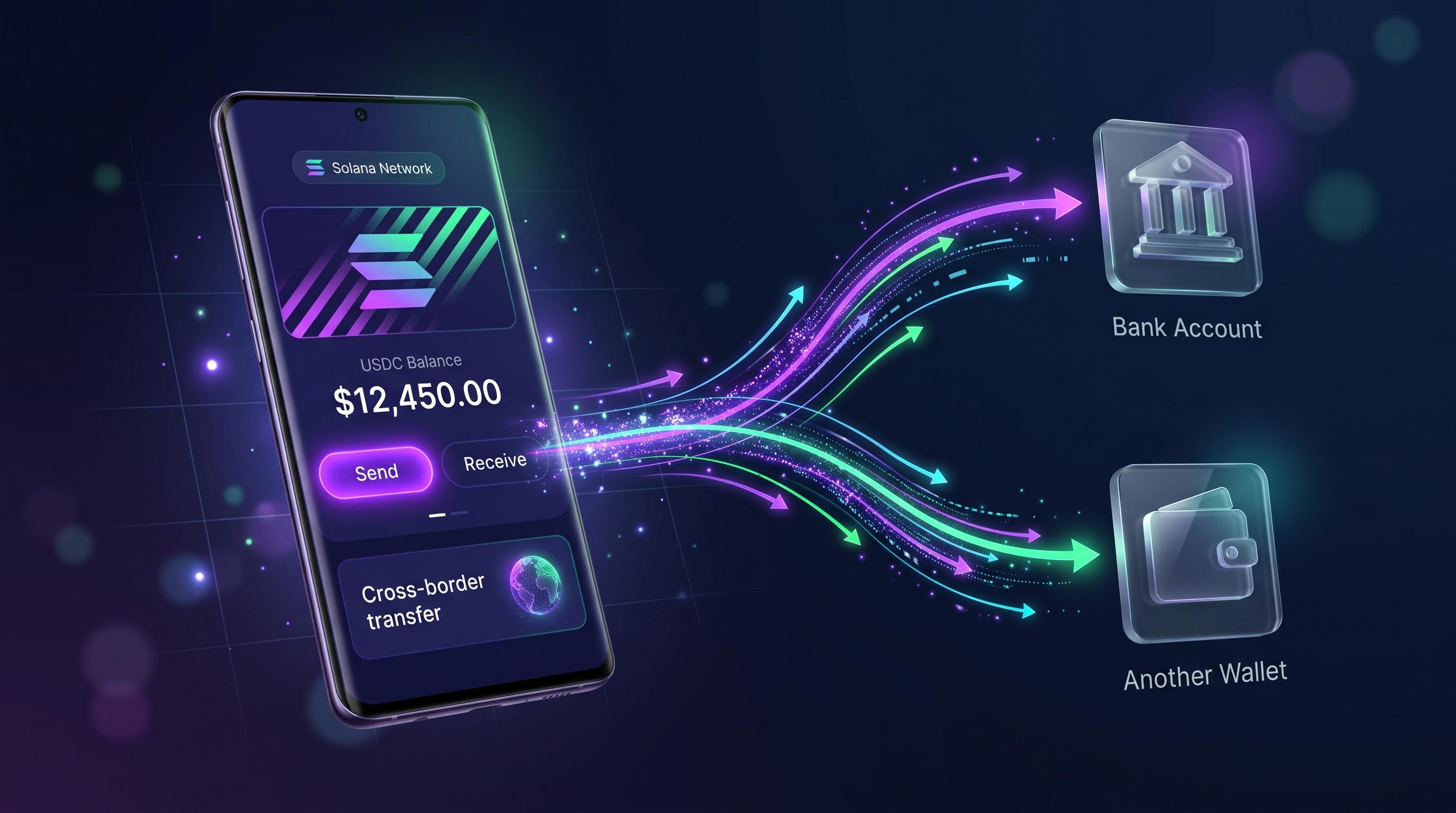
Solana’s announcement also says eligible users can send USDC to compatible wallets and make transfers to qualifying bank accounts in more than 60 countries. That makes the feature relevant beyond simple crypto-to-crypto transfers, though the exact countries, banks, fees, and eligibility rules depend on Samsung Wallet’s implementation.
How USDC Support Works in Samsung Wallet
For an eligible user, the general workflow is straightforward:
-
Open Samsung Wallet.
-
Find the crypto or stablecoin section.
-
Select USDC and confirm that Solana is the selected network.
-
Buy USDC, if available through the supported provider.
-
Hold the balance in Samsung Wallet.
-
Send USDC to a compatible Solana wallet address or QR code.
-
Receive USDC by sharing a compatible Solana address or QR code.
-
Review the recipient address, network, amount, and any applicable fees before confirming.
The exact interface and available actions can vary by device, app version, account status, and region. Samsung Wallet’s rollout is limited to eligible U.S. Galaxy users at launch, so users outside the United States should not assume access.
Before sending USDC, users should verify that the recipient supports USDC on Solana. Sending an asset on the wrong network can result in loss of funds.
What Is USDC and Why Is It on Solana?
USDC is a stablecoin issued by Circle. It is designed to maintain a value linked to the U.S. dollar, rather than fluctuating freely like bitcoin, SOL, or many other crypto assets.
Stablecoins are commonly used for:
-
Payments and peer-to-peer transfers
-
Trading and moving value between platforms
-
Remittances and cross-border payments
-
Dollar-denominated balances in crypto apps
-
Settlement between businesses or payment providers
USDC is not exclusive to Solana. It exists on multiple blockchains, allowing users and applications to use the same dollar-linked asset in different environments. On Solana, USDC is an SPL token.
That distinction matters. SPL stands for Solana Program Library, and SPL tokens are digital assets created and managed on Solana through Solana’s token-program infrastructure. USDC is one example of an SPL token, but SPL also supports many other asset types, including community tokens, governance tokens, reward points, and in-game currencies.
For a fuller explanation, see Solsmint’s guide to what an SPL token is.
How USDC Transfers Work on Solana
A USDC transfer on Solana is a Solana transaction. It moves USDC from the sender’s USDC token account to the recipient’s USDC token account.
Solana uses token accounts to track balances of a particular token for a particular owner. A wallet may need a USDC token account before it can receive USDC. Many wallets use an associated token account, or ATA, which is a predictable token account derived from the owner’s address and the token’s mint address.
For example, if a user sends 50 USDC on Solana, the transaction transfers 50 USDC from the sender’s USDC token account to the recipient’s USDC token account. The user may also need SOL to cover the Solana network fee.
SOL is Solana’s native asset. It is used for network fees and core network activity. USDC is a separate SPL token designed to represent a dollar-linked value.
Network fees can vary based on transaction complexity, account creation, network conditions, and priority fees. A transfer may also involve wallet, provider, conversion, or exchange-related fees, depending on how the user acquired or sent the USDC.
Why Mainstream Wallet Integrations Matter
Samsung Wallet’s USDC support matters because it brings a Solana-based stablecoin into a wallet many people already use.
Many users do not start with a separate crypto wallet. They start with the apps already on their phone. If Samsung Wallet can handle USDC purchases, balances, and transfers, it removes one practical barrier: setting up and understanding a separate crypto wallet.
That does not mean every Galaxy user will immediately use crypto. It means eligible users may encounter USDC on Solana through an interface they already know.
The potential benefits are practical:
-
Easier access to a dollar-linked stablecoin.
-
A familiar mobile interface for sending and receiving value.
-
Potential support for cross-border transfers.
-
A simpler on-ramp for users who are new to crypto.
-
More direct exposure to Solana-based payments without needing to understand blockchain infrastructure in detail.
The important caveat is that access does not equal adoption. A wallet integration can create opportunity, but real usage depends on user demand, fees, merchant acceptance, regulation, and the overall product experience.
What This Means for Solana Adoption and Payments
For Solana, the integration is significant because it connects the network to a mainstream consumer wallet at scale.
Solana’s October ecosystem roundup reported 14 million stablecoin-holding addresses and $1 billion in cumulative stablecoin card spending. Those figures describe ecosystem activity, not Samsung Wallet usage, but they show that stablecoin payments are already an important part of the Solana ecosystem.
Source: Solana Ecosystem Roundup: October 2026
Samsung’s rollout could make it easier for eligible users to send USDC to compatible wallets and make transfers to qualifying bank accounts in more than 60 countries. That places Solana within a payments flow that includes both blockchain wallets and traditional bank accounts.
The development may support several use cases:
-
Sending money to family or friends abroad.
-
Paying a business or service provider that accepts USDC.
-
Moving value between a wallet and a bank account.
-
Using a stablecoin for in-app payments or peer-to-peer transfers.
-
Reducing reliance on volatile crypto assets for everyday transfers.
Still, this is not proof that Solana has achieved mass payments adoption. It is a distribution and access upgrade. Whether it leads to sustained usage will depend on how many eligible users try the feature, how often they use it, and whether the experience is simpler than existing payment methods.
USDC vs. SOL vs. Other SPL Tokens
USDC, SOL, and other SPL tokens are often discussed together, but they serve different purposes.
| Asset | USDC | SOL | Other SPL Tokens |
|---|---|---|---|
| What it is | A U.S. dollar-linked stablecoin issued by Circle | Solana’s native asset | Tokens created through Solana’s token-program infrastructure |
| Main purpose | Stable-value transfers and payments | Network fees, staking-related activity, and ecosystem use | Varies by project: community, utility, governance, rewards, DeFi, or other uses |
| Price behavior | Designed to track the U.S. dollar | Market-priced and volatile | Often market-priced and volatile, depending on the token |
| Network fees | Transfers generally require SOL for Solana network fees | Used to pay Solana network fees | Transfers generally require SOL for Solana network fees |
| Who can create it | Circle issues USDC | Solana’s native asset; projects cannot create their own SOL | Projects, communities, and individuals can create their own SPL tokens |
USDC is an SPL token on Solana, but not every SPL token is a stablecoin. SOL is not an ordinary SPL token; it is Solana’s native asset.
For example, a community token may be used for access or rewards, while USDC is designed to maintain a dollar-linked value. A project creating its own SPL token should not assume that its token will behave like USDC or have the same payment utility.
What This Means for Solana Token Creators
For Solana token creators, Samsung Wallet’s USDC support is a reminder that stablecoins can serve as a practical payment layer within an ecosystem.
A project building a payments app, marketplace, rewards system, or cross-border service may find USDC useful because users can hold a dollar-linked asset rather than a volatile token. But stablecoin support does not automatically make every SPL token useful for payments.
Token creators should distinguish between:
-
Stablecoins: assets designed to maintain a stable value, such as USDC.
-
Utility tokens: tokens used to access a product or service.
-
Governance tokens: tokens used for voting or protocol participation.
-
Community tokens: tokens tied to a community, brand, or social layer.
-
Reward points: tokens used for loyalty, referrals, or incentives.
A token’s usefulness depends on its actual product, integrations, distribution, and user demand. Creating a token does not create utility, liquidity, users, or demand by itself.
For builders considering launching a project, Solsmint’s Solana token creator provides a no-code way to create a supported Solana token. Token creation is only one part of building a credible project.
Limitations and Risks to Understand
Samsung Wallet’s USDC integration is promising, but it comes with limitations.
Regional eligibility
The feature is initially described as available to eligible U.S. Galaxy users. Users in other countries should not assume access.
Device and account requirements
Solana says the rollout covers 82 million compatible U.S. Galaxy devices. Device compatibility, software version, account verification, and Samsung Wallet availability may affect access.
Source: Solana Ecosystem Roundup: October 2026
Custody and control
Users should review Samsung Wallet’s official documentation to understand how funds are held, secured, recovered, and transferred. A wallet interface does not automatically mean full self-custody.
Fees and exchange rates
Buying, sending, converting, or transferring USDC may involve network fees, provider fees, spreads, or other costs. The exact fees depend on the transaction and provider.
Stablecoin risk
USDC is designed to maintain a dollar-linked value, but it is not risk-free. Users should understand issuer risk, regulatory risk, platform risk, and the risk of sending assets to an incompatible address or network.
No guarantee of adoption
A wallet integration can increase access, but it does not guarantee that people will use USDC, transact frequently, or adopt Solana for payments.
Frequently Asked Questions
Does Samsung Wallet support USDC on Solana?
Yes. Samsung Wallet supports USDC on Solana for eligible U.S. Galaxy users. Eligible users can buy, hold, send, and receive USDC through the wallet.
Who can use USDC in Samsung Wallet?
Eligible U.S. Galaxy users with compatible devices can use the feature. Availability may depend on device compatibility, app version, account status, and regional restrictions.
Can Samsung Wallet users buy, send, and receive USDC?
Yes. Solana says eligible users can buy, hold, send, and receive USDC on Solana through Samsung Wallet.
Is USDC the same as SOL?
No. USDC is a dollar-linked stablecoin issued by Circle. SOL is Solana’s native asset and is generally used to pay Solana network fees.
Is USDC an SPL token?
Yes. On Solana, USDC is an SPL token. However, SPL is the broader token-program infrastructure used by many asset types, not only stablecoins.
Do I need SOL to send USDC on Solana?
Usually, yes. Sending a Solana transaction generally requires SOL to cover network fees. The exact cost can depend on the transaction and network conditions.
Is USDC on Solana the same as USDC on Ethereum?
USDC represents the same Circle-issued stablecoin, but it exists as separate tokens on different blockchains. A user should always confirm the correct network before sending funds.
Is Samsung Wallet self-custody?
That depends on Samsung Wallet’s implementation and the user’s account setup. Users should review Samsung’s official documentation before assuming they control the private keys.
Final Thought
Samsung Wallet’s USDC-on-Solana support is a meaningful payments integration because it brings a dollar-linked stablecoin into a mainstream mobile wallet. For eligible U.S. Galaxy users, it makes USDC on Solana more accessible without requiring them to start with a separate crypto wallet.
For Solana, the development adds another mainstream distribution channel for stablecoin payments and gives token creators another example of how SPL assets can support real-world financial activity. But adoption is not automatic. The real test will be whether users find the experience useful enough to send, receive, and hold USDC through Samsung Wallet over time.
Continue Reading
-
Learn what an SPL token is before sending or receiving USDC on Solana.
-
Understand how Solana token authorities work before trusting a token’s supply or transfer controls.
-
See how Solana liquidity pools support token trading if you are building a token-based payments project.
-
Ready to build? Create a Solana token without code using Solsmint.
Disclaimer: This article is for information and education only and is not financial, investment, or tax advice. Crypto assets are volatile and you can lose money. Always verify token authorities and contract details yourself before interacting with any asset.
Ready to create your own token?
Launch an SPL token on Solana in minutes. No code, 0.05 SOL total, metadata and authorities handled for you.

Amir Ali
Founder of Solsmint | Solana Ecosystem Builder | Crypto & Web3 Enthusiast
Amir Ali is the founder of Solsmint, a Solana-based platform focused on making token launches and on-chain tools more accessible. He writes about Solana, crypto, memecoins, blockchain technology, and the evolving Web3 ecosystem.
Through Solsmint, Amir aims to simplify token creation and liquidity management by building practical, affordable tools for creators, developers, and crypto communities. His work focuses on making blockchain technology easier to use and helping builders turn their ideas into reality.
Follow Amir and explore his work at Solsmint.com.