Crypto Liquidations Explained: November 2026 Selloff
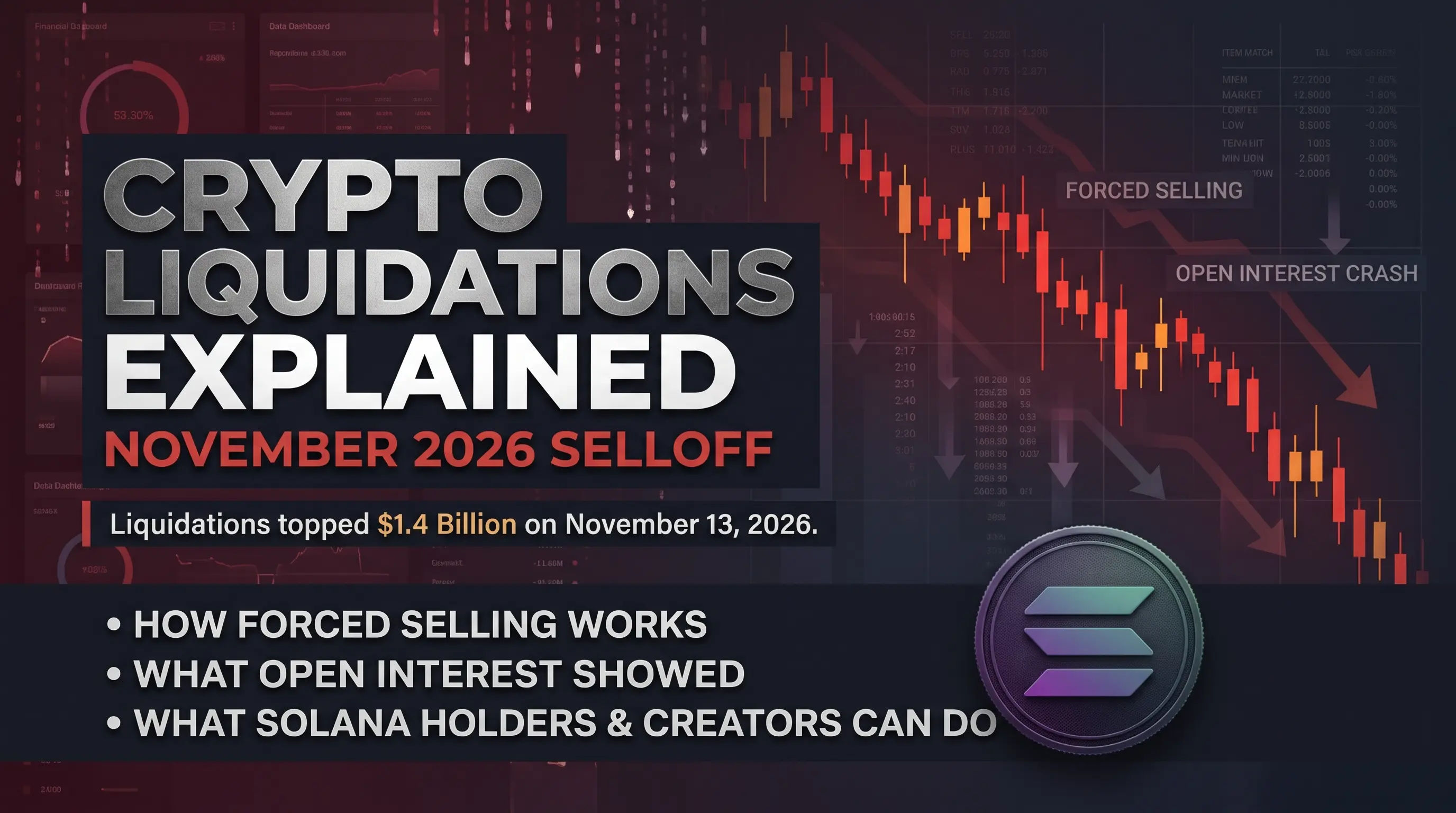
Liquidations topped $1.4 billion on November 13, 2026. Here is how forced selling works, what open interest showed, and what Solana token holders and creators can do about it.
Not financial advice. Solsmint publishes educational content about crypto assets. Prices are volatile, and nothing here is a recommendation to buy, sell, or invest. Verify every contract, authority, and fee yourself before you transact.
Last updated: November 14, 2026
Crypto liquidations topped $1.4 billion on November 13, 2026, as Bitcoin fell below $69,000 and long positions absorbed most of the damage. A single hour accounted for roughly $225 million of forced closures, with $176.6 million of that from longs.
A liquidation is not a market crash in miniature. It is a specific mechanical event: an exchange closes a leveraged position because its collateral no longer covers the loss. Those closures are market orders, so they consume liquidity and can push prices further, which closes more positions. This article explains how that chain works, what the November data showed, and how to read it without treating it as a forecast.
This article is for informational purposes only and is not financial, legal, or investment advice. Not financial advice. DYOR.
Key takeaways
- Liquidations above $1.4 billion were reported on November 13, 2026, according to CoinGlass data cited by CryptoPotato.
- Longs took the larger share, as they usually do when a rally reverses.
- Open interest fell by roughly $3 billion during one cascade, which is the deleveraging the process performs.
- Solana open interest dropped 4.25% to about $929.5 million, a larger percentage fall than Bitcoin's.
- Liquidation totals describe derivatives positions on exchanges. They are not on-chain token transfers.
- Leverage, thin order books, and clustered stop levels turn a normal pullback into a cascade.
What happened on November 13
The move built through the week. Hotter-than-expected inflation data, persistent ETF outflows, and rising rate expectations pushed risk assets lower. Bitcoin broke below $69,000 on November 13 after losing more than 14% over eight sessions, and it traded near $66,900 the following day.
| Metric | Reading | Source |
|---|---|---|
| 24-hour liquidations | Above $1.4 billion | CoinGlass data cited by CryptoPotato |
| Liquidations in one hour | About $225 million, including $176.6 million in longs | Crypto Briefing |
| Open interest change | Fell about $3 billion during the cascade | Crypto Briefing |
| Solana open interest | Down 4.25% to about $929.5 million | Crypto Briefing |
| Long share of accounts | 63.2% | Crypto Briefing |
| Large Hyperliquid short | About $143.1 million across BTC and ETH, as of November 14 | TokenPost |
Those figures come from different trackers and snapshots, so they do not add up into one clean total.
Crypto liquidations explained: how a position gets closed
Perpetual futures let a trader control a position larger than their collateral. That leverage cuts both ways. A 5x long with $1,000 of margin controls $5,000 of exposure, so a 20% move against it wipes out the margin.
The exchange does not wait for zero. It sets a maintenance margin requirement, a minimum collateral level relative to position size, and it closes the position when equity falls below that line. The sequence is mechanical:
- A trader posts collateral and opens a leveraged position.
- Price moves against the position, reducing equity.
- Equity approaches the maintenance margin threshold.
- The liquidation engine closes the position at market, or hands it to a backstop mechanism.
- The forced order consumes resting liquidity and moves price further.
Step five is where a routine pullback becomes an event. Liquidations are not patient. They execute at whatever price the book offers, and in a thin market that price can be far from the last trade.
Mark price versus last price
Most venues liquidate against a mark price derived from several spot markets rather than the last trade on their own order book. The design exists to stop a single bad print from triggering a wave of unnecessary closures. It also means a trader can be liquidated while their chart still shows a survivable price, which surprises people who only watch one feed.
Why cascades happen
Three conditions turn a decline into a chain reaction.
Clustered leverage. When many traders use similar entry prices, similar leverage, and similar stop levels, their liquidations trigger at similar prices. The result is a dense band of forced orders rather than a smooth distribution.
Thin liquidity. Market makers widen spreads and reduce size during volatility. The same forced sell that would cost 0.5% in a calm market can cost several percent in a stressed one.
Reflexivity. Forced selling lowers price, which triggers more forced selling. The process continues until the collateral is exhausted or buyers step in.
This is why open interest matters more than any single liquidation headline. Open interest is the total value of outstanding contracts. Falling open interest during a selloff means positions are being closed. Rising open interest during a selloff means new positions are being opened into the move, which can set up the next cascade.
What funding rates and open interest tell you
Perpetual futures have no expiry, so exchanges use funding payments to keep the contract price near spot. When funding is positive, longs pay shorts. When it is negative, shorts pay longs.
Persistently positive funding means traders are paying to stay long. That is a crowding signal, not a prediction. Persistently negative funding shows the opposite. Neither number tells you the direction of the next move, and both can stay stretched longer than a leveraged trader can stay solvent.
Open interest adds the missing piece. Funding tells you who is paying. Open interest tells you how much exposure exists. A market with expensive funding and rising open interest is carrying more risk than one where funding is flat and exposure is shrinking.
Why Solana's open interest fell faster
Solana open interest dropped 4.25% to about $929.5 million during the same window, a larger percentage decline than Bitcoin's. That fits a pattern: traders treat SOL as a higher-beta position, so they cut exposure faster when the market turns. Faster deleveraging is not automatically bad. It clears leverage sooner, and it leaves spot holders, who cannot be liquidated, carrying more of the price discovery.
What this means for Solana token holders
Most people reading this do not have a leveraged perp position. They hold spot tokens in a wallet. Liquidations still affect them, in three ways.
- Price transmission. Forced selling in derivatives pulls spot prices down through arbitrage and market-maker hedging.
- Liquidity withdrawal. Market makers reduce size across venues during stress, so a token that looked liquid on Monday can be thin on Friday.
- Narrative damage. A cascade produces dramatic numbers that get repeated without context, which can push retail attention toward short-term trading.
Spot holders cannot be liquidated, but they can still sell at the worst moment. The mechanics of a cascade are designed to create exactly that pressure.
What this means for token creators
If you run a token with a liquidity pool, a cascade is a stress test of your market structure.
Thin pools amplify price impact in both directions. A pool with $20,000 of liquidity cannot absorb a $5,000 sell without a visible move, and a cascade makes that asymmetry worse. Concentrated holder bases add to it: when a few wallets control most of the supply, one large sale does more than a hundred small ones.
Practical steps worth taking before the next volatile week:
- Review pool depth against your realistic daily volume, not your launch-day volume.
- Check holder concentration and publish what you find.
- Keep treasury operations transparent so holders are not guessing about large transfers.
- Avoid marketing a token on price action you cannot control.
- Verify authorities and supply so buyers can check the basics themselves.
Solsmint's explainer on Solana liquidity pools covers how depth and price impact work together. The liquidity tool is where a pool is actually created.
How to reduce liquidation risk
For anyone using leverage, the boring answers are the correct ones.
- Use lower leverage. A 3x position survives a 33% move; a 20x position does not survive 5%.
- Use isolated margin so one position cannot drain the rest of the account.
- Set stops above the liquidation price, not at it. The liquidation engine is not a stop-loss.
- Size positions so a full loss is survivable and does not change your plans.
- Check the mark price feed and the exchange's liquidation rules before opening.
- Avoid adding to a losing leveraged position during a cascade.
None of this removes risk. It changes the shape of the risk from account-ending to inconvenient.
Common misconceptions
"Liquidations mean the bottom is in." A cascade clears leverage. It says nothing about demand. Open interest can rebuild within days.
"Liquidation numbers are on-chain selling." They are mostly centralised-exchange derivatives data. On-chain token sales are a separate flow.
"A big short means the market will fall." A large position is a signal of conviction, not a guarantee. Positions close, and a short that closes is a buy.
What we still don't know
We do not know who controls the $143 million Hyperliquid short, whether it has been reduced, or whether it is hedged elsewhere. We do not know how much of the November selling was spot versus derivatives, and different trackers report different liquidation totals for the same 24 hours.
Whether open interest rebuilds quickly is also open. It usually does, because leverage re-accumulates after every flush, but the pace depends on volatility, funding, and macro data.
FAQ: crypto liquidations
What is a crypto liquidation?
A forced closure of a leveraged position by an exchange after the trader's collateral falls below the required maintenance margin.
Why were most liquidations longs in November 2026?
The market had a long tilt: long accounts made up about 63% of the accounts surveyed. When price fell, those were the positions that breached their margin requirements.
Can I lose more than I deposited?
On most major venues, isolated margin limits losses to the position's margin. Cross margin and some protocols can expose more of the account, so the terms matter.
Do liquidations cause the price drop?
They amplify it. An initial move, often macro-driven, triggers forced selling, which pushes price lower and triggers more forced selling.
What is open interest?
The total value of outstanding derivatives contracts. Falling open interest means positions are closing; rising open interest means new exposure is being added.
Does a large short position mean prices will fall?
No. It shows that someone expects a decline. It can be closed at any time, and closing a short means buying.
How do I check liquidation data?
Trackers such as CoinGlass aggregate exchange data. Treat totals as estimates, since venues report differently and some report late.
Bottom line
November 13 was a leverage event inside a macro selloff. Forced closures above $1.4 billion cleared leverage across the market, and Solana's derivatives exposure fell faster than Bitcoin's. That is deleveraging doing its job, at a cost to the traders on the wrong side.
The practical takeaway is not a direction call. It is structural: leverage determines who gets forced out, and liquidity determines how far the forced orders travel. Spot holders and token creators cannot control the macro, but they can control position size, pool depth, and how much of their supply sits in a few wallets.
Continue reading
- Learn how liquidity depth affects price impact during a selloff.
- Read why one-tap trading makes fast decisions riskier.
- Start with the Solana token creation guide before launching a market.
- Ready to build? Create a Solana token without code using Solsmint.
Disclaimer: This article is for information and education only and is not financial, investment, or tax advice. Crypto assets are volatile and you can lose money. Always verify token authorities and contract details yourself before interacting with any asset.
Ready to create your own token?
Launch an SPL token on Solana in minutes. No code, 0.05 SOL total, metadata and authorities handled for you.

Amir Ali
Founder of Solsmint | Solana Ecosystem Builder | Crypto & Web3 Enthusiast
Amir Ali is the founder of Solsmint, a Solana-based platform focused on making token launches and on-chain tools more accessible. He writes about Solana, crypto, memecoins, blockchain technology, and the evolving Web3 ecosystem.
Through Solsmint, Amir aims to simplify token creation and liquidity management by building practical, affordable tools for creators, developers, and crypto communities. His work focuses on making blockchain technology easier to use and helping builders turn their ideas into reality.
Follow Amir and explore his work at Solsmint.com.