Solana Token Unlocks in November 2026: What to Watch
November brings unlocks for $TRUMP, $PUMP, $CARDS, $JTO, and $2Z. Here is the schedule, the supply math behind each release, and how to read an unlock without guessing at price.
Not financial advice. Solsmint publishes educational content about crypto assets. Prices are volatile, and nothing here is a recommendation to buy, sell, or invest. Verify every contract, authority, and fee yourself before you transact.
Last updated: November 14, 2026
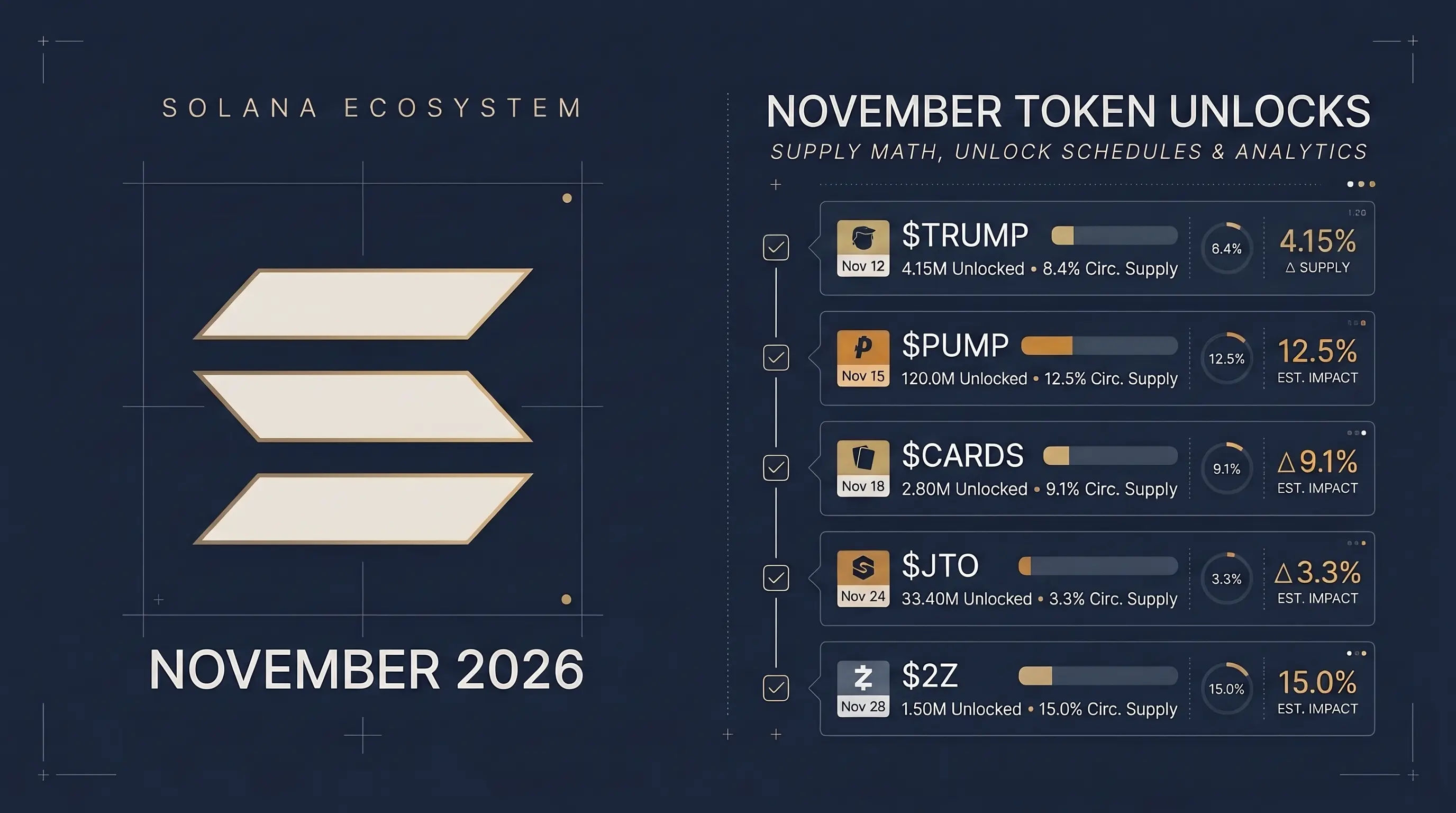
Solana token unlocks in November 2026 are heavy. $TRUMP releases about 27.12 million tokens, $PUMP releases about 6.77 billion, and $CARDS releases about 59.26 million on November 29. $JTO and $2Z continue linear vesting, and Jito’s emissions are close to their scheduled end.
An unlock is not automatically bearish. It is a scheduled increase in tradeable supply, and its effect depends on how large it is relative to circulating supply, who receives the tokens, and whether the market has already priced it in.
This article breaks down the November schedule and explains how to read an unlock without guessing at price direction.
This article is for informational purposes only and is not financial, legal, or investment advice. Not financial advice. DYOR.
Key takeaways
-
November’s largest unlocks by dollar value are $TRUMP, $PUMP, and $CARDS, according to SolanaFloor’s schedule.
-
$TRUMP’s release equals roughly 9.62% of circulating supply, the biggest relative supply increase on the list.
-
$CARDS unlocks about 6.69% of circulating supply on November 29, a single-day event rather than a stream.
-
$JTO adds about 3.34% of circulating supply and is nearing the end of scheduled emissions.
-
$2Z is in its first month of linear vesting after October’s large cliff release.
-
Unlock size matters less than recipient behavior and existing liquidity depth.
What is a token unlock?
A token unlock is a scheduled release of previously restricted tokens into transferable supply. The tokens already exist on-chain; the unlock removes a vesting-contract or program restriction on moving them.
An unlock does not create sell pressure by itself. Tokens affect price only when someone sells them. The useful way to think about an unlock is as an increase in potential supply, plus a test of whether the market can absorb it.
The Solana token unlocks scheduled for November 2026
Unlock trackers group events differently, so the table below follows one consistent snapshot: SolanaFloor’s November 2026 schedule, published with dollar values calculated at the time of writing. Prices move, so the dollar column is a reference point, not a fixed figure.
| Token | Unlock type | Tokens released | Value at snapshot | Change to circulating supply | What it means |
|---|---|---|---|---|---|
| $TRUMP | Linear vesting | 27.12 million | About $44.5 million | +9.62% | Largest release by both dollar value and relative supply |
| $PUMP | Linear vesting | 6.77 billion | About $27.7 million | +1.47% | Large in absolute terms, but small relative to float |
| $CARDS | Release on November 29 | 59.26 million | About $13.5 million | +6.69% | A one-day cliff release, rather than a gradual schedule |
| $JTO | Linear vesting | 18.02 million | About $6.6 million | +3.34% | Meaningful supply, but Jito is nearing the end of emissions |
| $2Z | Linear vesting | 133.44 million | About $3.3 million | +2.53% | A small monthly slice of a longer vesting program |
Read the percentage column first. The dollar value and the supply increase measure different things, and the second one drives market impact.
A $44 million unlock sounds large, but if it lands on a token with thin order books and a concentrated holder base, the effect can be far bigger than the headline number suggests.
What a token unlock actually changes
Token supply is usually split between circulating supply and locked supply. Locked tokens exist on-chain, but a vesting contract or a program-controlled account restricts who can move them and when.
An unlock does three things at once:
-
It increases the number of tokens that can legally be transferred.
-
It changes the denominator in market-capitalization calculations, because circulating supply rises.
-
It can change incentives, because recipients now have a choice they did not have before.
It does not create sell pressure by itself. Tokens only affect price when someone sells them. The honest way to think about an unlock is as an increase in potential supply plus a test of whether the market can absorb it.
Cliff unlocks versus linear vesting
A cliff release happens all at once. $CARDS on November 29 is the clearest example on this list.
A linear unlock releases tokens over time, usually monthly or per block. $TRUMP, $PUMP, $JTO, and $2Z all use linear schedules in November.
Linear vesting is easier for a market to absorb because the daily flow is small. Cliffs create a visible date, and visible dates attract attention, hedging, and front-running.
Neither structure is inherently better. What matters is whether the schedule was disclosed before launch and whether the project stuck to it.
Why $2Z looks calm and is not identical to the others
$2Z released 1.66 billion tokens in a cliff in October and now runs linear vesting through October 2029. November’s 133.44 million tokens are a small slice of a much larger vesting program.
That makes each month less eventful, and it also means supply will keep growing for three more years.
Where the real pressure sits
Three variables decide whether an unlock matters in practice.
Size relative to float
A 10% increase in tradeable supply is a different event from a 1% increase.
$TRUMP sits at the high end of this month’s list, while $PUMP sits at the low end.
Who receives the tokens
Team and investor allocations tend to be larger, more concentrated, and more likely to be sold for cash. Community or ecosystem distributions behave differently, especially when they carry conditions.
Liquidity depth
If a token trades $200,000 a day, a $13 million unlock cannot be absorbed without moving the price. If it trades $50 million a day, the same unlock is background noise.
This is why unlock calendars should always be read next to volume data.
What $JTO’s schedule tells you about maturity
Jito is approaching the end of scheduled emissions, with November and December the last meaningful months on the calendar.
A project that finishes emissions removes a recurring overhang. That is structurally different from a project that keeps adding supply every month for years.
Ending emissions is not a bullish signal on its own. It simply means one source of new supply is closing, while demand, revenue, and token utility still have to do the rest.
How to read an unlock without overreacting
A practical sequence:
-
Check the percentage of circulating supply, not just the dollar value.
-
Check the recipient category. Team, investor, treasury, and community allocations behave differently.
-
Check average daily volume over 30 days. Compare the unlock size to it.
-
Check whether the schedule was published before launch and whether past unlocks matched it.
-
Check whether tokens are sent to exchanges or held in self-custody wallets after release.
-
Check the broader market. Unlocks land in whatever conditions exist that week, and a risk-off market absorbs supply worse.
Exchange inflows are the most direct signal, and they are also the easiest to misread. A deposit can be a sale, a market-making transfer, a custody move, or a collateral posting. On-chain data shows movement, not intent.
Before acting on any token, verify its mint address, authorities, and on-chain details. Solsmint’s rug-check tool can help users verify a token’s details on-chain.
What creators should take from this schedule
If you are designing a token now, the November calendar is a useful set of case studies. The projects that handle unlocks well tend to share a few habits.
-
Publish the schedule before launch. A vesting table in the documentation is worth more than a promise in a chat.
-
Use a vesting contract, not a treasury wallet with good intentions. A program-controlled release is verifiable by anyone.
-
Match the schedule to liquidity plans. A 20% unlock against a shallow pool is a design mistake, not bad luck.
-
Decide the mint-authority question early. If supply can be increased outside the published schedule, the schedule means little.
-
Avoid surprise mints. One unexplained supply increase does more damage than a year of scheduled unlocks.
-
Communicate before, not after. Announce the date, the size, and the recipient category in advance.
Most of this is about the same thing: making supply predictable. Buyers can price a known schedule. They cannot price a surprise.
Solsmint’s explainer on mint, freeze, and update authorities covers who can change supply after launch. If you plan to add supply later, read the guide on minting more tokens on Solana before you publish a vesting table.
Common mistakes
Treating every unlock as a sell event
Most linear unlocks are absorbed quietly. The loud ones usually combine a large relative size with thin liquidity and weak demand.
Ignoring the float
A token with a $500 million fully diluted valuation and a $40 million market cap carries a very different supply risk from one where the two numbers are close.
Assuming locked tokens are unsellable
Some vesting arrangements allow borrowing against locked tokens or early sale at a discount. The on-chain lock does not always mean the economic exposure is frozen.
Reading one tracker as gospel
Aggregators sometimes use different definitions of circulating supply and different valuation dates. Cross-check against the project’s own documentation.
What we still don’t know
Unlock calendars describe eligibility, not behavior. We do not know how recipients will treat November’s releases, whether any sales are pre-arranged over the counter, or how much supply is already hedged off-chain.
Exchange-flow data lags and mixes purposes. Dollar values in the table above move with price. Third-party trackers can also differ on what counts as circulating supply, which changes every percentage on the list.
Whether the market has already priced these events is unknowable in advance. Unlocks are scheduled information, and scheduled information tends to be anticipated, but anticipation is not the same as absorption.
FAQ: Solana token unlocks in November 2026
What is a token unlock?
A token unlock is a scheduled release of previously restricted tokens into transferable supply. The tokens already exist on-chain; the unlock removes the contract or program restriction on moving them.
Which November unlock is the largest?
By dollar value, $TRUMP is the largest at roughly $44.5 million at the time of the snapshot. By percentage of circulating supply, $TRUMP is also the largest at about 9.62%.
Do unlocks always push prices down?
No. Price depends on how much of the released supply is sold and how deep the market is. Many unlocks pass without a visible move.
Is a linear unlock better than a cliff?
Linear schedules are easier for a market to absorb because the flow is spread out. Cliffs are simpler to track and easier for a project to communicate, but they concentrate risk on one date.
Why does $JTO matter this month?
Jito is close to the end of scheduled emissions, so November and December are the last meaningful months of recurring supply increases from that program.
How do I check a token’s unlock schedule?
Start with the project’s own documentation, then compare it with an unlock tracker. Verify whether supply is controlled by a vesting contract or a wallet with mint authority.
Can I create a token with a vesting schedule?
You can create the token and lock supply in a vesting contract. Solsmint handles token creation, minting, and metadata; vesting and locks are configured separately.
Bottom line
November’s Solana unlocks are a supply story, not a price forecast. $TRUMP and $CARDS carry the largest relative increases, $PUMP is large in absolute terms but small against its float, and $JTO is closing out its emissions schedule.
The useful habit is to read percentage of float, recipient category, and liquidity depth together. If you are building a token, apply the same standard to your own schedule before anyone else does it for you.
Continue reading
-
Understand mint and freeze authorities before trusting a supply schedule.
-
Learn what an SPL token is before launching or transferring tokens on Solana.
-
See how to mint more supply later without breaking your published tokenomics.
-
Learn how liquidity depth absorbs new supply after an unlock.
-
Ready to build? Create a Solana token without code using Solsmint.
Disclaimer: This article is for information and education only and is not financial, investment, or tax advice. Crypto assets are volatile and you can lose money. Always verify token authorities and contract details yourself before interacting with any asset.
Ready to create your own token?
Launch an SPL token on Solana in minutes. No code, 0.05 SOL total, metadata and authorities handled for you.

Amir Ali
Founder of Solsmint | Solana Ecosystem Builder | Crypto & Web3 Enthusiast
Amir Ali is the founder of Solsmint, a Solana-based platform focused on making token launches and on-chain tools more accessible. He writes about Solana, crypto, memecoins, blockchain technology, and the evolving Web3 ecosystem.
Through Solsmint, Amir aims to simplify token creation and liquidity management by building practical, affordable tools for creators, developers, and crypto communities. His work focuses on making blockchain technology easier to use and helping builders turn their ideas into reality.
Follow Amir and explore his work at Solsmint.com.