Solana 1.0: What Dropping the Mainnet Beta Label Changes
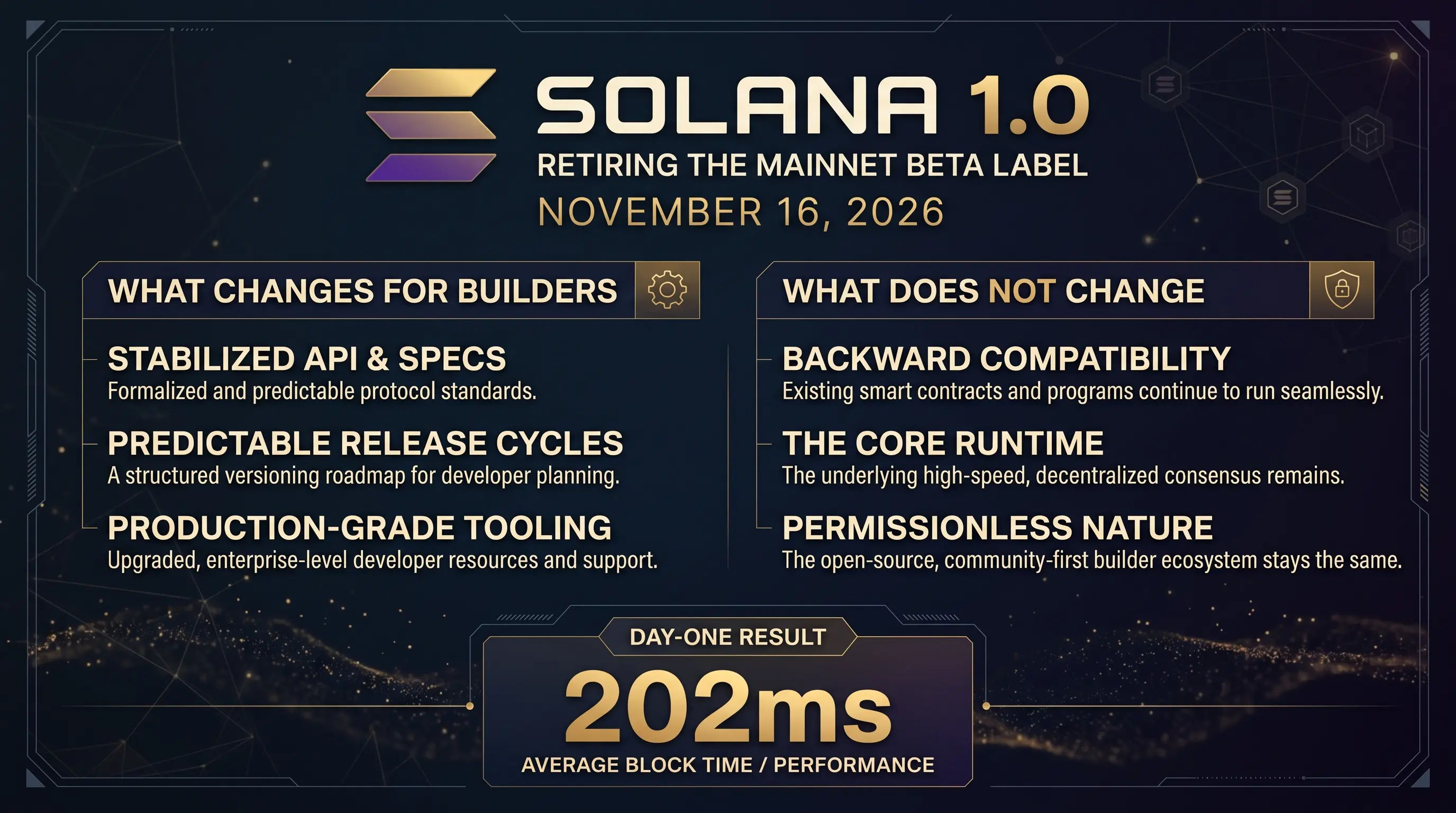
Solana retired the mainnet beta label on 16 November 2026 and introduced Solana 1.0. What the protocol version actually separates, what stays the same, and why day-one finality came in at 202 milliseconds.
Not financial advice. Solsmint publishes educational content about crypto assets. Prices are volatile, and nothing here is a recommendation to buy, sell, or invest. Verify every contract, authority, and fee yourself before you transact.
Last updated: November 20, 2026
On November 16, 2026, the Solana Foundation retired the "mainnet beta" label the network had carried since it launched in 2020 and introduced Solana 1.0. The announcement came on the first day of Breakpoint at Olympia London, in front of a room that had spent the previous year being told about 150-millisecond finality and a second validator client.
The label change is the least dramatic part of the story. Nothing about balances, accounts, applications, or transaction history changes, and users do not need to do anything. What changes is how the network describes itself, and how developers track what is actually live.
This article is for informational purposes only and is not financial, legal, or investment advice. Not financial advice. DYOR.
Key takeaways
- Solana 1.0 is a protocol version, not a breaking upgrade. It separates the network's version from the version numbers of validator clients such as Agave and Firedancer.
- Existing SOL balances, token accounts, applications, and transaction history are unaffected, and holders do not need to migrate or claim anything.
- The announcement followed mainnet activation of Alpenglow, which targets roughly 150 milliseconds to finality, and the deployment of Firedancer as an independent validator client.
- The Foundation's own dashboard showed observed finality of 202 milliseconds on day one, about 35% above the 150-millisecond target.
- Announcing a version does not activate features. Upgrades still ship and switch on according to their own release schedules.
- SOL traded roughly 7% higher across the Breakpoint week but remained near $72, well below its late-October level.
What Solana 1.0 actually is
Solana has run as a live production network for six years, processing real payments, real trading volume, and real outages. The "beta" in its name was a description of the software's maturity, not of the chain's status. Retiring the Solana mainnet beta label is an admission that it had outlived its usefulness.
The more useful change is structural. Until now, the ecosystem described network progress using client release numbers. Agave and Firedancer are separate codebases with separate version numbers and separate release schedules, so "which version are we on" had more than one answer depending on who was asked.
Solana 1.0 introduces a single protocol version that sits above both. A Solana protocol version says which features the network has activated. A client version says which software a validator or RPC operator is running. Both matter, and they are no longer the same number.
The Foundation coordinated the rollout with the Anza and Firedancer teams. Documentation, websites, and block explorers will adopt the new designation progressively, which means you will see "Solana" and "Solana Mainnet Beta" side by side for a while.
What changed for users, and what did not
For anyone holding SOL or an SPL token, the answer is nothing. The Foundation says balances, accounts, assets, applications, and transaction history all stay as they are. There is no migration, no snapshot, no claim, and no new token.
For application developers, the practical work is reviewing the APIs, SDKs, and infrastructure their products depend on. The Solana Changelog tracks those changes weekly, and it was already the place to look before this announcement.
For validator and RPC operators, the work is checking which client releases support each protocol rollout and following the Agave or Firedancer upgrade instructions. Operators who have kept up with Alpenglow and Firedancer have little to do. Operators who have not were already behind.
The two upgrades behind the version
The Foundation pointed to two milestones as the reason for the label change. Both are worth understanding on their own terms.
Alpenglow and 150-millisecond finality
Alpenglow replaces the voting and consensus mechanism validators use to agree on blocks, and it targets finality of roughly 150 milliseconds, down from about 12.8 seconds. Finality is the point at which a transaction is treated as settled rather than merely included.
The upgrade was scheduled for October 21, 2026, and went to mainnet with 20.3% of stake flagged as unprepared a day before activation. Day-one results were mixed in the way that first days usually are: the Foundation's dashboard showed observed finality of 202 milliseconds, about 35% above the target. Sustained performance across congested markets is the number that matters, and that number takes months to accumulate.
Firedancer as a second client
Firedancer is a validator client written independently of Agave. Running two implementations reduces reliance on a single codebase, limits the damage a bug can do when it hits only one client, and puts competitive pressure on performance work. Its hybrid predecessor, Frankendancer, had run on mainnet since 2024 and reached roughly a fifth of staked SOL by early 2026.
What the Foundation was careful to say
The announcement included a caveat that is easy to miss and important to repeat: declaring a version does not switch on every related improvement at once. Software releases and feature activations keep their own timelines.
In practice that means "Solana 1.0" is not a day on which the network becomes faster, cheaper, or more reliable. It is a naming convention that makes it easier to say what is live and what is pending. A token creator will see no change in fees or confirmation times because of the version number alone.
How the market read it
SOL finished the Breakpoint week roughly 7% higher, which sounds like a vote of confidence until you put it next to the rest of November. The token opened around $102 on October 29, fell to a four-month low of $67.41 on November 15, and was trading near $72 when the 1.0 announcement was a day old.
Spot SOL ETFs had recorded six straight weeks of outflows over the same stretch, and price sat below its 50-, 100-, and 200-day moving averages. A 7% bounce from an oversold low is not a trend change. It is what a relief rally looks like when the daily RSI is in the mid-twenties.
The bigger institutional news arrived alongside the label change rather than because of it. DTCC has committed to tokenising Russell 1000 stocks, index ETFs, and Treasuries on Solana in the second half of 2027. Intercontinental Exchange, which owns the NYSE, said its planned tokenised trading venue can already accept Solana-minted tokens and is weighing whether to run a validator. Bitwise published a five-year model with a base case of $385 and a bull case of $1,100 by 2031, both of which depend on how much global equity trading moves on-chain.
What it means if you create tokens on Solana
Almost nothing changes mechanically. Minting an SPL token, revoking a mint authority, adding liquidity, or running an airdrop works exactly as it did on November 15. The mint you deploy is still an SPL token or a Token-2022 token, and the tooling that reads it has not changed.
Two small things are worth knowing. First, documentation and explorer labels will lag, so a tutorial that says "mainnet beta" is describing the same network you are using. Second, expect the version split to appear in release notes you rely on: a client update is not the same as a protocol upgrade, and a changelog entry that only bumps a client version may not change anything you can observe.
The credible read is that Solana 1.0 is a communication milestone with a real engineering story behind it. It removes an excuse institutions used to raise in diligence, and it gives developers a cleaner vocabulary for upgrades. It does not make a token more likely to succeed, and it does not fix fees, liquidity, or distribution.
What we still don’t know
Sustained finality under load is unproven. Day-one numbers were collected on a network that had just changed its consensus mechanism, and the meaningful test is a period of heavy trading, not a quiet Tuesday. The Foundation has published a target; it has not published a durable average.
Firedancer's share of stake will decide how much resilience the second client actually adds. A client that runs a fifth of validators diversifies risk. A client that runs half of them concentrates it in a different way, and nobody has said publicly where the comfortable range sits.
It is also unclear how quickly the ecosystem retires the old label, and whether the version split confuses more people than it helps during the transition. Confusing documentation is a real cost, even when the underlying change is sound.
And the market question is open. A version number is not a catalyst on its own. Whether 1.0 marks the start of a re-rating depends on the tokenisation pipeline delivering in 2027, which is a long way from a stage announcement in London.
FAQ: Solana 1.0 and the mainnet beta label
What is Solana 1.0?
Solana 1.0 is a protocol version introduced on November 16, 2026, that replaces the "mainnet beta" designation the network had used since 2020. It sits above the individual version numbers of validator clients such as Agave and Firedancer.
Do I need to do anything as a SOL holder?
No. Balances, token accounts, applications, and transaction history are unchanged. There is no migration, snapshot, or claim.
Does Solana 1.0 make transactions faster or cheaper?
Not by itself. Performance gains come from upgrades such as Alpenglow, and the version number is a way of tracking which of those upgrades are live.
What is the difference between a protocol version and a client version?
A protocol version describes which features the network has activated. A client version describes the software a validator or RPC node is running. Agave and Firedancer are separate clients with separate releases.
Is "mainnet beta" gone from explorers yet?
Not entirely. Documentation, websites, and explorers are adopting the new designation progressively, so both labels will appear for a while.
What is Alpenglow?
Alpenglow is the consensus upgrade that targets finality of roughly 150 milliseconds instead of about 12.8 seconds. It activated on mainnet on October 21, 2026.
Did Solana's price rise because of the announcement?
SOL was up roughly 7% across the Breakpoint week, but it was also bouncing from a four-month low after a 30% slide from late October. One week of price action does not separate the announcement from the wider market move.
Does Solana 1.0 change how tokens are created?
No. SPL and Token-2022 tokens are created, minted, burned, and distributed exactly as before. The tools and account model are unchanged.
Continue reading
- Read what Alpenglow’s 150-millisecond finality means for meme coins and token creators, the upgrade that made the 1.0 announcement possible.
- Catch up on Solana ETF inflows, record transactions, and ecosystem upgrades from earlier in 2026.
- See how institutional payments are landing on Solana through Visa, Formation, and stablecoin card spending.
- Ready to build? Create a Solana token without code using Solsmint.
Disclaimer: This article is for information and education only and is not financial, investment, or tax advice. Crypto assets are volatile and you can lose money. Always verify token authorities and contract details yourself before interacting with any asset.
Ready to create your own token?
Launch an SPL token on Solana in minutes. No code, 0.05 SOL total, metadata and authorities handled for you.

Amir Ali
Founder of Solsmint | Solana Ecosystem Builder | Crypto & Web3 Enthusiast
Amir Ali is the founder of Solsmint, a Solana-based platform focused on making token launches and on-chain tools more accessible. He writes about Solana, crypto, memecoins, blockchain technology, and the evolving Web3 ecosystem.
Through Solsmint, Amir aims to simplify token creation and liquidity management by building practical, affordable tools for creators, developers, and crypto communities. His work focuses on making blockchain technology easier to use and helping builders turn their ideas into reality.
Follow Amir and explore his work at Solsmint.com.
Last updated: