Solana Memecoin Surge: Why No‑Code Creators Are Winning in 2026
June 2026 saw a massive memecoin surge on Solana. This article explains the Solana memecoin surge, why no-code tools are powering creators, and how to launch quickly and cheaply.
Not financial advice. Solsmint publishes educational content about crypto assets. Prices are volatile, and nothing here is a recommendation to buy, sell, or invest. Verify every contract, authority, and fee yourself before you transact.
Solana Memecoin Surge: Why No‑Code Creators Are Winning in 2026
INTRODUCTION
June 2026 saw a striking spike in activity on Solana driven by memecoins, AI tokens, and no-code creator tools. The solana memecoin surge made headlines as tens of thousands of low-cost tokens launched daily, shifting how creators approach token launches.
In this article you’ll learn what caused the surge, why no-code token makers are benefiting, and a clear, actionable path to launching your own memecoin on Solana. This is practical, step-by-step guidance for creators and collectors alike.
Disclaimer: This article is for informational purposes only and does not constitute financial or investment advice. Always do your own research (DYOR) before making any financial decisions.
WHAT IS THE SOLANA MEMECOIN SURGE?
The solana memecoin surge describes the sudden increase in memecoin and micro-token launches on the Solana network in June 2026. Creators released large volumes of novelty tokens and AI-themed coins, often using no-code platforms to skip smart contract development.
Key characteristics:
-
High daily launches, many low market-cap memecoins.
-
Low on-chain fees and fast settlement times.
-
Integration with DeFi venues (AMMs) for liquidity provisioning.
WHY THE SURGE MATTERS
The surge matters for creators, traders, and the Solana ecosystem because it lowers barriers to entry and tests token discovery dynamics at scale. Data: Solana recorded record daily token creation and usage spikes in mid‑2026 [Solana Docs], and many newly launched tokens sought liquidity on Raydium and other AMMs [Raydium Docs].
Real-world relevance:
-
Creators can experiment cheaply, iterating tokenomics and marketing.
-
Traders gain more diverse short-term opportunities.
-
Ecosystem grows as new projects drive on-chain activity and fees.
HOW MEMECOINS ARE LAUNCHING SO FAST (NO-CODE TOOLS)
No-code platforms let non-developers create SPL tokens, mint NFTs, and perform airdrops via simple web interfaces. These tools often:
-
Pre-fill token metadata and defaults.
-
Handle minting transactions with one click.
-
Route liquidity provisioning to DEXs like Raydium.
Example: Using a no-code tool, a creator can generate an SPL token for roughly 0.05 SOL in transaction fees, set total supply controls, and configure free mint/burn and airdrops without writing Rust or deploying custom contracts [Solana Docs].
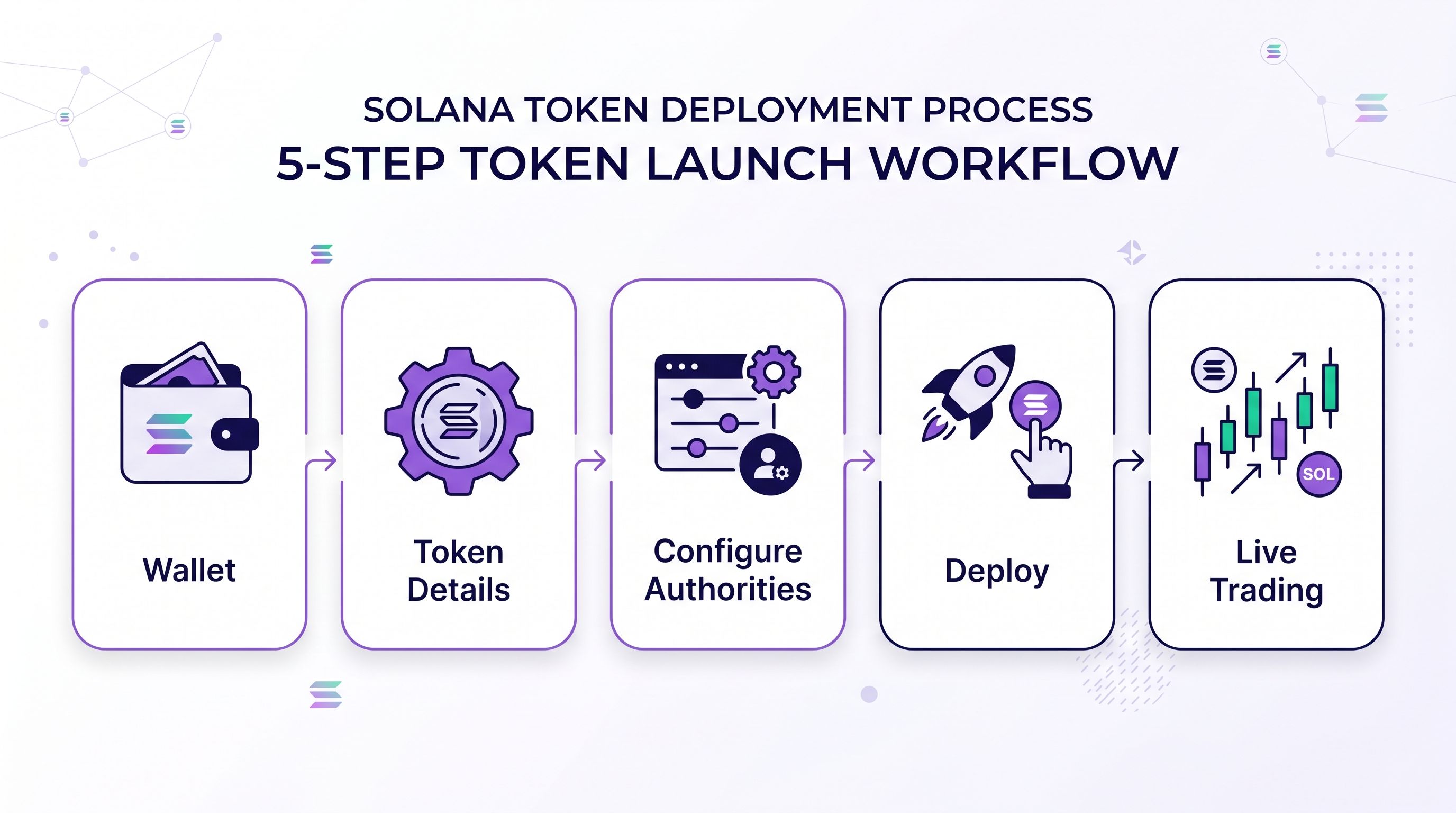
STEP-BY-STEP: LAUNCH A MEMECOIN ON SOLANA
Follow these steps to launch a memecoin quickly. Replace placeholders with your project details.
-
Define token purpose and supply. Choose a name, symbol, total supply, and distribution plan.
-
Prepare assets and branding. Create a logo, short description, and social links.
-
Choose a wallet. Use a Solana-compatible wallet (Phantom, Solflare) and secure your seed phrase.
-
Use a no-code token creator. Select a trusted platform to create your SPL token (confirm fees and routing before proceeding).
-
Pay the network fee (~0.05 SOL). Confirm the transaction on your wallet.
-
Set mint/burn and airdrop permissions. Decide who can mint or burn and schedule any airdrops.
-
Add liquidity. Provide liquidity on a DEX (e.g., Raydium); no platform fee may apply depending on tool routing.
-
Announce and market. Launch social campaigns, threads, and token listings.
At minimum, follow token-safety practices: lock some liquidity, set transparent tokenomics, and document ownership/permissions.
BENEFITS AND RISKS / PROS AND CONS
Benefits
-
Low cost: transaction fees around ~0.05 SOL make experimentation cheap.
-
Speed: near-instant confirmations enable rapid launches.
-
Accessibility: no-code tools broaden participation to non-developers.
-
Liquidity integration: easy routing to AMMs like Raydium.
-
Viral potential: memecoins can gain rapid community traction.
Risks / Considerations
-
High failure rate: most memecoins have low long-term value.
-
Rug risk: anonymous creators may withdraw liquidity.
-
Regulatory scrutiny: tokens with investment-like promises can attract attention.
-
Market volatility: memecoins are extremely volatile.
-
Platform dependency: features and fee routing can change; verify on the official site.
TIPS AND BEST PRACTICES FOR CREATORS
-
Plan tokenomics: define supply, allocations, and vesting.
-
Start small: test with a low supply or small launches.
-
Use multisig for admin keys to increase trust.
-
Document everything: create a short whitepaper or GitHub with contract info.
-
Engage community early: use X threads, Discord, and Telegram.
-
List responsibly: follow DEX and CEX listing guidelines.
-
Monitor on-chain metrics: track holders, transfers, and liquidity pools.
-
Consider audits for larger projects.
At least one actionable list above is included for quick reference.
EXTERNAL CITATIONS
-
Solana technical and activity context: [Solana Docs]
-
Liquidity & AMM routing: [Raydium Docs]
-
Market metrics and token listings: [CoinGecko]
FAQ SECTION
Q: How quickly can I create a memecoin on Solana?
A: You can create a memecoin in minutes using no-code tools, typically paying a small network fee (~0.05 SOL). Follow a no-code creator flow, confirm via your wallet, and set token parameters.
Q: Is creating a memecoin on Solana expensive?
A: No — transaction fees are low; token creation often costs around ~0.05 SOL, making it affordable for experimentation. Always check current network fees before proceeding .
Q: Are Solana memecoins worth investing in?
A: Short answer: usually no for long-term value. Many memecoins are speculative and volatile; evaluate tokenomics, team, and liquidity before investing.
Q: How do no-code token makers on Solana route liquidity?
A: Many no-code tools route liquidity provisioning to AMMs like Raydium for swap access; verify routing and fees on the tool’s documentation .
Q: What precautions should creators take to avoid scams?
A: Use multisig, lock liquidity, publish transparent tokenomics, and consider audits. Communicate clearly with your community and avoid promises of guaranteed returns.
CONCLUSION & CTA
The solana memecoin surge shows how low fees and no-code tools democratize token creation, enabling creators to launch quickly and experiment. If you're building on Solana, solsmint.com makes it easy to create tokens, mint NFTs, and launch with no platform fees — starting at ~0.05 SOL. Always verify current fees and features at solsmint.com.
Continue reading
- Airdrop Tokens on Solsmint: Free Mass Drops to 400 Wallets (Network Fees Only)
- Generate NFTs on Solsmint: The Easiest Way to Mint Your NFT on Solana
- Mint More Tokens on Solsmint: Scale Your Solana Supply Free (Just Network Fees)
Key takeaways
- The Solana memecoin surge produced tens of thousands of low-cost token launches.
- No-code creators win because they launch in minutes at near-zero cost.
- Liquidity, not the launch itself, decides whether a memecoin survives.
- Most memecoins fail, so treat any spend as speculative.
- A clear community and a real use case are the only durable advantages.
How to launch a memecoin on Solana with no code
- Define the idea: name, symbol, and a story people can repeat.
- Create the token for about 0.05 SOL with a no-code creator.
- Revoke the freeze authority, and decide openly whether to cap supply.
- Create a liquidity pool so the token can be bought and sold.
- Airdrop to early supporters to seed a real community.
- Publish your supply plan so buyers can verify it.
Why no-code token creators changed the memecoin market
Before no-code tools, launching a token required a developer, a budget, and days of waiting. That friction acted as a filter. Today the filter is gone, which means volume is enormous and attention is the only scarce resource. Creators who understand distribution beat creators who only understand code.
| Dimension | Old process | No-code process |
|---|---|---|
| Time to launch | Days | Minutes |
| Cost | Developer budget | About 0.05 SOL |
| Skill required | Smart contract knowledge | None |
| Risk | Custom code bugs | Market risk only |
FAQ: Solana memecoin surge
Do most memecoins go to zero? Yes. The distribution is extremely skewed, which is why position sizing matters.
Can I still launch one in 2026? Yes. The tooling is faster and cheaper than ever, but competition for attention is far higher.
What tools do creators use? The Solana token creator for the launch, then liquidity and airdrops to build a community.
Bottom line on the memecoin surge
The surge proved that launch friction is gone and that attention is now the bottleneck. No-code creators win because they can iterate quickly, not because the technology is special. The winners are the ones who build a community and stay honest about supply.
If you want to try, do it deliberately. Start with the no-code Solana token creator, size your spend as speculative, and give holders a reason to stay beyond the first pump.
Disclaimer: This article is for information and education only and is not financial, investment, or tax advice. Crypto assets are volatile and you can lose money. Always verify token authorities and contract details yourself before interacting with any asset.
Ready to create your own token?
Launch an SPL token on Solana in minutes. No code, 0.05 SOL total, metadata and authorities handled for you.

Amir Ali
Founder of Solsmint | Solana Ecosystem Builder | Crypto & Web3 Enthusiast
Amir Ali is the founder of Solsmint, a Solana-based platform focused on making token launches and on-chain tools more accessible. He writes about Solana, crypto, memecoins, blockchain technology, and the evolving Web3 ecosystem.
Through Solsmint, Amir aims to simplify token creation and liquidity management by building practical, affordable tools for creators, developers, and crypto communities. His work focuses on making blockchain technology easier to use and helping builders turn their ideas into reality.
Follow Amir and explore his work at Solsmint.com.
Last updated: