Private Key Leaks Identified as Leading Cause of Asset Theft in Q3 2025
Private key leaks accounted for the majority of crypto thefts in Q3 2025. Discover how these leaks occur, real cases, and security measures to protect your assets.
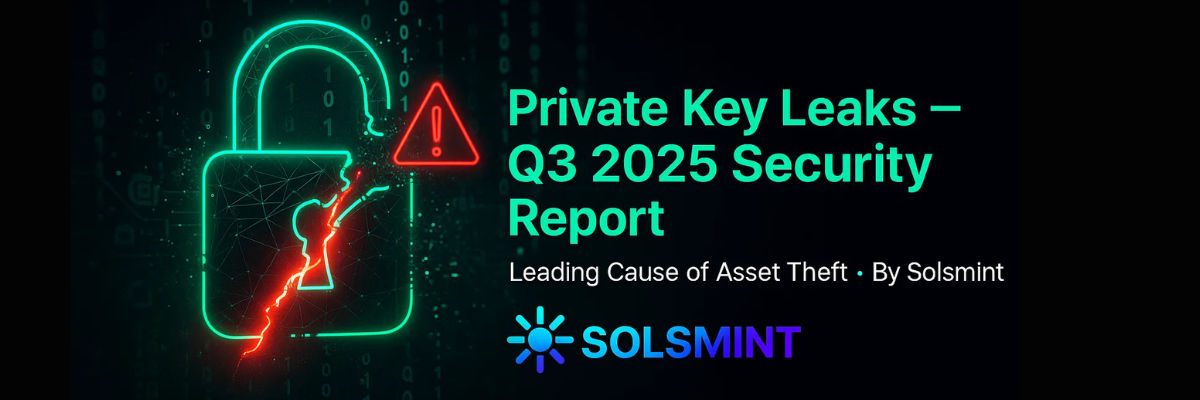
Private Key Leaks Dominate Crypto Theft Trends in Q3 2025
Recent reports confirm what many in the crypto world feared: private key leaks have become the primary cause of asset theft in Q3 2025. According to an analysis by security platforms (such as MistTrack via Binance) Binance, among the various attack vectors tracked in Q3, compromised private keys overtook exploits, phishing, and protocol-level hacks in frequency.
This trend sends a clear signal: wallet security and key management must be elevated as top priorities for any crypto project or token holder.
The Scale of the Problem
-
In Q3 2025, MistTrack recorded 317 theft reports, with private key leaks being the leading method.
-
In 2024, infrastructure attacks—largely due to key or seed phrase compromises—accounted for nearly 70% of stolen funds in crypto hacks.
-
As of mid-2025, over $2.17B had already been stolen from crypto services — with a growing share attributed to personal wallet compromises.
These figures illustrate how attackers increasingly target the weakest link: the private key.
How Private Key Leaks Occur
Phishing & Social Engineering
Attackers trick users into entering their private keys into fake websites or chatbots masquerading as support. Phishing remains one of the most common vectors.
Poor Storage Practices
Many victims store private keys or seed phrases insecurely—like in notes apps, cloud storage, screenshots, or unencrypted files. When devices are compromised, attackers can retrieve these credentials.
Malware & Keyloggers
Malware, including trojans and stealth keyloggers, can monitor keystrokes and capture wallet input. Browser-based wallet extension vulnerabilities also play a role.
Insider / Accidental Exposure
Sometimes private keys are leaked by insiders or inadvertently exposed through shared access or backups.
Real-World Impact & Notable Cases
-
The ByBit hack of 2025 saw attackers exploit private key vulnerabilities — part of a massive theft of ~$1.5B.
- In earlier quarters, security analysis frequently cited private key leaks as the top cause of asset loss.
When private keys are compromised, thieves often move assets through mixers, tumblers, or bridge networks to conceal tracks.
Why This Matters for Token Creators & Holders
For anyone creating tokens (especially on platforms like Solana or via no-code tools like solsmint), or holding crypto assets, this trend is a red warning. If your private key leaks:
-
Attackers gain full access to your tokens.
-
Any minted or staked tokens might be immediately drained.
-
You lose control over mint authority, freeze authority, or supply adjustments.
-
Damage to reputation and community trust.
Strong key security must be baked into every project’s design.
Best Practices to Prevent Private Key Leaks
Use Hardware Wallets
Store private keys on devices like Ledger or Trezor to reduce exposure.
Cold / Air-Gapped Storage
Keep keys offline in secure environments. Avoid storing seeds on internet-connected devices.
Multi-Signature & Vaults
Use multi-sig schemes or smart contract vaults so that one leaked key is less catastrophic.
Encrypt Backups
If you must backup keys digitally, always encrypt and store offline.
Vigilant Phishing Protection
Never input private keys into unfamiliar sites. Use verified official channels only.
Monitor & Rotate Keys
If you suspect leakage, rotate keys and revoke key access promptly.
Use Projects with Safety Features
Platforms like solsmint should support token-level security: freeze authority, mint limits, and role-based permissions.
How solsmint Can Fit Into the Solution
-
When you create token at solsmint, your key material remains local and under your control.
-
Use separate minting keys or freeze authority distinct from your main wallet.
-
Encourage users to adopt key best practices while interacting with solsmint-powered tokens.
Looking Ahead — Q4 2025 and Beyond
As crypto matures, security is becoming the battleground. Private key leaks will likely remain among top threats. Projects that design for security, educate users, and adopt layered protection will survive — while others risk catastrophic losses.
Final Thoughts
The rise of private key leaks as the leading cause of crypto theft in Q3 2025 is a wake-up call. As the cryptocurrency landscape evolves, your private key is your vault — and if that vault cracks, everything within is at risk.
Don't wait for a breach. Strengthen your key management today.
Continue reading
- Big Banks Strike Deal to Move to Solana Blockchain
- SOL Institutional Holdings: Total Holdings at 11.739M SOL, 2.04% of Current Total Supply
- Solana (SOL) Price News: Outperforms BTC, Poised to Follow Ether’s 200% Rally
Key takeaways
- Private key leaks overtook exploits and protocol hacks as the leading cause of crypto theft in Q3 2025.
- Phishing, insecure storage, and malware keyloggers are the main attack vectors.
- Over $2.17B was stolen from crypto services by mid-2025, with personal wallets an increasing share.
- Hardware wallets and key isolation prevent the majority of these losses.
- Transparent token design reduces the trust burden on individual users.
How private key leaks happen in practice
A private key is the entire account. Whoever holds it controls the funds, and there is no chargeback, no support line, and no recovery. That asymmetry is exactly what attackers exploit, and it explains why key compromise now outranks smart-contract exploits in reported theft.
Wallet security practices that actually work
- Use a hardware wallet for meaningful balances, and never type a seed phrase into a website or chat.
- Separate wallets by purpose: a hot wallet for daily activity and a cold wallet for holdings.
- Verify every URL before connecting, and bookmark the official app rather than clicking links.
- Never sign a transaction you do not understand, especially an approval that grants unlimited token spending.
- Revoke old approvals periodically so a compromised dApp cannot drain connected wallets.
Why token transparency reduces user risk on Solana
Some risk sits with the project, not the user. A token with revoked mint and freeze authority, locked liquidity, and published supply cannot be quietly manipulated, which removes a whole category of scam that relies on secrecy. Verifying those three things on a block explorer takes seconds and is the single best protection against buying a fraudulent SPL token.
| Attack vector | How it works | Prevention |
|---|---|---|
| Phishing | Fake site or support chat | Bookmark official URLs |
| Insecure storage | Keys in notes or cloud | Hardware wallet |
| Malware keyloggers | Keystrokes captured | Clean devices, no cloud keys |
| Malicious approvals | Unlimited spend permission | Review and revoke approvals |
FAQ: private key leaks and crypto asset theft
Can stolen crypto be recovered? Rarely. Prevention is the only reliable strategy.
Are exchange wallets safer than self-custody? They shift the risk from you to the exchange, which is not always better.
How do creators reduce holder risk? Launch transparently with the Solana token creator and burn unneeded supply to prove your intent.
Bottom line on private key leaks
The Q3 2025 data is a reminder that blockchain security is mostly operational. The network rarely fails; users are tricked, and keys are exposed. Every measure here is simple and unglamorous, and together they defeat the overwhelming majority of real-world attacks.
Creators carry a parallel responsibility. A transparent launch with verifiable supply reduces the chances your holders become statistics. Start at the Solana token creator and make your authorities and supply public.
Disclaimer: This article is for information and education only and is not financial, investment, or tax advice. Crypto assets are volatile and you can lose money. Always verify token authorities and contract details yourself before interacting with any asset.

About Solsmint
Solsmint publishes hands-on guides about Solana, SPL tokens, DeFi, and NFTs based on direct use of the tools described. Every article names its author and dates, and corrections are reviewed after a request via our contact page. Read more about our editorial approach.
Last updated: