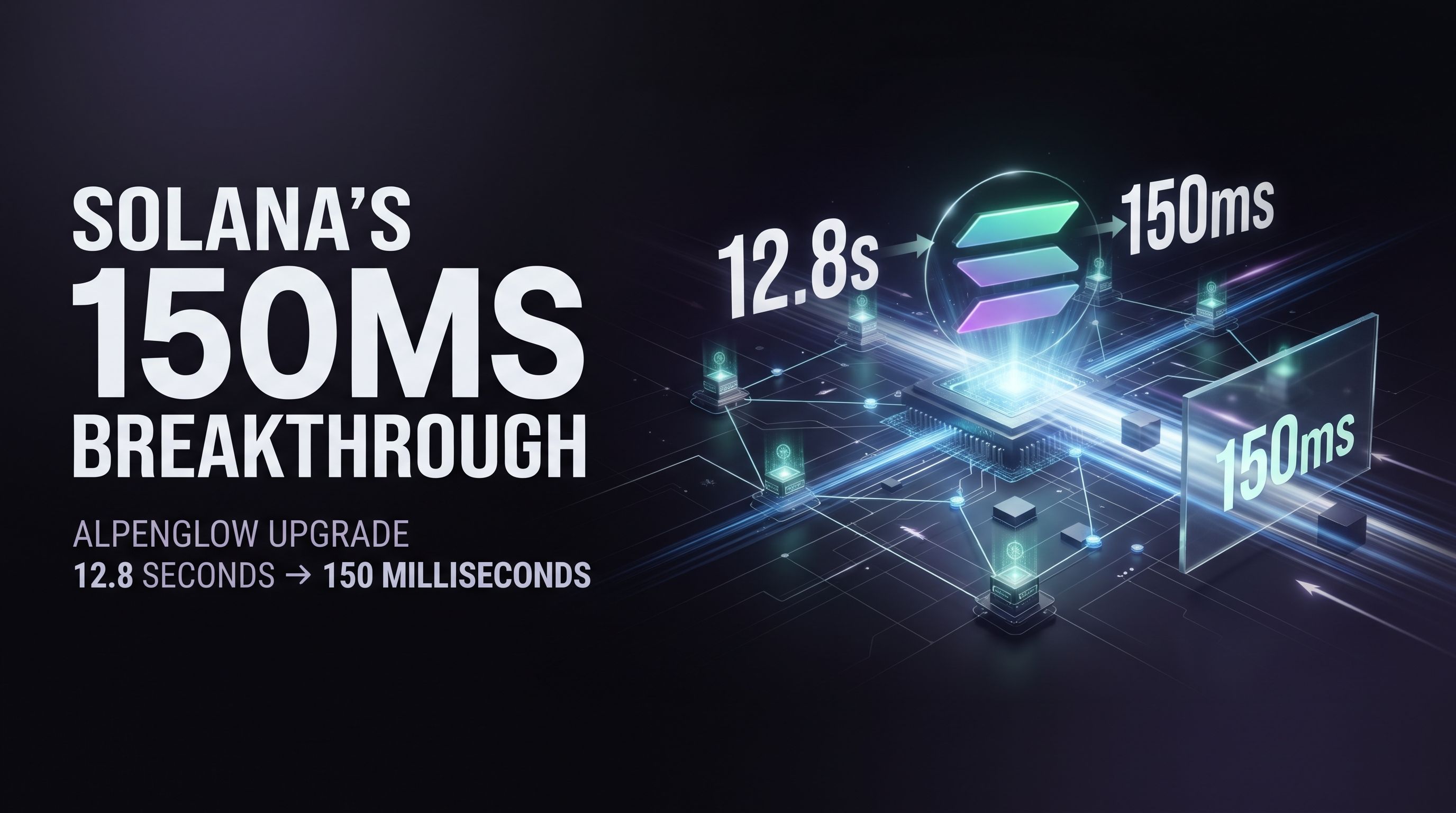
Solana Tests Alpenglow Upgrade Targeting 150-Millisecond Finality
Explain how Alpenglow could reduce Solana’s finality target from about 12.8 seconds to roughly 150 milliseconds, what the upgrade changes, and why faster settlement matters for users, developers, exchanges, bridges, and token creators.

admin
Author
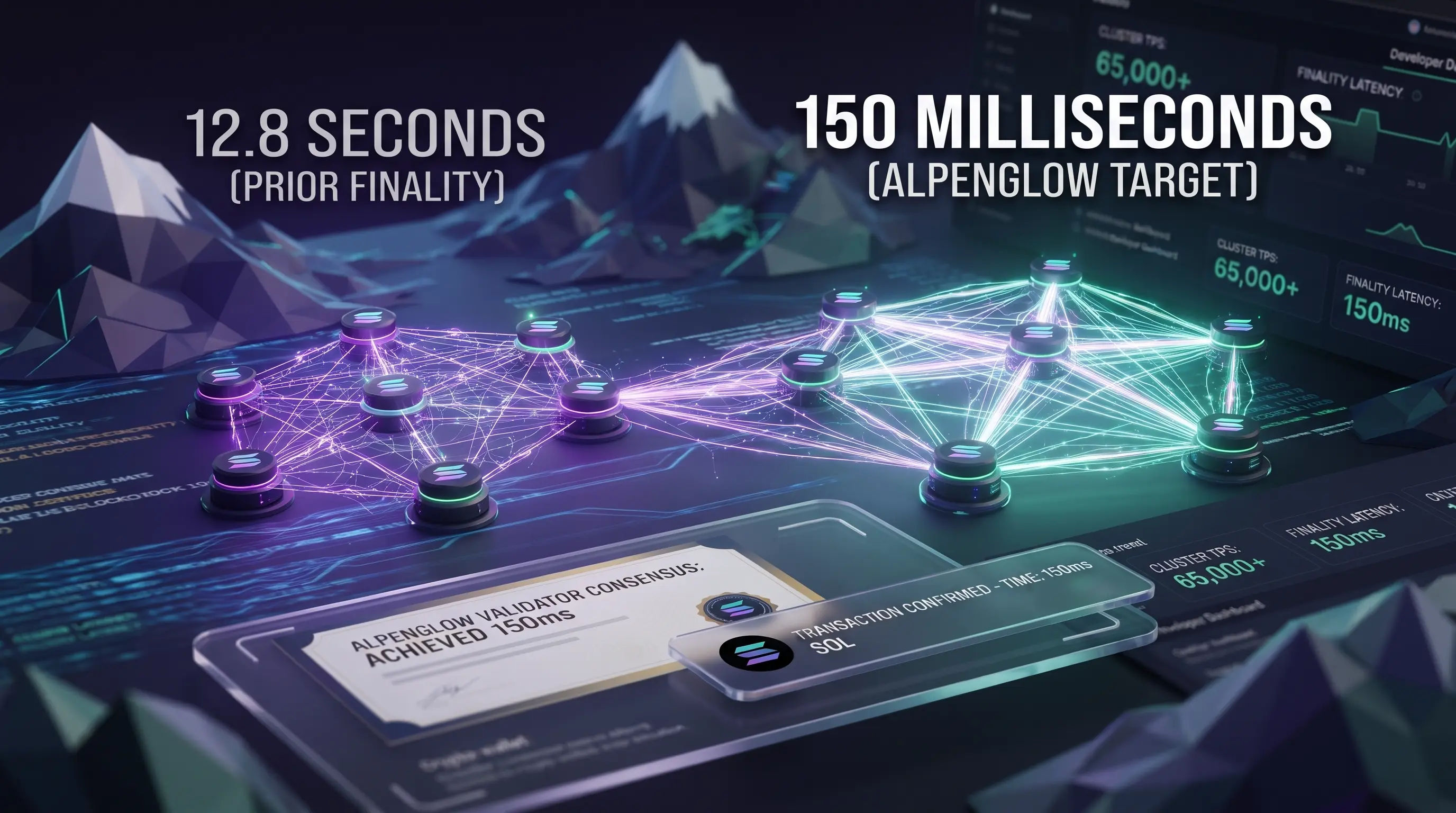
Solana has started testing Alpenglow, a major consensus upgrade designed to reduce the network’s finality target from approximately 12.8 seconds to roughly 150 milliseconds.
If successful, the upgrade could make Solana transactions feel almost immediate for exchanges, bridges, merchants, DeFi applications, and Web3 users. It could also improve the experience for developers building high-speed applications on the network.
The key point is that Alpenglow focuses primarily on consensus and finality. It is not simply a faster wallet interface or a minor performance patch. The upgrade changes how validators vote and how the network determines that a block is final.
Solana’s official upgrade documentation describes Alpenglow as a move toward approximately 150-millisecond finality while leaving the Solana Virtual Machine, transactions, programs, and fees unchanged.
Disclaimer: This article is for informational purposes only. It does not constitute financial, investment, legal, or technical advice. Always verify upgrade status through official Solana sources and conduct your own research before making decisions.
Quick Answer
What is the Solana Alpenglow upgrade?
Alpenglow is a planned Solana consensus upgrade that aims to reduce finality from approximately 12.8 seconds to roughly 150 milliseconds. Its first major component, Votor, replaces the current TowerBFT voting process with a faster validator-voting and block-finalization system
The 150-millisecond figure is a target and expectation, not a guaranteed constant for every transaction or future network condition.
What Is Transaction Finality?
Transaction finality is the point at which a blockchain transaction is considered irreversible under the network’s consensus rules.
A transaction can appear confirmed before it reaches finality. Confirmation usually means validators have recognized or voted for the transaction. Finality means the network has reached a stronger level of agreement that the block should not be reversed under normal conditions.
Confirmation vs. finality
These terms are related but not identical:
-
Submitted: The wallet sends the transaction to the network.
-
Processed: A validator receives and processes it.
-
Confirmed: The transaction is included and recognized by the network.
-
Finalized: The network reaches a stronger consensus state.
For everyday transfers, the difference may be difficult to notice. For exchanges, bridges, merchants, and financial applications, it can be extremely important.
A shorter finality window allows an application to act with greater confidence sooner.
What Is Solana Alpenglow?
Alpenglow is Solana’s next major consensus upgrade. It is designed to replace the existing TowerBFT-based finalization process with a new architecture focused on faster validator voting and block finality.
The first major component is Votor. According to Solana’s upgrade documentation, Votor replaces vote transactions with direct validator votes and aggregate finalization certificates
The upgrade targets:
-
Approximately 150-millisecond finality.
-
Faster validator coordination.
-
Simplified block-finalization logic.
-
Lower settlement latency for applications.
-
More predictable finality for high-speed use cases.
Alpenglow is not intended to change the core execution environment. Solana programs, transactions, and fees are expected to remain separate from the consensus change
From 12.8 Seconds to 150 Milliseconds
Solana’s current TowerBFT finality baseline is approximately 12.8 seconds. Alpenglow targets finality of roughly 150 milliseconds.
That represents a substantial reduction in the time applications may need to wait before treating a transaction as final.
The comparison is important, but readers should not interpret 150 milliseconds as the guaranteed time for every transaction. Actual performance can depend on validator participation, network conditions, stake distribution, hardware, propagation, and implementation status.
How Votor Works
Votor is the consensus component at the center of Alpenglow’s first rollout phase.
Instead of relying on traditional vote transactions recorded through the existing process, Votor uses direct validator votes and aggregate certificates to establish finality more efficiently.
The design uses validator stake participation to determine whether a block can be finalized in one or two voting rounds.
One-round finalization
If enough validator stake approves a block in the first round, the block can reach finality immediately.
Two-round finalization
If the first-round threshold is not reached but sufficient participation remains, a second voting round can complete the finalization process.
This structure is intended to preserve safety while reducing unnecessary waiting time.
The exact speed depends on validator participation and the distribution of stake at the time. Therefore, the 150-millisecond number should be understood as an expected target rather than a fixed guarantee.
Why Faster Finality Matters
Faster finality can improve more than transaction speed. It can change how applications design their user experience and risk systems.
Exchanges
Centralized and decentralized exchanges can reduce the time required to recognize deposits and withdrawals as settled.
Potential benefits include:
-
Faster deposit crediting.
-
Quicker withdrawals.
-
Reduced settlement uncertainty.
-
More responsive trading systems.
-
Improved capital efficiency.
Exchanges would still need their own risk controls. Faster blockchain finality does not eliminate operational, compliance, custody, or market risks.
Bridges
Bridges move assets or messages between blockchain networks. They often wait for strong confirmation before releasing funds on the destination chain.
Faster Solana finality could help bridges:
-
Detect finalized deposits sooner.
-
Reduce user waiting time.
-
Improve cross-chain application responsiveness.
-
Potentially reduce capital locked during transfers.
Bridge security remains separate from consensus speed. A faster bridge is not automatically a safer bridge.
Merchants
Merchants and payment providers need confidence that a payment will not be reversed.
If Solana reaches its finality target, payment applications could provide faster settlement experiences while reducing the time users wait for confirmation.
Businesses would still need fraud monitoring, refund procedures, compliance controls, and transaction-risk policies.
DeFi protocols
Decentralized finance applications depend on timely information and reliable settlement.
Faster finality could support:
-
More responsive swaps.
-
Faster collateral updates.
-
Quicker liquidations.
-
More efficient arbitrage.
-
Improved settlement for derivatives.
-
Lower waiting times for users.
However, DeFi protocols must still account for price-oracle delays, congestion, smart-contract risk, and liquidity conditions.
What Alpenglow Could Mean for Solana Users
For everyday users, the upgrade could make Solana transactions feel more immediate.
Potential improvements include:
-
Faster wallet feedback.
-
Quicker token transfers.
-
Reduced waiting for finalized transactions.
-
Faster NFT purchases.
-
More responsive gaming applications.
-
Smoother DeFi interactions.
The visible difference may depend on the application. Wallet interfaces, exchanges, and dApps must update their systems to take advantage of the new finality model.
A faster base layer does not automatically make every application faster. The complete user experience also depends on RPC providers, front-end design, indexing systems, wallet software, and backend infrastructure.
What Alpenglow Means for Developers
Developers may gain more flexibility when designing applications that depend on fast settlement.
Better application responsiveness
Applications can respond to finalized transactions faster, making interfaces feel more interactive.
Improved real-time experiences
Gaming, social applications, trading tools, and payment systems can benefit from shorter settlement windows.
New product possibilities
Faster finality may support applications that are difficult to build on networks with longer settlement times.
Possible examples include:
-
Real-time games.
-
High-frequency payment systems.
-
On-chain order books.
-
Instant reward systems.
-
Interactive consumer applications.
-
Machine-to-machine payments.
-
Automated agent transactions.
Less waiting in development workflows
Developers testing applications may spend less time waiting for finalization during deployment and transaction workflows.
Still, developers must update their applications carefully. They should not assume that every confirmation is final or that all infrastructure will support the new model immediately.
What Alpenglow Means for Token Creators
The upgrade could be especially relevant for creators launching Solana tokens, memecoins, NFTs, and community assets.
A faster finality target may improve:
-
Token creation workflows.
-
Airdrop processing.
-
Wallet balance updates.
-
Liquidity operations.
-
DEX interactions.
-
Community reward distribution.
-
NFT minting experiences.
For example, a token creator distributing rewards to thousands of wallets may benefit from faster confirmation and finality signals. Users could see updates sooner, while dashboards and explorers may refresh more quickly.
However, network speed is only one part of a successful token launch. Creators still need:
-
Clear token utility.
-
Transparent supply details.
-
Secure wallet management.
-
Responsible liquidity planning.
-
Accurate project information.
-
Community support.
-
Clear disclosure of admin permissions.
Faster deployment does not make a weak project valuable. It simply reduces friction in the technical workflow.
Alpenglow and Solana Memecoin Activity
Solana has become a major home for memecoins and community-driven tokens. These launches often involve fast-moving social campaigns, airdrops, liquidity pools, and rapid user activity.
If Alpenglow delivers its target, memecoin users could experience:
-
Faster token transfer finality.
-
Quicker airdrop confirmation.
-
More responsive trading interfaces.
-
Faster liquidity updates.
-
Reduced waiting during launch events.
This could improve the user experience during high-attention launches. It could also make the ecosystem more competitive for creators who want to deploy tokens quickly.
But speed can increase risk as well. Faster transactions may encourage impulsive trading, rushed launches, and inadequate project checks.
Before interacting with any token, users should review:
-
The token’s mint address.
-
Supply and authority settings.
-
Liquidity conditions.
-
Holder concentration.
-
Project ownership information.
-
Contract or token permissions.
-
Official communication channels.
Testing Status and Rollout
The CoinDesk report states that Solana has started testing the Alpenglow upgrade, with the goal of reducing finality from approximately 12.8 seconds to 150 milliseconds.
Solana’s official upgrade material says Alpenglow is on track for a later mainnet release and identifies Agave 4.3 as the expected activation release.
Upgrade timelines can change. Testing, validator adoption, security review, performance measurement, and governance or activation procedures must progress before a protocol change is considered fully deployed.
Readers should distinguish between:
-
A design target.
-
A testnet result.
-
Validator adoption.
-
Feature-gate activation.
-
Full mainnet availability.
-
Measured production performance.
The 150-millisecond figure is not a current guarantee for every Solana mainnet transaction.
What Is Not Changing?
Alpenglow focuses on consensus and finality. It is important not to confuse the upgrade with a complete redesign of every part of Solana.
According to Solana’s official documentation, the upgrade is intended to leave the following areas unchanged:
-
Solana Virtual Machine execution.
-
Existing transaction model.
-
Solana programs.
-
Core application logic.
-
Network fee structure.
This means developers may not need to rewrite every application simply because the consensus layer changes. However, infrastructure providers and application teams may still need to update clients, monitoring, transaction handling, and finality assumptions.
Alpenglow vs. Slot-Time Changes
Finality and slot time are different metrics.
-
Slot time is the interval at which the network produces or schedules block opportunities.
-
Finality is the point at which the network reaches a strong consensus that a block is settled.
Solana is also pursuing slot-time reductions in separate stages. Official Solana material distinguishes the roughly 150-millisecond Alpenglow finality target from slot-time changes that move toward shorter intervals.
A shorter slot time does not automatically mean finality occurs in the same amount of time. The two improvements can work together, but they measure different parts of network performance.
Create Your Token with Solsmint.com
If you want to create a Solana token or launch a Solana memecoin, Solsmint.com provides a simple no-code token creation workflow.
Solsmint is designed for creators who want to work with Solana-based assets without writing complex blockchain code.
How to create a Solana token
-
Visit Solsmint.com.
-
Connect a compatible Solana wallet.
-
Enter your token name and symbol.
-
Set the total supply and decimals.
-
Review available mint, burn, or management settings.
-
Confirm the token details.
-
Approve the wallet transaction.
-
Save the token mint address.
-
Distribute tokens or add liquidity when appropriate.
Solsmint supports Solana token creation, including workflows for memecoins, community tokens, NFTs, airdrops, and related Solana projects.
Token creation is available for approximately 0.05 SOL, but users should always verify the current fee and supported features on the official website before completing a transaction.
Why faster finality could help Solsmint users
If Alpenglow reaches its target, users may benefit from:
-
Faster wallet confirmation.
-
Quicker token-management updates.
-
More responsive airdrops.
-
Faster liquidity interactions.
-
Improved launch-day user experience.
The upgrade does not remove the need for careful planning. Creators should still test their settings, verify the mint address, and communicate token details clearly.
FAQ
What is Solana Alpenglow?
Solana Alpenglow is a consensus upgrade designed to reduce the network’s finality target to approximately 150 milliseconds from the current TowerBFT baseline of about 12.8 seconds.
Is Solana already finalizing every transaction in 150 milliseconds?
No. The 150-millisecond figure is an Alpenglow target and expected performance measure. It should not be treated as a guarantee for the current mainnet or every future transaction.
What is Votor?
Votor is the first major component of Alpenglow. It uses direct validator voting and aggregate finalization certificates to establish block finality more efficiently.
Will Alpenglow reduce Solana transaction fees?
The upgrade primarily targets consensus and finality. Solana’s official material describes execution, programs, transactions, and fees as separate from this consensus change.
Will developers need to rewrite Solana applications?
Not necessarily. The upgrade is designed to leave Solana’s execution environment and programs intact. However, developers may need to review client versions, infrastructure, monitoring, and finality assumptions.
How will faster finality help bridges?
Faster finality could allow bridges to recognize finalized deposits sooner and reduce user waiting times. Bridge security still depends on its own contracts, validators, verification model, and operational controls.
How can I create a Solana memecoin?
You can use a Solana token creator such as Solsmint.com. Connect your wallet, enter the token details, select the available settings, approve the transaction, and save the token mint address.
How much does it cost to create a token on Solsmint?
Solsmint token creation is available for approximately 0.05 SOL. Fees and features can change, so verify the current amount on Solsmint.com before deployment.
Conclusion
Solana’s Alpenglow upgrade could significantly change how quickly applications treat transactions as final. Its Votor component targets finality of roughly 150 milliseconds, compared with the current TowerBFT baseline of approximately 12.8 seconds.
That improvement could benefit exchanges, bridges, merchants, DeFi applications, wallets, developers, and token creators. It may also strengthen Solana’s position for high-speed use cases, including payments, gaming, memecoins, NFTs, and real-time Web3 applications.
The upgrade is still part of a testing and rollout process, so the 150-millisecond figure should be treated as a target rather than a permanent guarantee.
If you want to create a Solana token or memecoin, visit Solsmint.com and create your token with a simple no-code workflow for approximately 0.05 SOL. Always verify current fees, features, and upgrade status before proceeding.
About admin
Crypto enthusiast and blockchain analyst with expertise in the Solana ecosystem. Passionate about educating others on the potential of decentralized technologies and DeFi innovations.