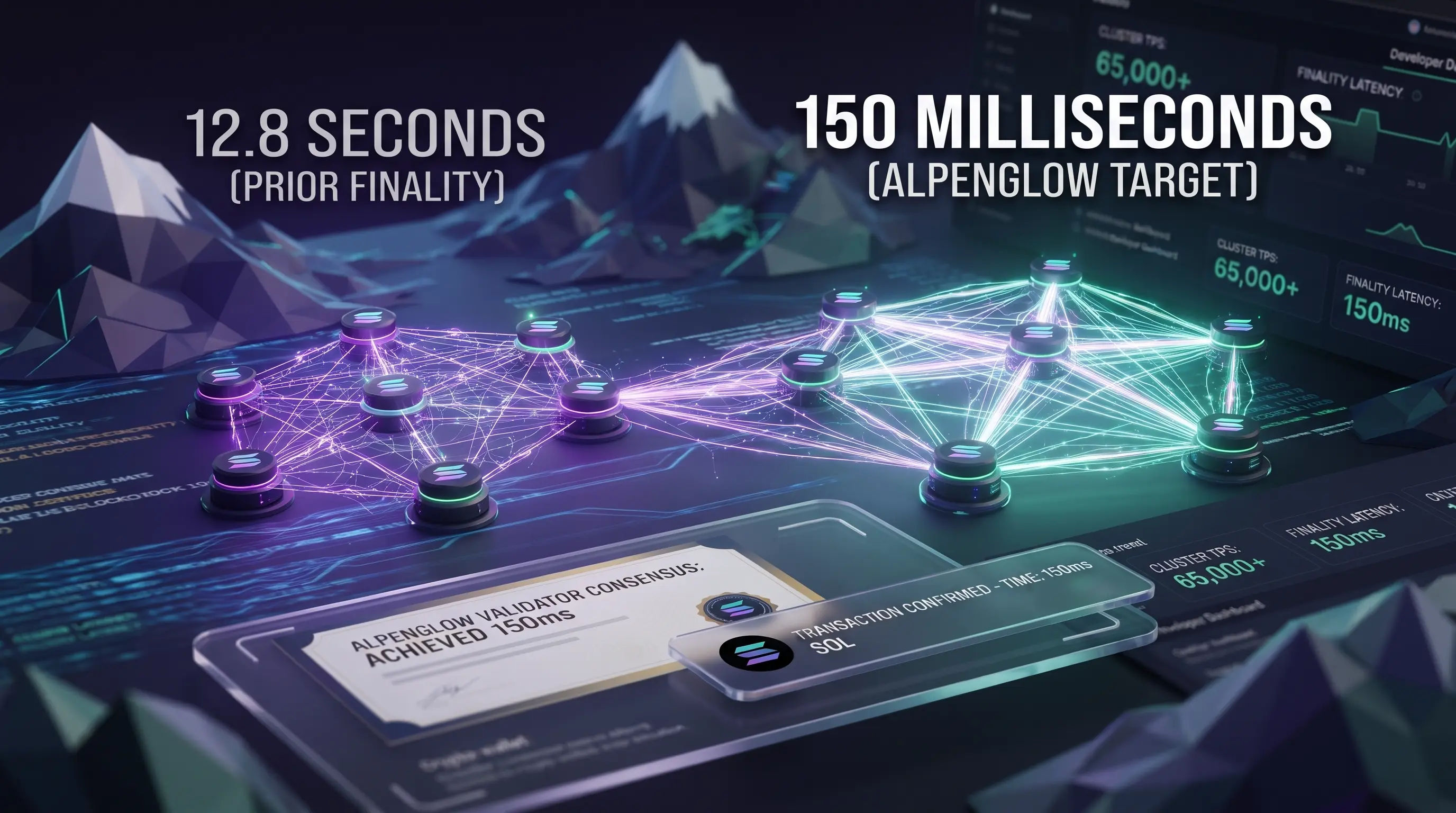
Solana Starts Testing Alpenglow Upgrade That Could Cut Finality From 12.8 Seconds to 150 Milliseconds
Solana has started testing Alpenglow, a major consensus upgrade designed to reduce transaction finality from around 12.8 seconds to approximately 150 milliseconds.

admin
Author
Solana is moving ahead with one of its biggest network upgrades yet. The blockchain has started testing Alpenglow, a new consensus system designed to dramatically reduce the time required for transactions to reach finality.
Under the current TowerBFT system, Solana finality takes around 12.8 seconds. Alpenglow is targeting finality of approximately 150 milliseconds — a major reduction that could make Solana more suitable for applications where transactions need to become irreversible almost instantly.
The upgrade is currently being tested on Solana's public test network. Developers and validators will use this stage to identify potential problems, measure performance and make sure the system is ready for a future mainnet deployment.
What Is Solana Finality?
Finality is different from simply seeing a transaction confirmed.
When a transaction becomes final, the network has reached a level of agreement that the transaction is effectively irreversible. This is particularly important for exchanges, payment companies, bridges and merchants that need stronger certainty before releasing funds or completing a transaction.
Today, Solana can show transaction confirmations much earlier, but its current consensus mechanism requires considerably more time before reaching full finality.
Alpenglow is designed to dramatically shorten that finality window.
Instead of waiting around 12.8 seconds, the target is approximately 0.15 seconds.
Alpenglow Replaces Solana's Current Consensus Design
Alpenglow is not simply a small performance update. It represents a major redesign of how Solana validators reach consensus.
The upgrade will replace the current TowerBFT consensus system with a new approach that includes Votor, allowing validators to communicate votes more directly and reach agreement with fewer rounds of voting.
The goal is to reduce the amount of time validators need to coordinate before a block can be considered final.
Importantly, Alpenglow does not change the basic way users interact with Solana. The Solana Virtual Machine, transactions, programs and fee structure remain separate from the consensus changes.
Why 150 Milliseconds Matters
A finality time of 150 milliseconds could change how businesses and applications use Solana.
For example, exchanges could potentially reduce the waiting period before crediting deposits. Blockchain bridges could settle transfers faster, while merchants could receive much quicker confirmation that a payment is final.
This could become particularly important as blockchain networks are increasingly used for stablecoin payments, tokenized assets and other financial applications.
Solana has already been working on faster slot times. Its target slot time was recently reduced from 400 milliseconds to 350 milliseconds as part of a longer-term plan toward 200-millisecond slots. However, slot time and finality are different measurements. Alpenglow specifically targets the much longer finality process.
Testing Comes Before Mainnet
The move to public testing is an important step, but it does not mean Alpenglow is already active on Solana's mainnet.
Developers still need to test the upgrade under different network conditions and make sure validators can operate it reliably.
Solana Foundation's current upgrade information lists Alpenglow as targeting roughly 150-millisecond finality, while the broader rollout is expected to happen through a future Agave release. The exact mainnet activation timing remains dependent on testing and deployment readiness.
That testing phase is especially important for a consensus upgrade because even small problems can have major consequences when thousands of validators are participating in the network.
What Could Change for Solana Users?
For everyday users, the difference may not immediately be visible in a wallet interface. Many Solana transactions already appear confirmed very quickly.
The bigger impact could come at the infrastructure level.
Faster finality could make Solana more attractive for:
- Stablecoin payments
- Crypto exchanges
- Cross-chain bridges
- DeFi applications
- Tokenized real-world assets
- Digital marketplaces
- High-frequency financial applications
- Merchant payment systems
For developers, faster finality can also make certain application designs easier because they can rely on stronger settlement guarantees much sooner.
A Bigger Upgrade for the Solana Ecosystem
Alpenglow is arriving alongside several other Solana improvements focused on speed, efficiency and scalability.
The network has been reducing slot times, working on larger transaction formats and making changes to reduce infrastructure costs. Solana has also described Alpenglow as part of its broader effort to improve the network's performance as blockchain usage expands.
The important point is that 150-millisecond finality is a target, not a guarantee that every transaction will always become final in exactly 150 milliseconds. Real-world performance can depend on network conditions, validator participation and other technical factors.
What This Could Mean for Solana Builders
For developers building on Solana, improvements at the consensus layer can create new opportunities.
A faster settlement environment can be especially useful when applications need to move assets quickly between users, exchanges or other blockchain networks. It can also make blockchain-based financial products feel closer to the speed users expect from traditional digital payment systems.
That could become increasingly relevant as more companies experiment with stablecoins, tokenized assets and on-chain financial infrastructure.
Build on Solana With Solsmint
The infrastructure behind a blockchain matters, but so does how easily builders can launch their own projects.
For creators and Web3 teams looking to launch a token on Solana, Solsmint provides a simple way to create and manage Solana tokens without needing to build the entire token infrastructure from scratch.
With Solsmint, users can create a Solana token for 0.05 SOL, with tools for minting, burning and airdrops. Liquidity can also be added directly to Raydium, while NFT creation is available with 0 platform fees.
As Solana continues improving its underlying infrastructure, tools like Solsmint can make it easier for builders to turn ideas into on-chain projects.
Final Thoughts
Solana's Alpenglow upgrade could represent a major change in how quickly the network reaches transaction finality.
Moving from approximately 12.8 seconds to a target of 150 milliseconds would dramatically shorten the time required for a transaction to become final.
But the upgrade is still going through testing, so the final real-world performance will depend on continued development, validator readiness and the eventual mainnet rollout.
If testing goes as planned, Alpenglow could give Solana another significant advantage in applications where fast and reliable settlement is critical.
About admin
Crypto enthusiast and blockchain analyst with expertise in the Solana ecosystem. Passionate about educating others on the potential of decentralized technologies and DeFi innovations.