Solana Perpetual Futures: Funding, Fees and Liquidations
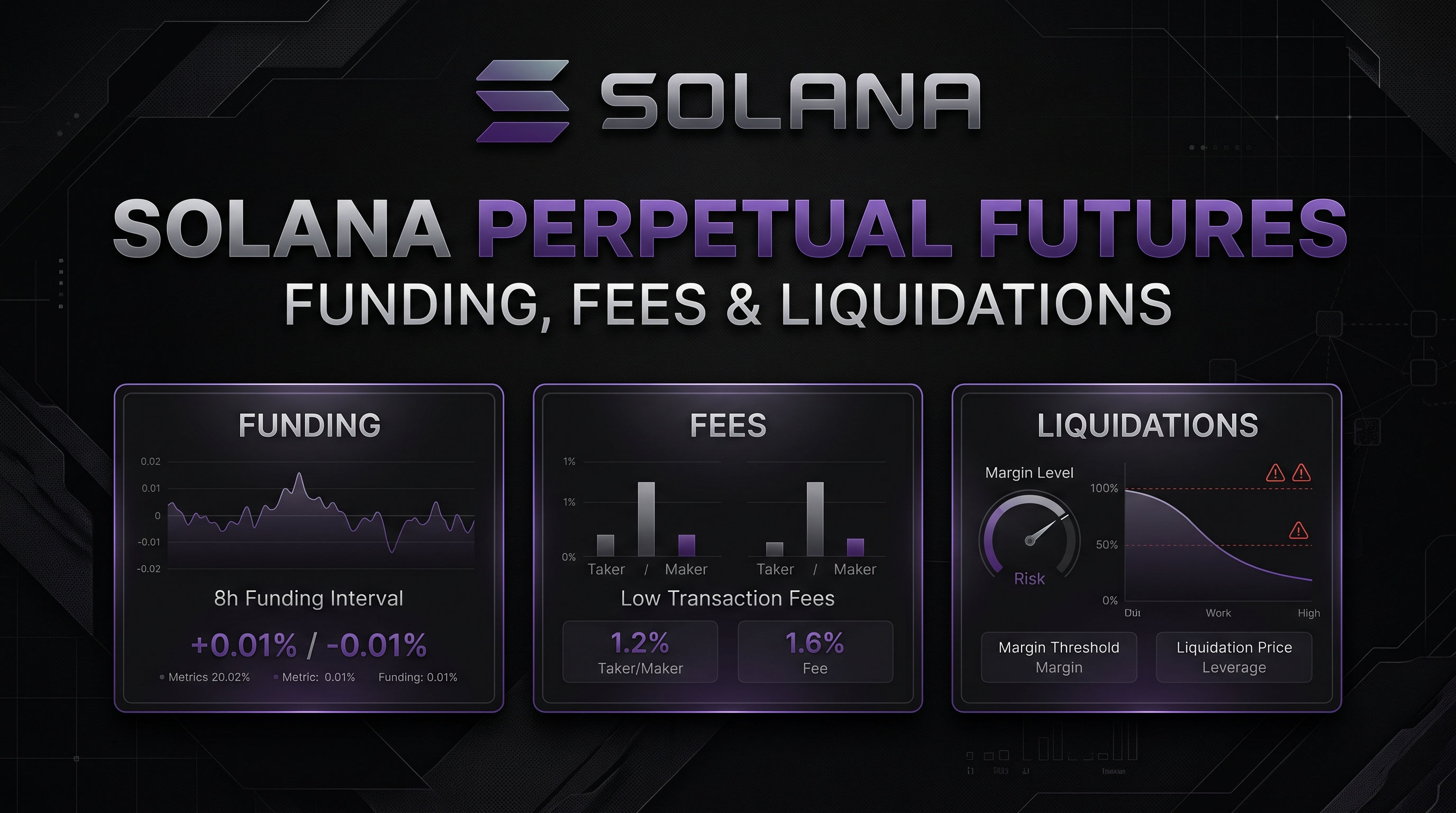
A perpetual future is a leveraged bet with no expiry date, held together by a funding or borrow fee and a liquidation engine. Here is how the mechanics work on Solana.
Not financial advice. Solsmint publishes educational content about crypto assets. Prices are volatile, and nothing here is a recommendation to buy, sell, or invest. Verify every contract, authority, and fee yourself before you transact.
Last updated: November 24, 2026
A perpetual future is a leveraged position with no expiry date. There is no settlement date to force a close and no delivery of the underlying asset, so the contract has to be held to the spot price by something else: a funding payment, a borrow fee, or both. On Solana, that mechanism and the liquidation engine decide whether a trade survives long enough to be right.
The two venues most traders meet first are Jupiter Perps and Drift. Jupiter’s main markets are priced by oracles and backed by the JLP liquidity pool; its newer Beta markets run on an orderbook with hourly funding. Drift runs a hybrid orderbook with maker rebates and a different fee profile. The labels sound similar, but the economics are not.
This guide explains how the fees work, why liquidation can take more than the loss, and which costs are easy to miss when a position looks profitable on paper.
This article is for informational purposes only and is not financial, legal, or investment advice. Not financial advice. DYOR.
Key takeaways
- A perpetual future never expires. Funding or a borrow fee ties it to spot and is charged for as long as the position stays open.
- Jupiter’s JLP markets charge a 0.06% base fee on open and close, a price-impact fee of up to 0.44%, and an hourly borrow fee on the full position size.
- On Jupiter’s JLP markets, liquidation closes the position and takes all remaining collateral after the loss and fees.
- Jupiter’s Beta markets use hourly funding between longs and shorts, a 0.75% to 1% liquidation fee, and one net position per market.
- Leverage does not change the direction of the trade, but it shortens the distance to liquidation. At 250x, a 0.4% move against you is enough before fees.
- Priority fees, price impact and rent are separate from the headline trading fee, and failed transactions can still cost SOL.
What makes a perpetual perpetual
A normal future has an expiry. As the expiry approaches, the futures price converges to spot because the contract can be settled. A perpetual has no expiry, so without a correction mechanism it could trade at a large premium or discount to spot indefinitely.
That correction is the funding rate. When the perpetual trades above spot, longs pay shorts, which makes holding a long more expensive and encourages the price back toward spot. When it trades below spot, shorts pay longs. The payment is usually charged periodically, and on Jupiter’s Beta markets it is applied every hour on the hour in UTC.
Jupiter’s JLP markets use a different mechanism. There is no peer-to-peer funding payment between longs and shorts. Instead, traders borrow assets from the JLP pool and pay an hourly borrow fee on the full position size. The fee depends on utilisation: the more of the pool that is in use, the higher the rate. That fee is revenue for the pool, not a transfer to the other side.
Both mechanisms do the same job, but they create different incentives. A funding rate can flip sign and pay you to hold a position. A borrow fee is always a cost, and it accrues against your collateral even when the price does not move.
Jupiter Perps: two markets, two rulebooks
Jupiter Perps currently runs two distinct systems, and the difference matters more than the brand name.
| Feature | JLP markets (SOL, ETH, BTC) | Beta markets |
|---|---|---|
| Pricing | Oracle price from Edge, Chainlink and Pyth | Orderbook with a mark price for margin and liquidation |
| Collateral | Longs post the underlying asset; shorts post USDC | USDC only |
| Cost to hold | Hourly borrow fee on full position size | Hourly funding paid between longs and shorts |
| Trading fee | 0.06% base fee on open and close, plus price impact up to 0.44% | Taker fee on market orders, maker fee on limit orders, no base fee |
| Liquidation | All remaining collateral is taken after the loss and fees | 0.75% to 1% liquidation fee; remaining collateral is returned |
| Positions | Up to six, one per asset per direction | One net position per market |
| Maximum leverage | Up to 250x | Varies by market, commonly 20x to 50x |
The JLP markets are the ones most people mean when they say “Jupiter Perps”. They are backed by the JLP pool, which holds the assets traders borrow and earns the fees traders pay. The Beta markets are an orderbook system powered by GUM, with a different fee model and a different liquidation rule.
The liquidation difference is not a detail. On the JLP markets, a liquidation is total: the position is closed, the loss and fees are deducted, and the remaining collateral is taken as a liquidation fee. On the Beta markets, the remaining collateral is returned after a percentage fee. The same leverage can produce very different outcomes depending on which market you used.
Funding versus borrow fees
A funding rate is a periodic payment between traders. If the rate is positive, longs pay shorts; if it is negative, shorts pay longs. The rate is usually quoted per hour or per eight hours, and the payment is calculated on the position’s notional value, not on the collateral.
A borrow fee is a payment to the liquidity provider. On Jupiter’s JLP markets it accrues continuously on the full position size and is taken from your collateral when you add to, reduce or close the position, or when you deposit or withdraw collateral. It also counts against your collateral in the liquidation price, which means your liquidation price moves closer over time even if the market does not move.
That last point is the one traders underestimate. A position held for days at high leverage can be liquidated by accumulated borrow fees alone, without any adverse price move. The effect is small at low leverage and short holding periods, and material at high leverage and long holds.
The rate itself is not fixed. On the JLP markets it depends on utilisation of the relevant custody. On Beta markets the funding rate depends on the balance of longs and shorts. A crowded trade pays more to stay open, which is the mechanism working as intended.
Drift and the orderbook model
Drift takes a different approach. It runs a hybrid decentralised limit order book, or DLOB, with market makers and takers interacting through orders rather than against a single pool. It offers maker rebates, which means a passive order can earn a small amount instead of paying a fee, and it supports up to 20x leverage on its main markets.
An orderbook model gives traders price levels and limit orders that a pool-based system has to approximate. It also introduces different risks: liquidity can thin quickly, maker rebates are not guaranteed, and the matching engine’s behaviour under stress is a design question rather than a simple oracle lookup.
Drift is also the venue behind one of the largest DeFi incidents of 2026. On 1 April 2026, attackers drained approximately $285 million in user assets from Drift. TRM Labs, Chainalysis and Bloomberg all reported the incident, and the reporting links it to a social-engineering operation attributed to North Korea. The lesson is not that orderbook perps are unsafe; it is that a leveraged venue concentrates user assets and privileged access, and that operational security is part of protocol risk.
For a trader, the practical takeaway is to treat the venue’s history, audits, admin keys and incident response as part of the cost of using it. A lower fee on a venue with weaker operational controls is not a saving.
How liquidation actually works
A leveraged position has a maintenance margin requirement. If the mark price moves against the position until the remaining collateral falls below that requirement, the engine can close the position. There is no margin call on Jupiter Perps; the interface does not ask you to add collateral before it acts.
On the JLP markets, the trigger is the oracle price. On Beta markets, it is the mark price. That distinction matters on a thin orderbook or when the underlying market is closed, because the mark price can diverge from the last traded price. Liquidation follows the mark, not your chart’s last candle.
When a JLP position is liquidated, the position is closed and the remaining collateral is taken as a liquidation fee after the loss, the close fee and accrued borrow fees. On Beta markets, a 0.75% to 1% liquidation fee applies and the rest is returned, though in a fast market the remainder can be little or nothing.
Stop-loss orders are not a guarantee. A stop close to the liquidation price may not execute first, and Jupiter’s documentation explicitly warns that limit orders and liquidations are not ordered first-in, first-out. If both are submitted at the same time, whichever the network processes first wins.
Auto-deleveraging, or ADL, is a separate mechanism. On Beta markets, if a liquidation cannot be absorbed by the orderbook, the engine can close profitable positions on the opposite side at the bankrupt account’s price. That can happen to a healthy account, which is why ADL is disclosed as a risk rather than a rare edge case.
Leverage, position caps and the distance to zero
Leverage is the ratio of position size to collateral. At 10x, a 10% adverse move wipes out the collateral before fees. At 100x, a 1% move does. At 250x, the figure is 0.4%.
That arithmetic is simple, but it is not the whole liquidation distance. Fees, borrow costs and the maintenance margin requirement all sit between your entry and the liquidation price. A 250x position can be liquidated by a move smaller than 0.4%, which is why the maximum leverage is a capability, not a recommendation.
Position caps also bind. Jupiter’s Beta markets use risk tiers: the higher the leverage, the lower the maximum position size. A trader who wants a larger position may have to accept lower leverage and post more collateral. The app shows the cap and the maximum leverage for each tier, and the displayed badge prevails over any general figure.
Collateral denomination adds another wrinkle on the JLP markets. Longs post the underlying asset, so a SOL long is collateralised in SOL; shorts post USDC. The collateral’s USD value is recorded at deposit and held fixed for the life of the position, which means a long’s collateral does not rise with the asset it is long. That design protects the pool, but it can surprise a trader who expects their collateral to appreciate.
The costs people forget
Price impact. Jupiter’s JLP markets charge a price-impact fee that scales with trade size and recent net flow. At current parameters the base fee and price impact together are capped at 0.50%, so the price-impact component is at most 0.44%. A large order can pay close to that cap on each side of the trade.
Priority fees. Every transaction pays a Solana network fee and, usually, a priority fee. Jupiter sets a priority fee automatically on its transactions. On a congested day, that cost can be material relative to a small position.
Rent. Request-based actions create temporary accounts that hold a small amount of SOL as rent. The rent is refunded when the request is executed or rejected, but it leaves your wallet in the meantime and produces the small SOL transfers traders sometimes mistake for a payout.
Swap fees. If the token you deposit is not the collateral the market expects, the interface swaps it first. That swap has its own fee and price impact.
Failed transactions. A transaction that is included and fails still consumes the base fee and the priority fee. A liquidation that fails and retries can cost SOL without changing the position.
Funding and borrow drift. The cost of holding is continuous. A trade that is profitable on price can be unprofitable after a few days of fees, especially at high leverage.
Risk management that actually applies
The first rule is to size the position so that the liquidation price is outside the range you think is plausible, not just outside the range you hope for. If a 10% move would liquidate you, the position is a bet on a very specific path, not a trade with room to breathe.
The second is to treat collateral and position size as separate decisions. Adding collateral lowers leverage and moves the liquidation price further away; increasing position size does the opposite. The interface may let you do both in one flow, but they are not the same action.
The third is to check which market you are on. A JLP market and a Beta market have different fees, different liquidation rules and different position limits. The same asset and the same direction can produce a different outcome.
The fourth is to read the oracle. On a JLP market, the oracle price is the trigger. On a Beta market, the mark price is. If the mark and the chart diverge, your stop may not behave as expected.
And the fifth is to assume the venue can fail. Drift’s April 2026 incident is a reminder that a leveraged protocol holds a large pool of user assets and a privileged set of admin functions. Diversifying across venues and keeping only trading capital on them is a risk decision, not a lack of conviction.
What we still don’t know
How much of the current perps volume is sustainable is unresolved. Incentive programmes, points and fee rebates can inflate activity, and the underlying demand for leverage on Solana is harder to measure than the headline volume.
The long-term effect of the Drift incident on venue design is also unclear. More multisigs, timelocks and withdrawal delays would reduce the impact of a compromised key, but they also reduce the speed that traders expect from a derivatives venue. The right trade-off is still being negotiated.
And the regulatory treatment of decentralised perpetuals is not settled in most jurisdictions. A venue that offers 250x leverage to anyone with a wallet sits outside the frameworks that govern traditional futures, and the rules that eventually apply may change the product rather than just its disclosure.
What is settled is the arithmetic. Funding and borrow fees accrue, leverage shortens the distance to liquidation, and the liquidation rule of the market you chose decides how much of your collateral survives.
FAQ: Solana perpetual futures
What is a Solana perpetual future?
It is a leveraged derivative that tracks an asset’s price without an expiry date. Instead of settling on a future date, it uses a funding rate or a borrow fee to keep the contract close to spot, and a liquidation engine to close positions that fall below maintenance margin.
What is the difference between funding and a borrow fee?
Funding is a periodic payment between longs and shorts that can be positive or negative. A borrow fee is a payment to the liquidity provider, usually charged on the full position size, and it is always a cost. Jupiter’s JLP markets use a borrow fee; its Beta markets use funding.
Why did I lose all my collateral on Jupiter?
On Jupiter’s JLP markets, a liquidation closes the position and takes the remaining collateral as a liquidation fee after the loss, close fee and accrued borrow fees. The Beta markets work differently: they charge a 0.75% to 1% liquidation fee and return the remainder.
What leverage should I use?
There is no universal answer, but the liquidation distance should be wider than the move you consider plausible. At 100x, a 1% adverse move is enough before fees; at 10x, it takes roughly 10%. Most traders underestimate how much fees and borrow costs shorten that distance.
Can a stop-loss protect me from liquidation?
Not reliably. Jupiter’s documentation warns that limit orders and liquidations are not processed first-in, first-out, so a stop close to the liquidation price may lose the race. A stop is a tool for managing risk, not a guarantee of execution.
What is ADL on Jupiter Beta markets?
Auto-deleveraging closes or reduces profitable positions on the opposite side when a liquidation cannot be absorbed by the orderbook. It can happen to a healthy account, and the close occurs at the liquidating account’s bankruptcy price with no trading fees.
Are Solana perps safer than a centralised exchange?
They are different, not automatically safer. Decentralised venues remove counterparty custody but introduce smart contract, oracle, governance and liquidation-engine risk. Drift’s April 2026 incident shows that operational security remains a major risk even when the venue is on-chain.
Continue reading
- Read how liquidations cascade in a selloff, including why forced selling can move prices further than the original position.
- See how Solana liquidity pools work to understand the pool side of Jupiter’s JLP markets.
- Then read how Drift’s model developed before relying on any single perps venue.
- Building a token that will trade against SOL? Create a Solana token without code and set the supply and authorities before listing.
Disclaimer: This article is for information and education only and is not financial, investment, or tax advice. Crypto assets are volatile and you can lose money. Always verify token authorities and contract details yourself before interacting with any asset.
Ready to create your own token?
Launch an SPL token on Solana in minutes. No code, 0.05 SOL total, metadata and authorities handled for you.

Amir Ali
Founder of Solsmint | Solana Ecosystem Builder | Crypto & Web3 Enthusiast
Amir Ali is the founder of Solsmint, a Solana-based platform focused on making token launches and on-chain tools more accessible. He writes about Solana, crypto, memecoins, blockchain technology, and the evolving Web3 ecosystem.
Through Solsmint, Amir aims to simplify token creation and liquidity management by building practical, affordable tools for creators, developers, and crypto communities. His work focuses on making blockchain technology easier to use and helping builders turn their ideas into reality.
Follow Amir and explore his work at Solsmint.com.