
Solana Liquid Staking: JitoSOL vs mSOL vs bSOL
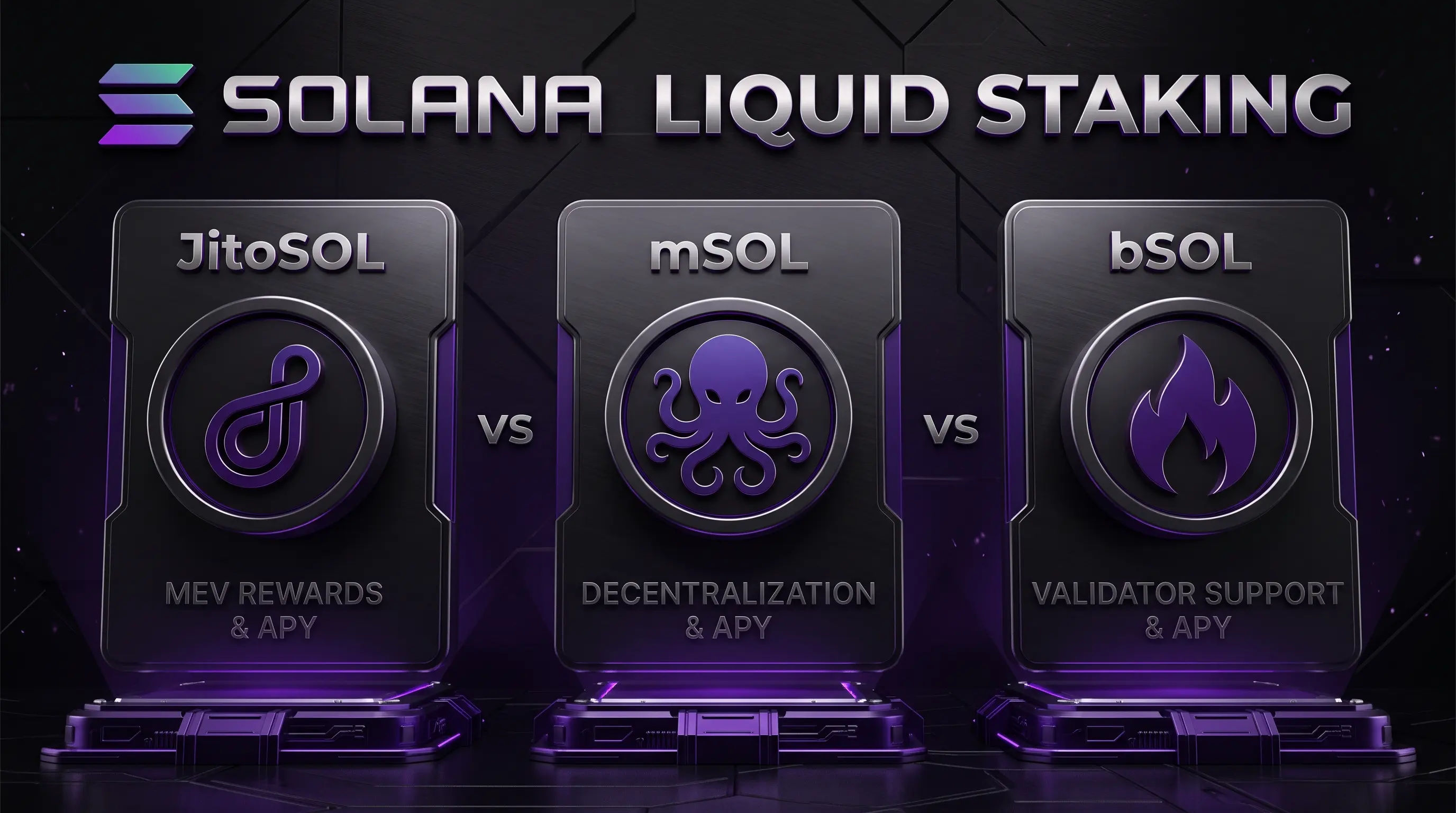
Liquid staking tokens let you stake SOL and keep a tradable claim on it. The three largest differ in fee model, MEV exposure and exit liquidity, and the differences matter more than the headline APY.
Not financial advice. Solsmint publishes educational content about crypto assets. Prices are volatile, and nothing here is a recommendation to buy, sell, or invest. Verify every contract, authority, and fee yourself before you transact.
Last updated: November 24, 2026
A liquid staking token lets you stake SOL and keep a tradable claim on the staked position. You give up direct control of the validator vote, and in return you get an asset that can be sold, used as collateral or held while it accrues staking rewards. The three largest Solana examples are JitoSOL, mSOL and bSOL, and they are not interchangeable.
The differences are easy to miss because the pitch sounds the same. All three delegate SOL to validators, all three appreciate against SOL over time, and all three advertise a yield. What changes is the fee model, how much MEV revenue is captured, how the validator set is chosen, and how quickly you can get out when the market is stressed.
This guide explains the mechanics behind each token, why headline APYs disagree, and the risks that do not appear in a yield comparison table.
This article is for informational purposes only and is not financial, legal, or investment advice. Not financial advice. DYOR.
Key takeaways
- A liquid staking token is a claim on staked SOL plus accumulated rewards. The token count stays fixed and the exchange rate to SOL rises.
- JitoSOL adds MEV revenue to staking rewards and charges a 4% management fee on total rewards, applied after validator commissions.
- Marinade’s current fee schedule sets the mSOL stake pool reward fee to zero and charges on exit instead, so older comparisons that quote a 6% reward fee are out of date.
- bSOL is a BlazeStake pool token with no deposit fee and a 0.1% withdrawal fee, plus optional validator selection.
- Headline APYs differ by several percentage points across trackers because of averaging windows, compounding assumptions and whether MEV is included.
- Exit liquidity and depeg risk matter more than a few basis points of yield, especially for large positions used as collateral.
What a liquid staking token actually is
When you stake SOL natively, you create a stake account and delegate it to a validator. The SOL is locked for the warm-up and cool-down periods, which on Solana are measured in epochs. A liquid staking protocol does the same delegation on your behalf, pools many depositors together, and issues a token that represents your share of the pool.
The pool stakes to a set of validators, earns staking rewards each epoch, and updates the exchange rate between the liquid staking token and SOL. If you deposit 1 SOL and receive 0.8 JitoSOL, that 0.8 JitoSOL is worth slightly more than 1 SOL later as rewards accrue. You still hold 0.8 tokens; each one is worth more SOL.
This exchange-rate model is why the token does not rebase. Your wallet balance stays constant, and the value per token grows. A rebasing token would increase your balance instead. Both approaches can represent the same yield, but they behave differently in DeFi: an exchange-rate token is easier to use as collateral because the number of tokens does not change.
The pool structure also creates the risks. You are trusting the protocol’s programs, its validator selection, its fee parameters and its ability to process withdrawals. Those are different risks from holding SOL directly.
Three models, three trade-offs
| Token | Protocol model | Fee structure | Distinctive feature |
|---|---|---|---|
| JitoSOL | Stake pool with MEV capture | 4% annual management fee on total rewards after validator commissions; 0.1% withdrawal fee on direct redemption | MEV revenue shared with stakers, plus a validator set managed through Jito’s stake net |
| mSOL | Marinade stake pool | No deposit fee and no reward fee under the current schedule; 0.2% delayed unstake fee; instant exit routed through a swap or pool | Validator selection through Marinade’s stake auction, with revenue collected from validator bids |
| bSOL | BlazeStake stake pool | No deposit fee; 0.1% instant or delayed withdrawal fee | Custom liquid staking: depositors can direct stake to specific validators |
These are current published parameters, not permanent constants. Fee schedules change, and a comparison written six months ago may already be wrong. Check the protocol’s own fee page before you size a position.
JitoSOL: MEV as a second revenue stream
JitoSOL is the largest of the three and the one most associated with MEV. Jito runs a block engine and a stake net that routes stake to validators participating in its MEV infrastructure. The pitch is straightforward: stakers earn normal Solana staking rewards plus a share of the tips and priority fees that searchers pay to have their transactions included.
The fee is 4% of total rewards, applied after validator commissions. That single number covers both staking and MEV revenue, so the effective cost depends on how much MEV the pool captures. Jito’s documentation also lists a 0.1% withdrawal fee when you redeem directly through the Jito stake pool rather than selling on a secondary market.
The MEV exposure is the attraction and the complication. MEV revenue is variable. It rises when on-chain activity and competition for block space rise, and it falls when activity drops. A period of high MEV can make JitoSOL’s yield look exceptional; a quiet period can make it look ordinary. That variability is not a flaw, but it means a single APY snapshot is a poor basis for comparison.
JitoSOL is also widely integrated as collateral and liquidity across Solana DeFi. That integration is a real benefit, and it is also a source of composability risk: the token’s price on a DEX, its oracle value and its redemption value are three different things that can diverge under stress.
mSOL: the fee model changed
Marinade was the first major liquid staking protocol on Solana, and mSOL is still one of the most recognisable LSTs. The important update is the fee structure. Marinade’s current documentation, updated on 11 November 2026, states that it charges no deposit fee and no performance fee on staking rewards, and that the stake pool’s on-chain reward fee is set to zero.
That is a material change from the older model many comparisons still quote. Marinade now earns revenue on the validator side through its Stake Auction Market, where validators bid for stake allocation, rather than by taking a cut of the rewards that reach stakers. Costs appear on exit: a 0.2% fee on delayed unstake, and a swap or pool fee on the instant route.
The trade-off is different from Jito’s. mSOL does not market itself primarily as an MEV product. Its validator set is diversified through the auction, and the yield is closer to base staking plus whatever priority-fee and MEV income the selected validators happen to produce. That can mean a lower headline yield in a hot MEV market and a more predictable one in a quiet market.
mSOL remains deeply integrated, and its long track record is an argument in its favour. The protocol has been through multiple market cycles and upgrade cycles, which is not a guarantee of safety but is relevant evidence.
bSOL: stake pool plus validator choice
bSOL is issued by BlazeStake, a Solana stake pool that distributes stake across a large validator set. Its differentiator is custom liquid staking: a depositor can direct their SOL to a specific validator or group of validators while still receiving a liquid token. That appeals to people who want to support a particular operator without giving up liquidity.
The published fee schedule is simple: no deposit fee, and a 0.1% fee on instant or delayed withdrawal. The token appreciates through the pool’s exchange rate, the same as JitoSOL and mSOL. There is no separate reward fee in the current schedule.
The validator-choice feature cuts both ways. It gives depositors more control, but it also means the yield and risk profile depend on the validators they pick. A depositor who chooses a high-commission or underperforming validator will earn less, and the pool’s aggregate performance is a blend of many choices rather than a single curated set.
bSOL is smaller than JitoSOL and mSOL, which affects liquidity. A smaller LST can have thinner secondary-market depth, so a large exit may move the price more than the fee schedule suggests.
Why the headline APY disagrees with itself
Search for the yield on any of these tokens and you will find numbers that differ by several percentage points for the same asset on the same day. That is not necessarily misinformation. Trackers compute APY differently.
Some use a seven-day average, some use a thirty-day average, and some annualise the most recent epoch. Some compound rewards daily; others show a simple rate. Some include MEV and priority-fee income; others count only base staking rewards. Some subtract the protocol fee; others show gross yield. A 4.66% figure and a 9% figure can describe the same token under different assumptions.
The practical rule is to compare like with like. Pick one tracker, read its methodology, and use it consistently across tokens. Better still, look at the exchange rate over thirty and ninety days and calculate the change yourself. That removes the annualisation assumptions and shows what the token actually did.
Do not treat a headline APY as a promise. Solana’s inflation schedule, validator commissions, MEV activity and network usage all change. A yield that looks attractive today can compress without any change to the token’s code.
Where the yield actually comes from
Solana staking rewards have three broad sources. The first is protocol issuance, which is paid to staked SOL under the inflation schedule. The second is priority fees, which validators collect from transactions that want faster inclusion. The third is MEV, which is the value extracted by ordering or inserting transactions and shared with validators and stakers through mechanisms such as Jito’s.
Validator commission is deducted before the pool’s fee. If a validator charges a 5% commission, the pool receives 95% of that validator’s gross rewards, and then the protocol’s own fee applies. A comparison that ignores commission is incomplete, because a pool with a low protocol fee and a high-commission validator set can deliver less than a pool with the opposite mix.
The pool’s exchange rate also reflects stake activation and deactivation. Newly deposited SOL does not earn rewards until it is activated, which takes an epoch. Large flows in or out can create short periods where the exchange rate moves differently from the underlying yield.
Exit routes, depegs and the liquidity illusion
There are three ways out of an LST, and they are not equally available in a crisis.
- Sell on a secondary market. Fast, but the price is set by supply and demand. In stress, LSTs can trade below their redemption value, which is a depeg even if the protocol is solvent.
- Instant unstake through the protocol or a router. Usually faster than a delayed withdrawal, but it carries a fee and depends on liquidity being available. The quoted rate can worsen as the pool is drawn down.
- Delayed unstake. You burn the LST and receive SOL after the unbonding period, which on Solana is measured in epochs. The fee is usually lower, but you wait.
The liquidity illusion is the dangerous part. An LST can look deep because it trades on several venues, but the depth is often concentrated in a few pools. A large seller can exhaust the best price levels and push the market below redemption value, at which point arbitrageurs need capital and time to close the gap. If you are using an LST as collateral, the oracle price and the liquidation engine may react before the arbitrage does.
This is why the question “how fast can I exit?” matters as much as “what does it yield?”. A slightly lower yield with deep, reliable liquidity can be worth more than a higher yield that is difficult to realise.
The risks that do not show in the APY
Smart contract risk. Each LST depends on programs that hold a large pool of SOL. A bug, an upgrade mistake or a governance attack can impair the claim. Audits reduce the risk; they do not remove it.
Validator risk. A pool delegates to many validators, which diversifies operator risk but does not eliminate it. Underperformance reduces rewards, and a validator that is delinquent for a period can drag on the pool’s return.
Depeg risk. The market price can fall below the redemption value during stress. If you borrowed against the LST, a depeg can trigger a liquidation before the protocol’s redemption mechanism catches up.
Governance and parameter risk. Fees, validator sets and reward distribution can change. A parameter change can alter the yield or the exit cost without any change to your position.
Composability risk. Using an LST in a lending market, a liquidity pool or a leveraged strategy adds layers of contract and oracle risk. The LST itself may be sound while the strategy around it fails.
Looping risk. Depositing an LST as collateral to borrow SOL and stake again increases yield and leverage. It also magnifies a depeg or a liquidation cascade.
How to compare them without chasing yield
Start with the fee schedule, not the APY. Read the protocol’s own documentation and confirm the deposit fee, the reward fee, the withdrawal fee and any instant-exit cost. Then check the validator set: how many validators, how they are selected, and whether the selection is transparent.
Next, check exit liquidity at the size you care about. Look at the depth of the main LST/SOL pools and the protocol’s instant-exit capacity. If you plan to use the LST as collateral, check which lending markets accept it and what oracle they use.
Finally, decide what you are optimising for. If you want MEV exposure and deep integrations, JitoSOL is the obvious candidate. If you want a long track record and a validator-auction model with no reward fee, mSOL is the alternative. If you want to direct stake to a specific validator and keep liquidity, bSOL is built for that.
None of these is a risk-free yield. They are different bundles of return, fee and risk, and the right choice depends on how you plan to use the token.
What we still don’t know
How durable the current fee models are is unresolved. Marinade’s zero reward fee and BlazeStake’s withdrawal-only fee are competitive choices, and competitive choices can change if revenue pressure rises. A comparison based on today’s schedule may not hold for the life of a long position.
The long-term value of MEV capture is also uncertain. MEV revenue depends on on-chain activity and market structure, and it can be affected by protocol changes, routing improvements and regulation. A token that looks like a yield leader in a high-activity period may look average in a quiet one.
And the secondary-market liquidity of smaller LSTs is not well measured. Reported TVL and pool depth do not tell you how much you can sell in a stressed market without moving the price. That is a gap in the data, not just in the analysis.
What is clear is that the three tokens are not commodities. They have different fee structures, different validator models and different liquidity profiles, and those differences are the actual decision.
FAQ: Solana liquid staking tokens
What is a Solana liquid staking token?
It is a token that represents a share of a staked SOL pool. The protocol delegates the SOL to validators, earns staking rewards, and passes them on by increasing the token’s exchange rate against SOL. Holders keep a tradable asset instead of a locked stake account.
Is JitoSOL better than mSOL?
Neither is universally better. JitoSOL adds MEV revenue and charges a 4% management fee on total rewards. mSOL currently has no reward fee and earns through a validator auction, with costs on exit. The right choice depends on whether you want MEV exposure, how you will use the token and how much liquidity you need.
Does mSOL still charge a 6% fee?
Marinade’s current documentation sets the stake pool reward fee to zero and states that it takes no performance fee on staking rewards. Older comparisons that quote a 6% reward fee are out of date. Check the live fee page before relying on any figure.
How does bSOL work?
bSOL is a BlazeStake pool token. Depositors receive bSOL for staked SOL, and the token appreciates as the pool earns rewards. The current fee schedule has no deposit fee and a 0.1% withdrawal fee, and depositors can optionally direct stake to specific validators.
Why do LST yields differ between websites?
Because trackers use different averaging windows, compounding assumptions and revenue definitions. Some include MEV and priority fees, some count only base staking rewards, and some show gross rather than net yield. Compare one tracker’s methodology across tokens, or calculate the change in exchange rate yourself.
Can an LST lose its peg to SOL?
Yes. The market price can trade below the protocol’s redemption value when sellers outnumber buyers or liquidity is thin. The protocol may still be solvent, but a holder who sells at the market price realises the discount. A depeg can also trigger liquidations if the token is used as collateral.
Are liquid staking tokens risk-free?
No. They carry smart contract, validator, governance, depeg and composability risks. The yield compensates for staking and for those risks. Anyone who describes an LST as risk-free is omitting the part that matters.
Continue reading
- See why Solana DeFi TVL keeps growing even when the SOL price stalls, and how staking fits into that picture.
- Read how Solana liquidity pools work before using an LST in a pool or evaluating its depth.
- Then read how liquidations work in a selloff, including why collateral prices can move faster than redemption values.
- Launching a token that will be paired with SOL or an LST? Create a Solana token without code and plan the liquidity before the mint goes live.
Disclaimer: This article is for information and education only and is not financial, investment, or tax advice. Crypto assets are volatile and you can lose money. Always verify token authorities and contract details yourself before interacting with any asset.
Ready to create your own token?
Launch an SPL token on Solana in minutes. No code, 0.05 SOL total, metadata and authorities handled for you.

Amir Ali
Founder of Solsmint | Solana Ecosystem Builder | Crypto & Web3 Enthusiast
Amir Ali is the founder of Solsmint, a Solana-based platform focused on making token launches and on-chain tools more accessible. He writes about Solana, crypto, memecoins, blockchain technology, and the evolving Web3 ecosystem.
Through Solsmint, Amir aims to simplify token creation and liquidity management by building practical, affordable tools for creators, developers, and crypto communities. His work focuses on making blockchain technology easier to use and helping builders turn their ideas into reality.
Follow Amir and explore his work at Solsmint.com.